Paul Grohmann’s group ascent of Monte Antelao in 1863 lead by Matteo Ossi is often considered the mountain’s first. But Ossi claimed he had already reached the summit years before, yet according to Grohmann hesitated at the final crux.
Here you have a translated excerpt from Grohmann’s original text, with my own comments after climbing the same route 162 years later.
Grohmann’s original text translated from German
This is a translation from German, from the book Wanderungen in den Dolomiten by Paul Grohmann, p. 174, 1877. He climbed Antelao on September 18, 1863 in a group of four led by Ossi.
My companions on this ascent were the Ampezzaners Francesco Lacedelli and Alessandro Lacedelli. However, since I was told in St. Vito, contrary to earlier reports, that a certain Ossi from Resinego had climbed Antelao, the three of us visited him.
He immediately assured us that he had once been to the summit of Antelao and offered to show us the way for a small fee, while simultaneously claiming that it was very difficult to find. Since my Ampezzaners had no objection to his company, I gladly let him join us.
We left St. Vito at 4:00 a.m. The path initially led gently across fields and meadows, later along the trickle of a mountain stream, up to the Forcella Piccola. It was 6:20 a.m. We hadn’t been walking hard. The Forcella is an easily accessible pass between the Antelao on one side and the Marmarole group on the other.
Anyone who has ever stood up here at the first light of a beautiful day has taken in a view of almost as great a magnitude as the one at the Seletta on the way to the Sorapiss!
To our left and above us lies the Forcella di Valledelle, over which one crosses into the Val Bestioi, through which one descends into the Bosco St. Marco in the Thale des Anziei. On this path, the Col Negro remains to the left.
Here at the Forcella, we cannot see the summit of the Antelao. We stand at the foot of the long ridge, which stretches up to the highest horn, and our first task is to somehow gain the height of this ridge. The cirque, whose floor is covered with scree and snowdrifts, leads into the heart of the Antelao and also facilitates the ascent of the ridge.
We advanced to about the middle of the extremely gently sloping cirque, then we turned right and entered the rather steep slope of the ridge; 7:15 a.m. We reached the ridge itself at 7:45 a.m. The area here is called the Palla, our first objective.

The further route is extremely interesting. The ridge is broad and rises only very moderately overall. However, it is often divided by small rocky outcrops, creating so-called “places” that sometimes offer pleasant opportunities for climbing.
Here on the ridge, one can, by the way, advance in many small variations. Snowdrifts crowd up to our line of march, sometimes to the right, sometimes to the left, but there is no need to step on a single one. As we reached the height of the ridge, the summit of the Antelao seemed very close to us—but the hike over the countless slabs of weathered rock takes longer than one thinks!
Without any particular obstacle, we reached the foot of the last horn, to which an extremely steep snowfield rises to the left of our position. The route from below to here, and then on to the summit, is so characteristic that whoever has ever taken it can never forget it.
Nevertheless, Ossi hesitated here and apparently didn’t know if and where the rocky horn above us could be reached. But here the talent of my Ampezzo climbers proved its worth, and soon they had found the narrow gateway that leads up to the beautiful summit.
There are two access points here. To the left, through a steep chimney several meters high, or bypassing it via a very narrow ledge diagonally up the wall. The chimney requires skillful climbing, the ledge is a test of vertigo.
We ascended through the chimney and descended via the ledge. At 11:45 a.m., we reached the highest point of the Antelao, and I believe I can say that we stood on a previously unclimbed peak.
The view to the south, which I had been most looking forward to, was unfortunately completely obscured by fog. In contrast, we had a truly magnificent view of the Ampezzo Alps and, in general, to the north. Along a steep snowfield, the gaze sweeps through the clefts of the Antelao to a small green island in the rocky landscape — Val Antelao!
Magnificently, the Sorapiss stands nearby, with its sheer drops that I couldn’t admire enough. At that time, I hadn’t yet climbed it, and I eagerly studied its wild form, hoping to discover a way to its summit….
…At 1:30 a.m. we left the Antelao.
This time we did not descend so far along the ridge, but as soon as possible descended from it into the aforementioned cirque, a path where we had to navigate several difficult sections.
At 4:35 a.m. we were back at the Forcella Piccola, where we parted ways. The two Ampezzaners went home, while I descended into the Val Octanc with Ossi. From the pass, one quickly reaches the valley floor on a good path with a magnificent view back towards the glaciated terraces of the Antelao!
Val Oten is a wide, beautiful valley with a gentle gradient, flanked on the left by wall-like precipices. At the lower end of the valley, the whitewater has carved a deep bed and rushes stormily towards the Piave.
We reached Calalzo at 7:30 a.m. and Pieve di Cadore, the birthplace of Titian, at 8:00 p.m. Both are large, flourishing towns, especially Pieve, which has a truly magnificent location.
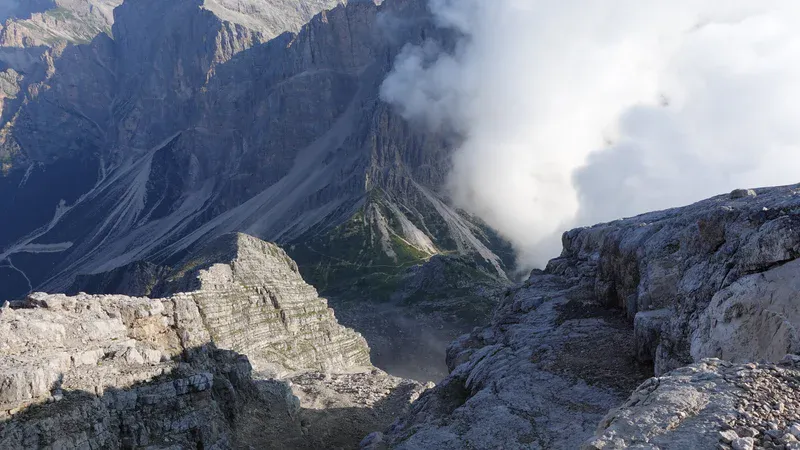
My comments
Ossi episode
From this first-hand description it is clear that Grohmann had impression that Ossi was not really earlier on the summit.
But this may be very wrong, here are some possible and obvious reasons:
Difficult to find route: As you have seen, Ossi warned them immediately that finding the route would be difficult. It is definitely so. I climbed the mountain by following the same route, and it was really hard to find the route although there were cairns and markers at some places. Nothing of that was there when they climbed, they had to find the route all the way up.
Now imagine, according to what many sources tell, Matteo Ossi climbed the mountain 13 years before! Thirteen years is a lifetime in mountain memory and life. Though, I have seen in one source year 1860 mentioned, but even in this case this is three years before.
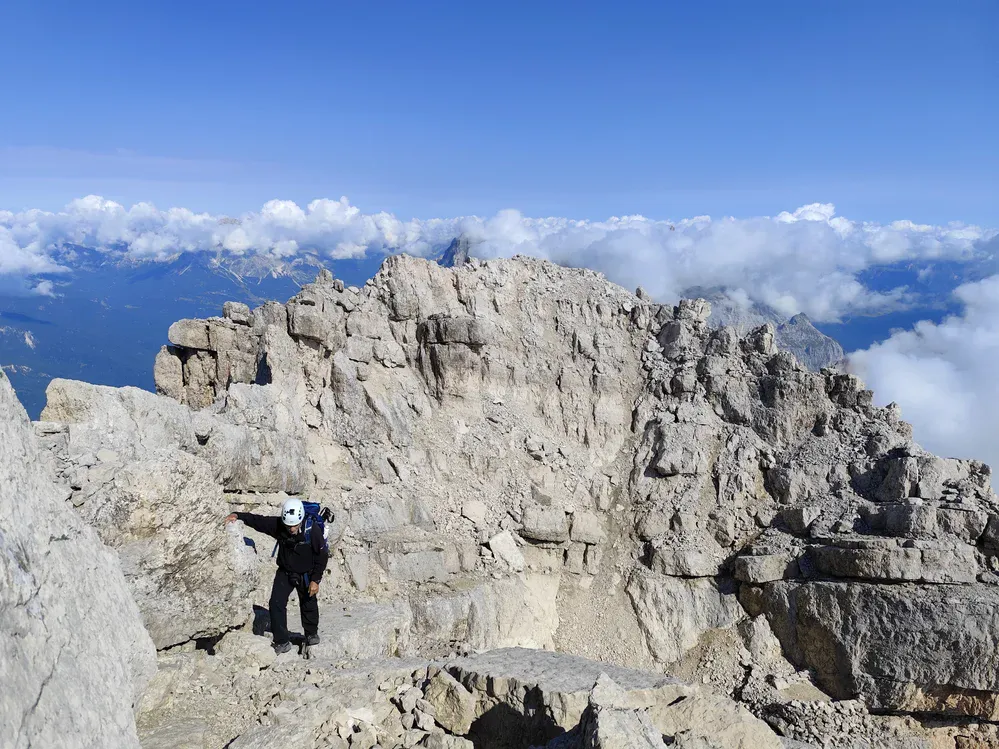
It is very easy to get confused and disoriented in this environment which is so repetitive and all in layers and ledges, see the photo below. On my own descent just one hour later, I had difficulties in finding the way back.
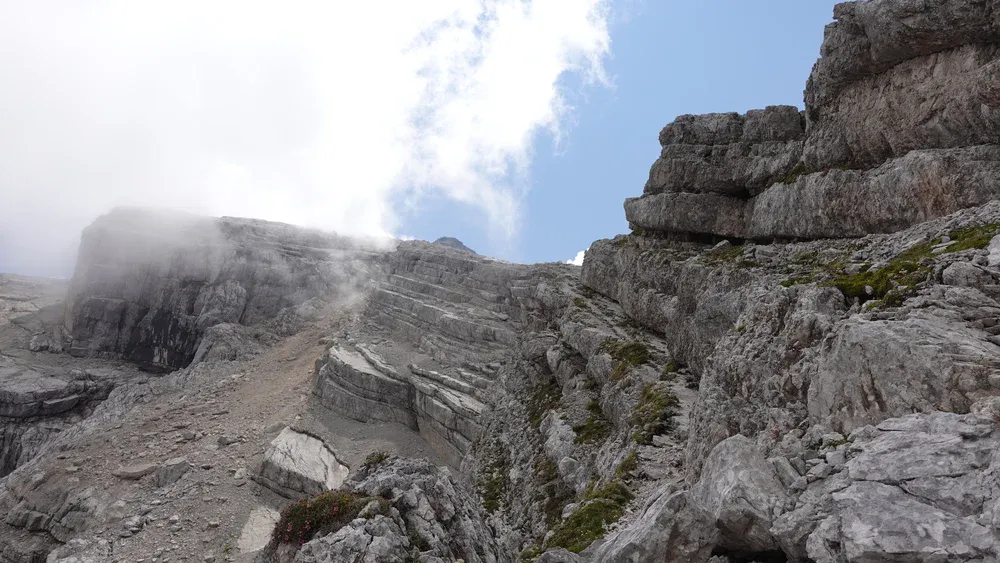
Terrain changes: Routes change due to rock falls, and the specific look of a ledge can vanish from the mind. This holds in particular for Antelao.
Do you know the story about the Bivacco Piero Rossi? Its fate is the perfect, chilling proof of the terrain change point and the instability of Antelao.
Built in the 1960s at the foot of the summit pyramid (at about 3100 m), it sat on what seemed like solid rock. Mountain climbing societies are careful in choosing such places for bivouacs.
But the “King of the Dolomites” is literally falling apart. In November 2014, a massive rockfall collapsed the entire ledge. The bivouac didn’t just get hit; it vanished into the valley along with 100000 cubic meters of mountain.
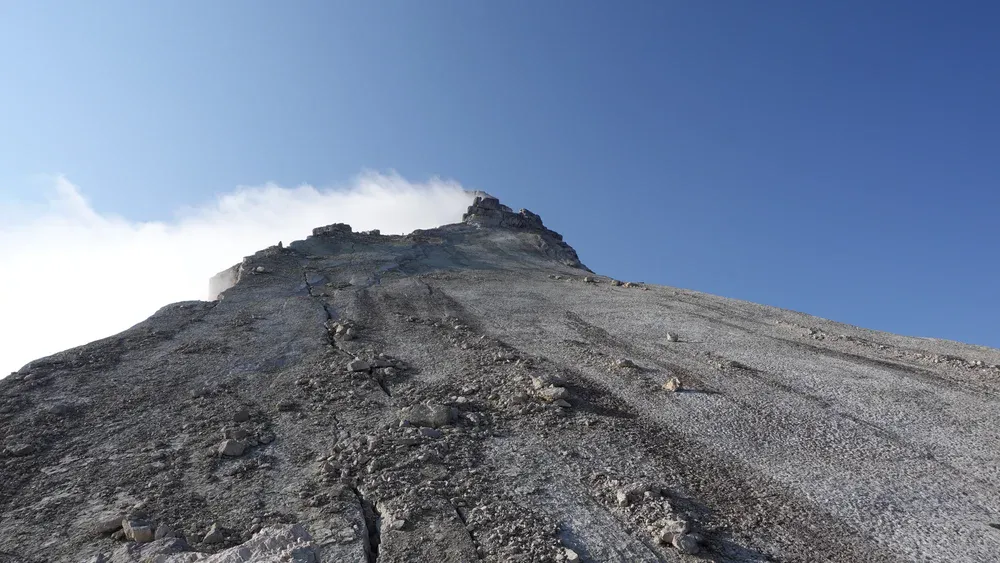
See the top picture above with the long crack on Laste area. On my descent, I was moving backward along this crack because this allowed me to grab its edges to avoid sliding down the smooth Laste rock. My nose was directly above it, and I was watching into its darkness all the time. It goes deep into the mountain which is splitting apart.
The pressure of the “foreman”: Imagine being Ossi. You have a wealthy, arrogant and young Viennese man (Grohmann) behind you, breathing down your neck, checking his watch, and judging your every move.
I am talking about the man who, three weeks earlier climbed Tofana di Mezzo with Lacedelli, and those hours he described in his book as “waste of time”. Lacedelli was too slow for him. He was in rush to conquer as many peaks in the Dolomites as possible; Tuckett, Ball, and others were around. It was a race.
That kind of pressure makes even a local expert second-guess their instincts.

Lies have a short shelf life
Ossi’s motives:
Why would Ossi lie? Ossi wasn’t writing for the Alpine Journal. He wasn’t looking for a medal from the Austrian Alpine Club.
For a hunter like Ossi, climbing a peak like Antelao wasn’t a conquest, it was part of the daily life. Following a chamois often leads a hunter to the highest ridges. If he told his friends at the local inn that he reached the top, he was likely just sharing the news of a long day’s work.
What Grohmann could not possibly understand was this:
In a small mountain village like San Vito, your reputation is everything. If you lie about a route and someone follows you and finds you were faking, you become a laughingstock. No man with honor and dignity would bring such a shame to his family name.
The locals knew the terrain. They would have known if Ossi was telling the truth.
And there are no indications anywhere in sources from that time that Ossi was a charlatan. In fact, it is the other way round as you will realize below.
Grohmann’s insistence that Ossi was unsure of the way is his biggest logical failure. I know from my own climb that Antelao is a shifting, crumbling landscape.
Ossi’s hesitation, his careful searching for the route after 13 years of erosion and rockfalls, actually sounds like the behavior of an honest man who respects the mountain enough to be cautious.
Go to my text about Tofana di Mezzo, and you will see something similar: Lacedelli was too slow for Grohmann who writes “Geccho had climbed rather cautiously”. Geccho was Lacedelli’s nickname.
So, this experienced local mountaineer was also advancing very slowly on such a dangerous terrain. Ossi’s behavior was the same, completely natural for such an environment. Rushing there may have tragic consequences.
The foreman’s motive: fame and records
For Paul Grohmann, the summit was a commodity. He was in a race against the British, against the clock, and against history. He needed the first ascent title to validate his status in Vienna.
To Grohmann, if a climb wasn’t documented, it was a waste of time. He had every reason to downplay Ossi because admitting a local hunter had already done it for free and without fanfare diminished Grohmann’s “heroic” achievement.
Grohmann’s pride made him blind to the reality of mountain life. He couldn’t imagine that a simple hunter would climb a giant like Antelao just for the sake of it, without needing to brag to the world.
Ossi had the truth on his side. Grohmann just had a louder voice and a printing press. But old hunters were the real masters of those peaks.
On the other hand, Ossi was a hunter and for him getting to the actual exact summit spot was probably not so important. Perhaps he did not bother getting up the last horn mentioned by Grohmann.
And I can tell you, that last part is indeed hard to pass, you have to go around it to the left (see the photo) along one of those ledges, and only then the actual summit is in sight.
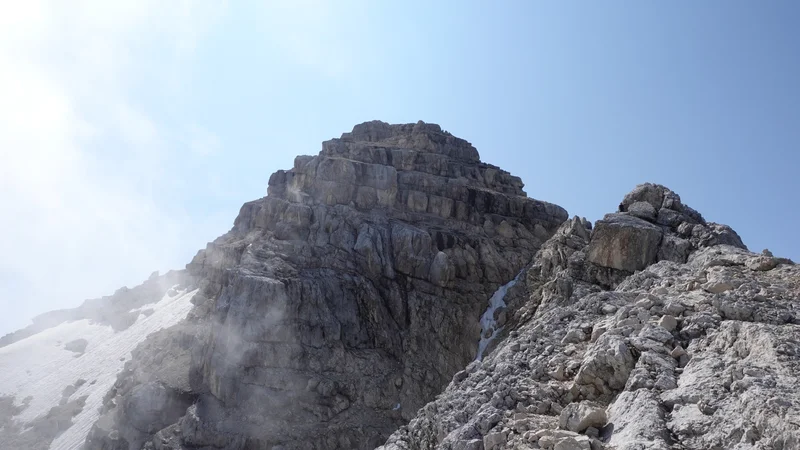
After that, the final meters are shown in the photo below taken by an Italian man who passed me below the summit (salute to Daniele!). The area looks like a rubble, with lots of unstable boulders, this is an ever-changing environment.
However, for Ossi this would be a really small extra climb in view of what he already climbed before that, and I believe he would do this out of curiosity. But clearly, we shall never know.
What we do know is this: Ossi and two Lacedellis were there with Grohmann. So credit goes to Ossi in any case, either as a person who previously climbed the mountain alone, or as the leader of that later group.
In all his tours, Grohmann commissioned locals to climb, and he joined them in the process, but without them he would never be able to climb any of those mountains.
The same was on three Tofana peaks, he was celebrated as the first person to climb them, while in reality he was led there by local Italian people.
Observe also that John Ball in his book from 1868, on page 523 writes favourably about Ossi:
The first ascent of the highest peak of the Antelao was made by Dr. Grohmann in 1863, and the next by the late Lord F. Douglas and Mr. F. L. Latham in 1864. Both were accompanied by Matteo Ossi of Besinego, of whom the English travellers gave a good account. Dr. Grohmann reports less favourably of his qualifications, and found his demands unreasonable.
Now back to the climb again.
Note that they climbed the mountain in 5 hours and 45 minutes from San Vito. This is more than 2200 meters of elevation difference. Incredibly impressive in any case, and in particular because they had to find the route in the process. One of them, Francesco Lacedelli, was 67 at that time. I climbed the mountain at 66, so I am able to appreciate their performance.
He also writes that the Forcella (Piccola) is an easily accessible pass. In reality, this is 1000 meters of elevation difference from San Vito, and incredibly hard with scree on the upper part above the area where now Rifugio Scotter Palatini is.
Yet, they walked it in two hours and 20 minutes. Grohmann was 25 years old at the time, so this might not be surprising, but see above about the age of Lacedelli.
Here is my video of the tour, have a look:
Final thoughts
In the end, history is usually written by those who own the printing presses, not those who carry the rifles. Grohmann’s account serves as a fascinating window into the birth of “peak-bagging” where the goal shifted from the hunter’s intimate knowledge of the land to the climber’s desire for a trophy.
Whether Ossi “hesitated” or was simply practicing the caution that keeps a mountain man alive into old age is something only Antelao knows.
But looking at the evidence, the shifting rock, the immense physical feat of their speed, and the corroboration from other travelers like John Ball, it seems clear that Ossi wasn’t a man lost on a mountain. He was a man who didn’t feel the need to shout about his presence there.
Grohmann gave us the date and the documentation, but Ossi likely gave them the summit. In the high, crumbling cathedrals of the Dolomites, the “first” to climb is often just the first to tell the world about it.
Thank you for reading. Please use the comment box below in the case of comments and questions.
Leave a Reply