In the book by Gilbert & Churchill The Dolomite Mountains, there is a picture of Monte Pelmo with its upper cirque filled with ice like a bowl. Was it really so?
Here is the picture created by what is known as chromolithography. This was a high-tech printing method of the Victorian era.
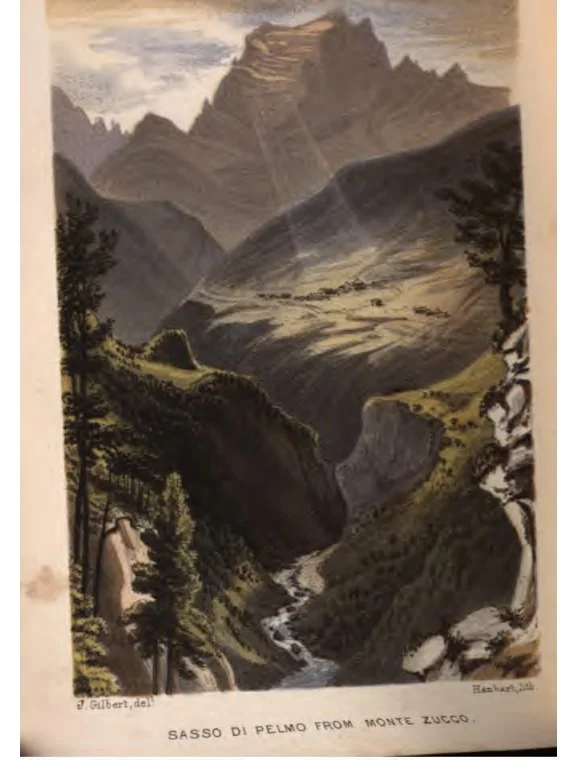
Unlike a standard painting, a chromolithograph required a separate limestone block for every single color used. To get that Pelmo scene, a master printer likely had to align 10 to 15 different stones.
Because it uses oil-based inks layered on top of each other, it creates a rich, textured depth. It was the first time in history that “regular” people could see the true colors of the Dolomites in a mass-produced book.
Josiah Gilbert, who was a painter, would have made a watercolour sketch on-site. He then worked with professional lithographers (like Hanhart, whose name is on the print) to “translate” his sketch onto the stones.
Here is the top of the painting zoomed a bit to see the details:
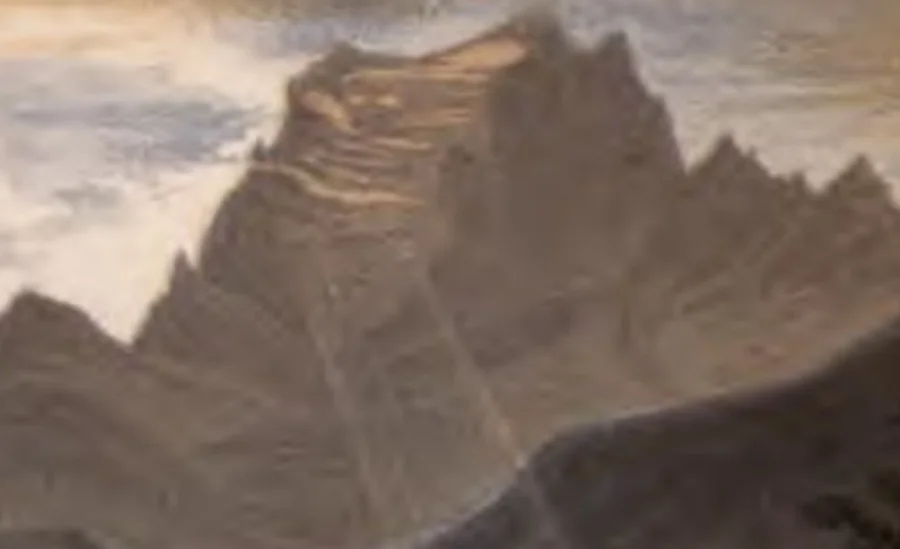
Those horizontal, jagged lines and stacked white-and-blue masses are unmistakable: Gilbert was depicting a high-altitude glacier with a defined structure, firn layers (compacted snow turning to ice) or even seracs (giant blocks of glacial ice).
The crevasses: The darker strokes cutting through the white mass are classic artistic shorthand for crevasses.
Here is the same area in my photo taken from above in 2024, this is from my Monte Pelmo tour and the view is from an area under the summit. I had a very compacted snow, so it was pleasant and easy to walk here, but no ice at all.

Was this painting real?
It is difficult to judge. Luckily, this is not the only source from that time. John Ball climbed Monte Pelmo a few years earlier, in 1857.
Ball’s witness
“Hard Ice” but not “Broken Ice”:
In his 1857 journal, Ball is very specific. He does not mention navigating a labyrinth of crevasses. Instead, he writes:
“The upper part of the Pelmo is a great hollow… occupied by a plateau of snow or névé… it was usually hard, and I was obliged to use the axe.”
The key takeaway:
“Plateau”: This word implies a relatively flat, uniform surface. If the cirque had been a shattered mess of seracs as Gilbert drew it, Ball (a scientific observer) would have used words like “broken,” “fissured,” or “shattered.”
On the other hand, nowadays the upper cirque is not really a plateau. But if it was filled with ice, then it may have looked like a plateau to him. The painting above also shows the highest area that looks like a quite flat plateau. It is much deeper now.
“Hard”: This confirms it was permanent ice/firn, but his description of it as a “slope” that he simply marched up suggests it was much smoother than the painting depicts.
While Ball might have been cautious in his terminology, perhaps calling it a névé or permanent snow-field, Gilbert’s artistic eye recorded the physical reality of a glacier. In the 1860s, this ice was thick enough to flow and crack under its own weight. Today, that “plug” has melted out, leaving only the “empty chair” and the smooth gravel walk.
My point: If Ball climbed after a heavy snow year (or late-season snow), the crevasses would be “bridged.” Though he climbed on September 19th. Usually, by mid-September, a glacier is at its “barest”, all the seasonal snow has melted, revealing the cracks.
If Ball found it “smooth” in late September, it means the glacier was likely a stable, cold-based ice mass rather than a fast-flowing, cracking valley glacier.
Here is a part from the Gilbert and Churchill book, p. 399, describing what the authors knew about Ball’s climb, copied without changes:
A few details, kindly supplied by Mr. Ball, will explain the character of the ascent.
Mr. Ball started from Borca, a little below St. Vito, on September 19, 1857, at three, A.M., with a guide who had accidentally discovered a way to the summit. In two hours a châlet* was reached on the alp at the foot of the Pelmo, and beyond lay long lines of débris, that abutted against the precipitous walls forming the eastern face of the mountain.
Arrived at the summit of this débris, a nearly horizontal ledge was followed, until, at a considerable distance from the point where it was entered upon, it was intersected by a channel that descended from the upper plateau. The ascent up this channel was long and steep.
Arrived at the plateau, a glacier, slightly inclined, was found to cover it. To the north-west it was bounded by a sheltered ridge of nearly vertical rocks, forming the highest crest of the Pelmo.
Ascending by the névé, Mr. Ball found no difficulty in reaching the ridge at a point where it commands a view on two sides-the one overlooking the Val di Zoldo, and the other the valley of Ampezzo. On gaining this point, the guide declared that they had reached the top. Mr. Ball pointed to a ridge, probably eighty or one hundred feet higher, that shut out the view to the north.
To ascend this, the guide declared was utterly impracticable, from the shattered condition of the rock, and earnestly deprecated the attempt. Mr. Ball, however, without much difficulty, made his way to the extreme summit of this ridge, and from it enjoyed an admirable panorama, in which the Gross Glockner on the one side, and the Marmolata on the other, were conspicuous.
The Antelao seemed to be about one hundred feet higher than the Pelmo; and some of the peaks in the ridge beyond Auronzo, as well as the Croda Maleora, appeared to be very nearly on a level with it.
Mr. Ball left the summit at 1, P.M., reached the chålet at 5, and after halting a quarter of an hour, arrived at the inn at Borca at 6.15, р.м.
*It is not known which chalet this is about. One source claims that very old Austrian military maps from the late 1800s show Cas. Arbe or M.ga Ardua at the place where nowadays Rifugio Venezia stands. I was not able to confirm or check this.
What have we learned from this?
- Clearly, Ball did not climb alone. Without his local guide Giovan Battista Giacìn, he would not be able to find the route.
- Famous Cengia di Ball (Ball’s Ledge) is in fact Cengia di Giacin because he found it earlier. But apparently Ball himself was always very humble, noting that he was only following the path of the hunter.
- Ball’s persistence made him the “conqueror” of the Pelmo, but it was Giacìn’s local, practical knowledge of the terrain that opened the door.
- As the text says, when they reached the final ridge, Giacìn tried to stop Ball. In his view, reaching the “viewpoint” was enough. To a hunter, climbing the final, crumbling teeth of the summit was an unnecessary risk.
- The top plateau was “slightly inclined”. No doubt it was filled with ice, see my photo above, the rocks on two sides were keeping the ice mass in place creating a nearly flat plateau which is visible also in the painting.
- As you see, glacier is explicitly mentioned.
It took them around 15 hours, quite remarkable for their circumstances. I climbed the mountain from Passo Staulanza by following the same Ball’s ledge in 13 hours, but my approach route was shorter and from a higher start point.
Why the peak in the painting looks so dangerous
First, Monte Pelmo is an impressive mountain and it is dangerous to climb.
Second, Gilbert was a Victorian romantic. At that time, there was a specific “sublime” style for depicting the Alps. Now, is this the case here? Hard to say unless we find an additional source that would provide more information.
But it looks unlikely that he would go into so many details depicting the glacier if the details were not there. On the other hand, he was not alone, his companion Churchill was there all the time.
Both of them were well-educated. Josiah Gilbert was a celebrated painter and art critic, while George Churchill was a dedicated botanist. This combination is why the book feels so different from a modern travel guide, they were observing the landscape through the lenses of geology, botany, and classical history.
They were not type of people who would invent things. There are other paintings in the book, and I am convinced they show the reality as it was. One of them is also the family home of Titian in Pieve di Cadore.
Gilbert and Churchill’s The Dolomite Mountains (1864) is essentially the “Big Bang” of Alpine literature for that region.
Would such a glacier indeed melt in 160 years?
The answer is easy here: absolutely so.
To realize why, it is enough to see my text about bivouac cave on Marmolada. It was carved at the level of glacier in 1875, and now it is 80 meters above the ice. That is how thinner the ice became there in one and a half century.
The elevation is the same, around 3100 meters, so even if Pelmo glacier was 80 meters thick, it had enough time to disappear completely in 160 years.
Conclusion
I would say that in general, I trust Ball over the painting. But Gilbert’s “seracs” cannot be ignored. They were possibly due to the fact that 1864 was the peak of the Little Ice Age.
Now, if Ball did not experience what the painting is suggesting, this could be partly due to lots of snow covering the ice and its complicated structure. So for him the area felt smooth, and he could not possibly know how deep and dangerous the glacier actually was.
After all, he was there and walked up that glacier 7 years before Gilbert’s painting. A dry glacier looks very different than when it is covered with thick snow. He had no previous knowledge about it; nobody had. He walked the place as the first person ever, the first human on the summit of Monte Pelmo.
Anybody knows some extra source that would cover this story? If so please share in the comment box below. Thank you for reading.
Addition
Here is what I have found after publishing this post. There is an old book by mountaineer Paul Grohmann, Wanderungen in den Dolomiten (1877). On page 126, he describes his climb of Monte Pelmo, and here is the final proof about the glacier:
“We have once again reached a gully, which leads upwards. It is far easier to traverse than the lower one and opens up at the summit of Pelmo. Here I was extremely surprised to find a glacier, which, gently inclined but adorned with two or three crevasses, descends from the main peak. There are actually three Pelmo peaks, which differ only slightly in height. The middle one is the true Pelmo peak.”
Then I found out these lines in Ball’s book (1868), page 526: “Whatever course the traveller may take, he finds with surprise a not inconsiderable glacier lying on the broken plateau which is surrounded by the topmost ridges of the mountain.”.
This is it, it is certain that there was glacier on the top as the painting suggested.
Leave a Reply