In 1935, mountaineers walked on iron nails and prayed for grip. Today, we walk on scientifically engineered rubber ‘tanks.’ If you have ever wondered why your Scarpa boots feel like a bridge while your hiking sneakers feel like slippers, the answer is under your feet.
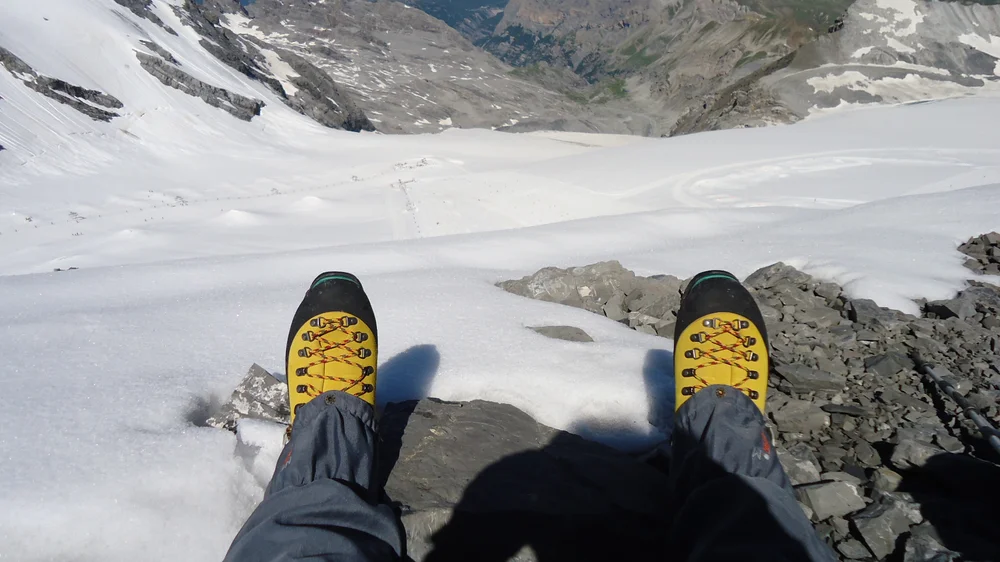
The photo above: Confidence at 3467 meters. While the glacier below is a world of ice and rock, my feet stay dry and supported. This is the ‘bridge effect’ in its natural habitat, rigid enough for crampons, insulated against the frost, and grippy enough for the final summit scramble
The history of Vibram: born from tragedy
Mountaineering boots have come a long way from the days of hobnailed leather soles, which were essentially ice skates on wet rock. See one pair in this photo by Anthony Appleyard:
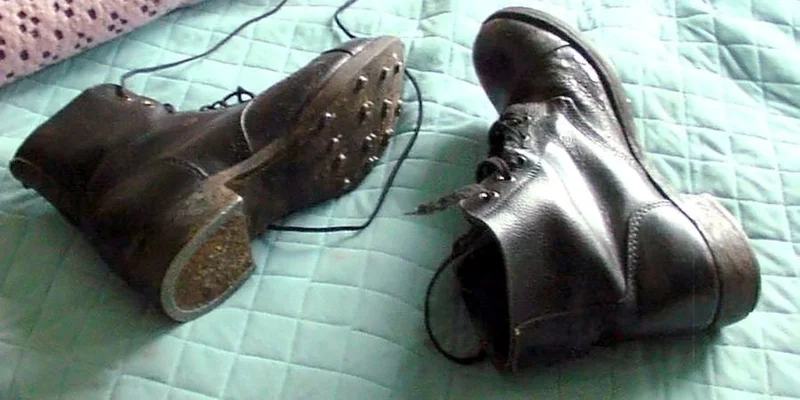
The transition to rubber was not just a convenience; it was a response to tragedy.
The story begins in 1935 with Vitale Bramani, an Italian mountain guide. During an expedition in the Italian Alps, six of Bramani’s companions died, a disaster largely blamed on their footwear.
At the time, climbers wore heavy leather boots with metal cleats for the approach, but switched to thin, felt-soled shoes for the actual climbing. These felt shoes offered no insulation or grip on snow and ice.
Driven to find a universal sole, Bramani partnered with Leopoldo Pirelli of Pirelli Tires. In 1937 they patented the first vulcanized rubber lug sole.
The name Vibram is a portmanteau of his name: Vi-tale Bram-ani. They called the design the Carrarmato (“tank tread”). It revolutionized climbing, famously proofing its worth in 1954 during the first successful ascent of K2.
The science of lugs: traction vs. friction
The lugs (the bumps on the bottom of the sole) are engineered based on two physical principles: mechanical keying, and friction.
Shape and geometry
Deep channels: Lugs are spaced apart to allow mud, snow, and debris to be pushed out as the sole flexes. This is called “self-cleaning.” If the gaps fill up, you essentially have a smooth, slick surface.
Leading edges: Square-cut lugs act like tiny shovels. When walking uphill, the front edges of the lugs bite into soft ground.
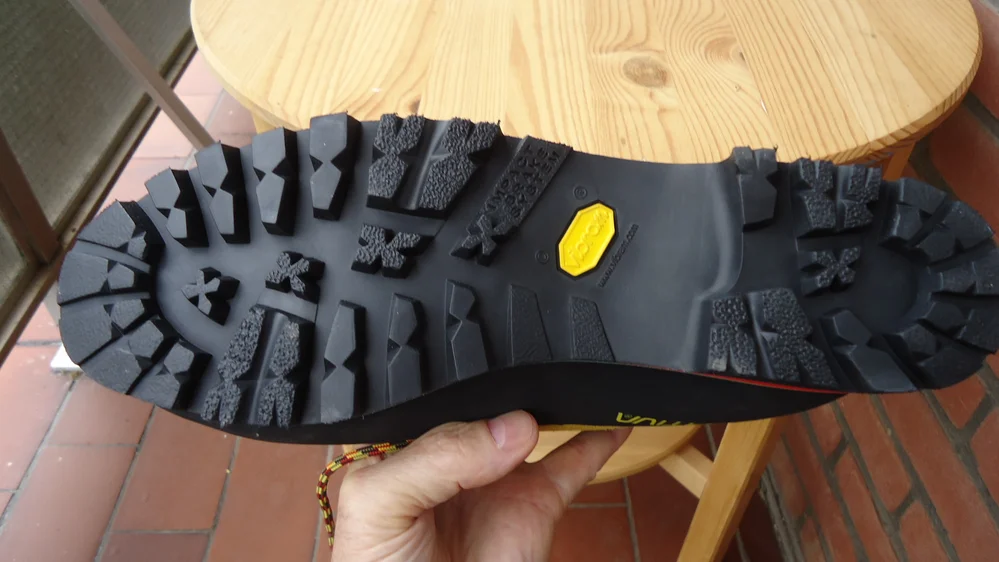
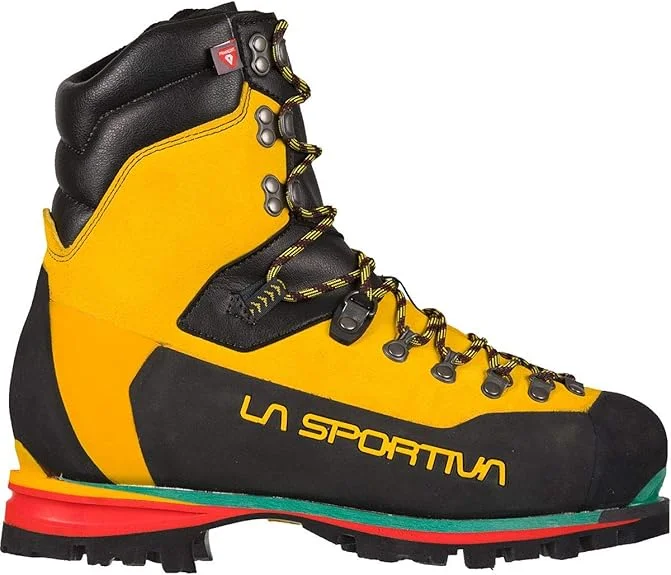
Braking zones: On the heel, lugs are often oriented in the opposite direction to provide “braking” power during descents. This is so obvious in my La Sportiva Nepal Extreme Mountaineering Boots for Men, the picture below.
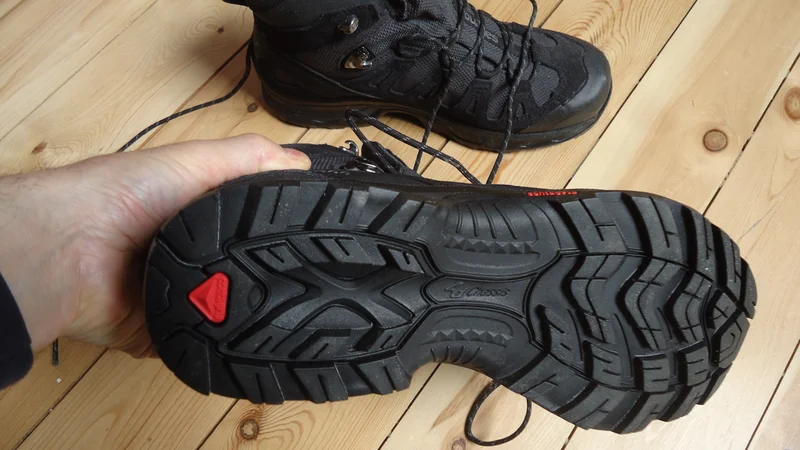
Siping: Small slits within the lugs (borrowed from tire tech) increase surface area and help grip wet, flat rock by dispersing the thin film of water. My Salomon boots below show exactly this.
The “climbing zone”: If you look at technical mountaineering boots, the toe area is often flat and smooth (no lugs). You can see this in my Scarpa boots below.
This is the “climbing zone.” On narrow rock ledges, you want maximum rubber-to-rock contact (friction) rather than lugs which can roll or deform under high pressure.
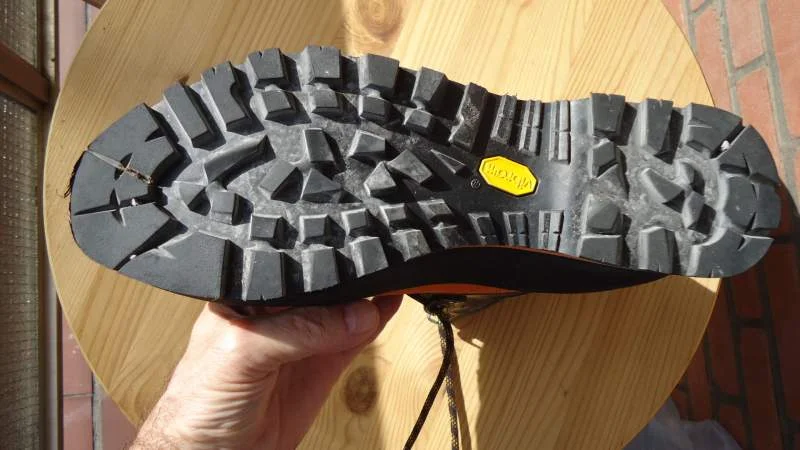
Car tire and mountain bike tire designs
That car tire look was not just a coincidence, it was likely a literal collaboration. In the world of high-end mountaineering, there is a specialized design trend where tire manufacturers apply their road-grip technology to the mountains.
Michelin is the most common culprit here. Unlike Vibram, which uses the famous lugs, Michelin often uses siping. If your sole had hundreds of tiny, razor-thin slits (like a winter tire for a car), it was a Michelin sole.
These slits open up when the sole flexes, creating “micro-edges” that suck water away from the surface. They are incredible on wet, slippery rock and ice, exactly like a tire on a rainy highway.
Adidas Terrex boots often use Continental rubber, and they frequently borrow the actual tread patterns from their mountain bike tires. The lugs are often shaped like small, sharp triangles or hexagons, spaced very widely to shed mud. They focus on mechanical grip in loose soil, much like a tire digging into a muddy track.
The original Carrarmato has those very recognizable, thick rectangular blocks around the edge. Vitale Bramani specifically modeled this after the heavy-duty treads of military tank tires from the 1930s. It is the “grandfather” of all tire-inspired soles.
All in all, traction and grip are two different things:
- Traction (lugs): Like a tire in mud, the lugs bite into soft ground.
- Grip (rubber chemistry): Like a tire on a race track, the rubber sticks to the smooth surface.
The tire-style sole is the perfect marriage of both. Your boots are essentially the “all-season tires” for your feet.
What does “non-marking” actually mean?
You will often see non-marking labeled on boots, though it is more common in hiking/approach shoes than heavy high-altitude plastics.
Traditionally, rubber was reinforced with carbon black, which makes soles durable but leaves nasty black streaks on gym floors or boat decks. The solution is non-marking soles that replace carbon black with silica or other light-colored fillers.
There is a common misconception that non-marking rubber is softer or stickier. In reality, a sole can be non-marking and still be extremely hard and durable.
For a mountaineer, non-marking is mostly a courtesy for the floor of the mountain hut or the interior of a rescue helicopter, it does not inherently change your grip on a rock.
General high altitude mountaineering boots
For general high-altitude trekking and mountaineering, the demands on a sole shift from pure climbing friction to a heavy emphasis on thermal insulation and mechanical stability. When you are trudging through snow or crossing glaciers, the sole acts as the primary barrier between your feet and the frozen earth.
Here are a few more specific details that are of importance in such situations:
The “rocking” motion (the rocker)
In high-altitude boots, the sole is usually very stiff to support crampons. To make walking possible without your feet feeling like they are in wooden clogs, the sole is shaped with a “rocker”, a slight upward curve at the toe and heel.
This mimics the natural roll of the foot, reducing the strain on your calves during long approach marches.
Lugs on a rockered sole are often tapered in height to maintain a consistent contact patch as you roll forward.
Density and the midsole
In high-altitude gear, the sole is actually a sandwich. The outsole (Vibram) is the thin, hard rubber layer with lugs. The midsole (PU or EVA) is there to provide the cushioning.
There is also a shank, a stiff plate (often carbon fiber or steel) embedded inside to prevent the boot from flexing, which is vital so that your crampons do not pop off.
Rubber hardness
The rubber used for high-altitude soles is generally harder than the rubber on a rock-climbing shoe. Soft rubber offers fantastic grip on warm rock, but it turns brittle and plastic-like in extreme cold.
Hard rubber maintains its structural integrity at −20°C and lasts much longer when walking on sharp, abrasive granite scree.
Tips for sole maintenance
In high-altitude trekking boots there is something called hydrolysis issue. If you leave your high-altitude boots in a closet for five years, the polyurethane (PU) in the midsole can chemically break down due to moisture in the air.
So the next time you step onto a trail, the entire Vibram sole might peel off in one piece. For high-altitude trips, testing your soles before the expedition is a safety requirement.
Sole stiffness
Boot stiffness is categorized by a standardized scale (often called the Meindl Scale) ranging from A to D. Determining which one you need depends entirely on the steepness of the terrain and the weight of your pack.
Manufacturers use these categories to communicate the flex of the sole. Understanding this parameter is the best way to choose a boot without guessing.
Category A (Flexible): These are like sneakers. They flex at the ball of the foot with almost no resistance. Best for well-maintained trails, day hikes, and light loads.
Category B (Moderate): A classic trekking boot. It has a stiffer midsole that resists twisting (torsional rigidity) but still allows your foot to roll naturally. Best for multi-day backpacking, uneven paths, and carrying 10–15 kg.
Category C (Stiff): High-altitude and technical trekking boots. These have very little flex. You can not easily bend the toe upward with your hands. Best for off-trail scree, heavy loads (20 kg+), and semi-automatic crampons. My Scarpa Triolet below is in this group.
Category D (Rigid): Professional mountaineering boots, they are 100% rigid. Best for vertical ice, glaciers, and step-in crampons.
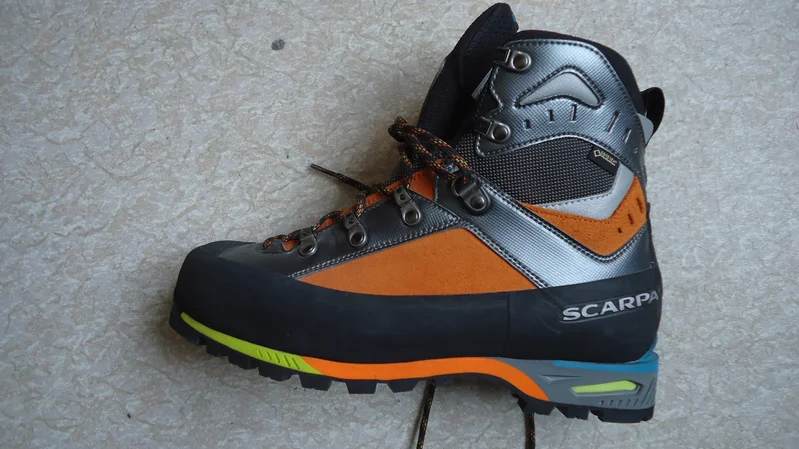
Why stiffness matters: the physics
Stiffness is not just about durability, it is about leverage and protection.
The bridge effect: On jagged, rocky terrain, a soft sole (Category A) wraps around the sharp edge of every rock. Your foot muscles have to work overtime to stabilize you, leading to foot fatigue.
A stiff sole (Category C) acts like a bridge; it stays flat regardless of the rock shape, letting the boot do the work instead of your arches.
Edge control: In high-altitude environments, you often need to kick the side of your boot into a slope to create a “step.” A soft boot will simply collapse/fold. A stiff boot acts like a shelf, providing a solid platform for your weight.
How to test it yourself
If the box does not list the category, you can use two manual tests to find the parameter:
The longitudinal flex test: Hold the heel and the toe and try to fold the boot in half. For high-altitude goal, it should barely move. If it folds easily, it is not supportive enough for heavy loads or steep snow.
The torsional twist test: Hold the heel in one hand and the toe in the other, then twist them in opposite directions (like wringing out a towel). For high-altitude goal, the sole should resist twisting. High torsional rigidity prevents ankle rolls on loose, shifting rocks (scree).
The “crampon parameter”
The easiest way to determine the necessary stiffness for general high-altitude use is to look at the crampon compatibility:
- No welts (notches), this is a flexible boot, only for walking.
- Heel welt only, this is semi-stiff. Designed for general high-altitude trekking.
- Toe and heel welts, this is a fully rigid boot designed for technical climbing, one excellent example is shown here:
Pro tip: For general high altitude, you are almost always looking for a category B/C or C boot. It provides the stiffness needed to safely use crampons on glaciers while still having enough “rocker” (curve) to let you walk for miles on the approach.
Best sole manufacturers
Vibram’s dominance is so absolute that for decades, seeing that yellow octagon was the only way to know you were not buying a “cheap” boot.
However, the landscape has shifted. Today, there are several tier-one brands that produce soles of equal quality, some are independent rubber experts, and others are proprietary brands owned by the boot manufacturers themselves.
Here are the brands currently operating on the same level as Vibram:
1. The global “rubber giants”
These brands started in tires or industrial rubber and have leveraged their chemical engineering to compete directly with Vibram.
- Michelin: This tire company has become a massive player in the last five years. They specialize in custom lug designs, they do not just sell a slab of rubber, they design specific treads for specific boots (like the Michelin “Wic” compound for ice). You’ll see them on brands like Millet, Mammut, and AKU.
- Continental: Known for their bike and car tires, Continental rubber is famous for its incredible grip on wet, smooth rock. They are currently the exclusive partner for Adidas Terrex and are frequently cited as being stickier than standard Vibram compounds.
- Pomoca: Primarily a Swiss ski-touring brand (famous for climbing skins), they now produce outsoles for brands like Salewa and Dynafit. Their soles are engineered specifically for the “glacier-to-rock” transition.
2. The proprietary powerhouses
Some of the best boot makers got tired of paying licensing fees to Vibram and decided to build their own labs. These are often better than entry-level Vibram because they are tuned exactly to that specific boot’s purpose.
- La Sportiva FriXion: If you look at high-end Sportiva boots, you will often see the FriXion logo. They have different colors for different uses (e.g., FriXion White is super sticky for rock, FriXion Blue is hard and durable for long-distance trekking).
- Salomon Contagrip: Salomon almost never uses Vibram. They spent decades perfecting Contagrip. It is widely considered the gold standard for mixed-terrain trekking. They use different rubber densities in different parts of the same sole (harder on the edges for durability, softer in the center for grip).
- Five Ten Stealth rubber: Now owned by Adidas, Stealth was originally developed for climbing shoes. It is arguably the stickiest rubber on Earth. While not usually used for heavy high-altitude plastics (it wears out too fast), it is the king of approach shoes (the boots you wear to get to the base of the climb).
Why does Vibram still win?
If these other brands are so good, why is Vibram still in all my boots? It comes down to resole-ability.
Vibram is the only brand with a global network of authorized cobblers. If you wear out the sole of a high-altitude boot with a Michelin or Salomon sole, it is very difficult to find a replacement part.
With Vibram, you can send your $600 boots to a cobbler anywhere in the world and they will have the exact Vibram Mulaz or Carrarmato sole in stock to make your boots new again.
Summary checklist
When looking at non-Vibram soles, check for these three high-level compounds:
1. Michelin Outdoor Compound: Best for cold-weather ice and snow.
2. Continental Rubber: Best for wet rock and scrambles.
3. Salomon Contagrip: Best for high-mileage durability.
Where the pack’s weight enters in the sole story?
The bridge effect is the best way to visualize how a boot manages the physics of weight distribution. When you carry a heavy pack (15–25 kg), your center of gravity shifts, and the downward force on your feet increases significantly.
Here is how the pack’s weight interacts with the stiffness of the sole:
1. The physics of the point load
When you walk on uneven, high-altitude terrain (like a boulder field or jagged scree), your foot often lands on a single sharp point of rock.
In a soft sole the weight of you and your pack is concentrated entirely on that one point. The sole deforms around the rock, and that pressure is transmitted directly into the small bones of your foot. This causes plantar bruising and rapid muscle fatigue.
In a stiff sole (the bridge), the rigid midsole (the shank) acts like a steel or carbon fiber beam. Even if only 10% of the boot is touching a rock, the stiffness redistributes the weight of the pack across the entire surface area of the sole. Your foot remains flat and supported on a platform, rather than balancing on a needle.
2. Torsional stability and lateral load
The pack’s weight does not just push down; it creates lateral (side-to-side) leverage. If you step on a slanted rock with a heavy pack:
- A flexible sole will twist or shear. Since your pack adds more mass to your upper body, this twist happens faster and with more force, often leading to an ankle sprain.
- A stiff sole resists that twisting motion (torsional rigidity). It forces the boot to stay level, keeping your ankle in a neutral position despite the extra weight trying to pull you off-balance.
3. The lever in steep ascents
When you are climbing a steep slope and only your toes are touching the ground, the boot becomes a mechanical lever.
With a pack the force pushing your heel downward is immense.
The stiff sole’s role: Because the sole cannot bend, it transfers that downward heel pressure directly to the toe of the boot. You can stand on a tiny ledge with a 20 kg pack and feel stable because the boot is essentially a solid shelf.
In a soft boot, your heel would drop, your Achilles tendon would stretch to its limit, and you would likely slip.
Stiffness = efficiency. The heavier the pack and the more pointed the terrain, the stiffer the sole must be. A rigid sole does not just protect the foot; it acts as a structural foundation that carries the pack’s weight so your muscles do not have to.
What is stitched sole?
In a stitched boot, the upper (the leather) is physically sewn to the midsole and insole using heavy-duty thread. You can se this in the Zamberlan boots in the picture:
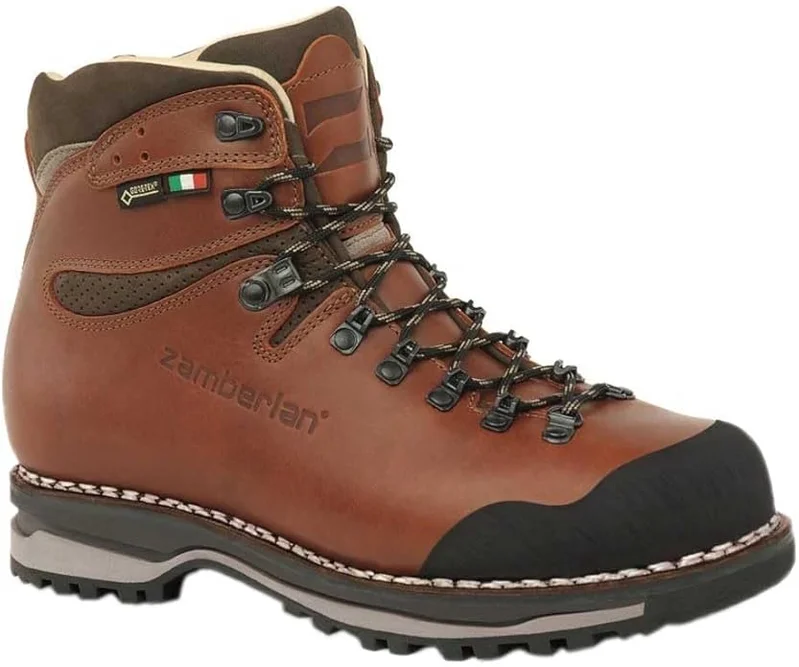
The stitches only hold the upper to the midsole. The rubber outsole is glued on top of that. This gives you the best of both worlds: a boot that is physically sewn together for strength, but has a rubber ‘tire’ that can be replaced when it wears out.
This is also known as Norwegian Welt (Norvegese). You will see two or three rows of visible stitching running along the outside where the leather meets the bottom.
But the stitches do not go through the final rubber outsole (the part that touches the ground). That would be a disaster for durability; the threads would fray and snap within a few miles of walking on sharp limestone.
The final rubber outsole is cemented (glued) to that stitched midsole. Because the rubber is not stitched, it can be easily ground off by a cobbler and replaced without ever touching the structural stitches of the boot.
The rubber protects the stitches from the ground, and the stitches protect the upper from the glue.
My big three plus more
Currently, I have a solid quiver that includes the Big Three of the alpine world, La Sportiva, Scarpa, and Mammut, plus Merrell Moab, and a disruptor Nortiv 8.
La Sportiva are hard compounds. They are designed to remain functional at $-30$°C. While a cheap rubber would turn into a hard, slippery plastic in that cold, these maintain a micro-roughness to grip cold rock.
Scarpa and Vibram have a very deep historical partnership. Most high-end Scarpas use the Vibram Precision Tech Roll sole. Look at your Scarpa from the side. You will notice the toe curves up significantly. This is that Rocker we discussed, it is there because the sole is so stiff (to hold the crampon) that you would walk like a penguin without that curve.
Mammut Sapuen with the Flextron technology is a great example of modern engineering. Instead of a heavy steel plate, they use a corrugated steel spring-sole (see the red spot in the picture below).
This provides the Bridge Effect laterally, so you do not roll your ankle, but allows the boot to flex naturally forward. It is a “Category B” stiffness, perfect for trekking but not for vertical ice.

Nortiv 8 (the budget grip secret), they often use a very soft, high-silica rubber compound to impress users immediately. The trade-off, while the grip is exceptionally great now, keep an eye on the lug wear.
Softer rubber on inexpensive boots tends to round off much faster than the high-density Vibram on Scarpas. For general hiking, that is fine, for high-altitude granite, it is a risk.

Regarding Merrell, I was not happy with the traction, but I have not used them in the mountains so this is fine. These are great shoes and I would always buy them again.
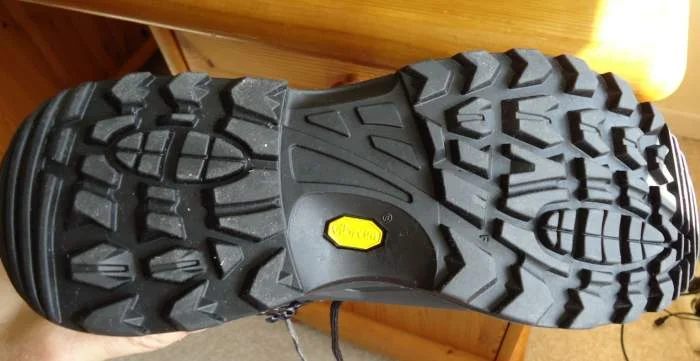
But see also my previous Lowa Renegade GTX Mid Hiking Boots for Men, I would always recommend them for hiking and backpacking:
Surprising comfort of Scarpa Triolet boots
These boots were my choice for Monte Pelmo. The reason was simply that I did not know the snow situation. It turned out that this was the right choice.
That 13-hour day on Pelmo is the ultimate testament to what a high-quality Category C boot should do. The Pelmo is famous for its Ball’s Ledge (Cengia di Ball) and massive scree slopes, exactly the kind of terrain where a sole’s engineering saves your legs.
But I had also a huge snow area in the top cirque where I used crampons.
These are stiff boots and when you put them on, they may feel uncomfortable. But as you start walking this changes. There are two scientific reasons why your Scarpa Triolet feels better the longer you walked, despite their stiffness:
1. The broken-in midsole (mechanical memory)
Even though the Vibram outsole is hard, the midsole (usually a mix of PU and cork or EVA) has mechanical memory. Over the years, your body weight and the heat from your feet have compressed the internal layers to match the specific topography of your foot.
A new stiff boot has pressure peaks where your foot hits the footbed. An older boot has pressure distribution. After a few years, those Scarpas are not just boots, they are a custom mold of your feet.
2. The efficiency of the rigid lever
On a 13-hour trek like Monte Pelmo, you take roughly 20000 to 30000 steps. In Nortiv 8 or Mammut Sapuen, the foot arches have to flex and engage every time you push off.
In the stiff Scarpas, the boot does the structural work. Because the sole does not bend, your calf muscles and plantar fascia do not have to strain to create a platform. You are essentially walking on a series of small, portable bridges. This is why I had no pressure points, the boot absorbed the jaggedness of the Pelmo’s limestone so my foot did not have to.
So, a stiff sole is not the enemy of comfort; it is the architect of it. By preventing the foot from over-flexing on uneven rock, a rigid Vibram sole keeps your muscles fresh for the 13th hour of the descent.
The hype vs. the high-alpine: enormously thick soles
Recently, I notice that some manufacturers are chasing the ‘maximalist’ cushioning trend of running shoes. While your knees might thank you on the paved approach, your brain might miss the precision of a traditional Vibram sole when the trail disappears and the rock takes over.
My Scarpa boots have a low-profile sole. When you are on a narrow ledge or a “cengia,” you can feel exactly where your center of gravity is over the edge of the rock. For a mountaineer, the sole is your “sensor”, so this is the ground feel issue.
But there are high-end mountain-running-hybrid boots where this is not so. They have that thick stack of EVA foam that acts like a noise-canceling headphone for your feet. It absorbs the impact, but it also absorbs the information coming from the rock.
For general trekking, that may be fine. For technical scrambles, it can feel “mushy” and disconnected.
High altitude and stability
A thick, soft sole has a specific weakness: lateral compression. If you are traversing a steep, grassy, or snowy slope with a heavy pack, that thick foam will compress more on the downhill side.
This creates a “sloping” feeling inside your boot, forcing your ankles to work harder to stay upright. Traditional Scarpa or La Sportiva use high-density rubber that does not compress, giving you a much more reliable platform.
The crampon conflict
While you can put strap-on crampons on them, the thick foam sole can sometimes bounce or flex enough to make the straps loosen over time. It is a cool fast and light gadget, but for a 13-hour day on a serious mountain, it is not as trustworthy as your current quiver.
If you dislike the look of such a sole, you will likely dislike the experience of it. In mountaineering, confidence in your foot placement is the most important psychological factor. If you do not trust the “platform” under your feet, you will hike slower and more tentatively.
Example: Mammut Aenergy Mtn Mid GTX
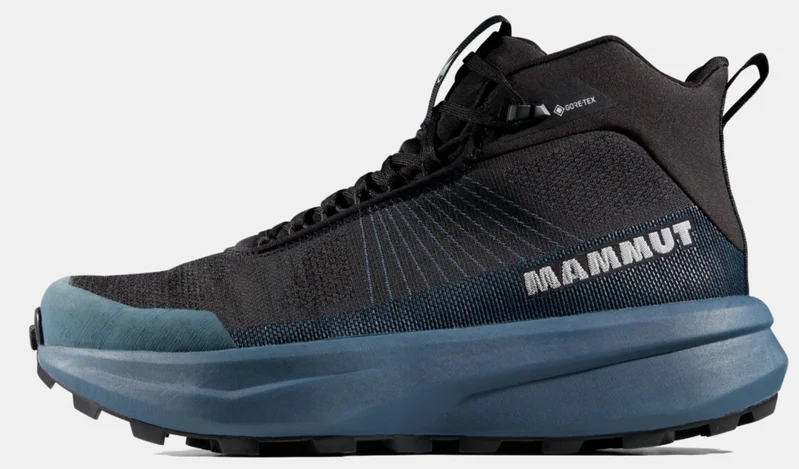
The Mammut Aenergy Mtn Mid GTX represents this specific modern trend in mountaineering footwear: the maximalist approach.
While that sole looks exceptionally thick (almost like a platform or a Hoka running shoe), it is not too much, it is actually a clever piece of engineering designed for speed and joint protection during high-altitude approaches.
Here is why that thickness exists:
1. The high-stack philosophy
In traditional boots, a thick sole usually meant a heavy, clunky boot. In the Aenergy series, Mammut uses high-rebound EVA (Ethylene Vinyl Acetate).
It provides massive shock absorption. When you are descending 1500 meters of scree, that thick foam absorbs the impact that would otherwise go into your knees and lower back.
Despite the thickness, these boots are incredibly light (around 520 g). It is airy volume, not heavy volume.
2. Precision on the edge
If you look closely at the toe of that sole, you will see it tapers down. This is to ensure you still have sensitivity.
In technical climbing, you need to feel the rock. Mammut keeps the stack height high under the heel for comfort but tries to keep the toe low enough so you can still use small ledges.
3. Here you have a very obvious rocker-shaped sole. It guarantees a smooth landing and easy toe-off.
Pros of this design: It is arguably more comfortable for 10+ hour days than stiff boots because of that cloud-like cushioning.
Cons: Because the sole is so thick and made of foam, it is less durable than the solid rubber/PU sandwich on my Scarpas. Sharp volcanic rock or limestone can chew through that exposed foam faster than a traditional mountaineering sole.
Where logic stops
It seems that for some people logic and science does not work, they go as they want and they still manage.
On my Pelmo tour there was a couple of runners in light running shoes. The upper cirque had 2 meters deep compacted snow, so their feet were instantly wet. They were fast and I met them in that area already coming in my direction.
In some other occasion in Bormio area such a runner arrived to the summit that was completely frozen.
It appears that every mountain range has these “sky-runners” who seem to defy the laws of physics and podiatry. However, there is a massive difference between surviving a route and mastering it.
1. The “safety margin” concept
A running shoe has a safety margin of zero. Runners rely 100% on their internal balance, fast reflexes, and dry conditions. If they slip, the shoe does nothing to stop an ankle roll. If the weather turns, they face immediate hypothermia because wet mesh sneakers are radiators for body heat.
For mountaineers Scarpa or La Sportiva boots provide a safety margin. The stiff sole and leather upper are insurance policies. If you get tired, the boot supports you. If you hit a hidden ice patch, the edges bite.
2. The short-term vs. long-term trade-off
Those runners were fast, but they were likely “renting” that speed by “spending” their joints.
The physics is something like this: Running shoes rely on the muscles in the foot and the Achilles tendon to do all the stabilization. On 2 meters of compacted snow, their feet were likely freezing and their muscles were working at 100% capacity just to stay upright.
The result is that they get to the top faster, but they often leave with micro-tears in their ligaments and “frozen feet.” I arrived with dry feet and stable joints, ready to go again the next day.
3. The ordinary mountaineer’s manifesto
The mentioned runners looked fine, and that is the classic mountain runner spirit, high on endorphins and moving too fast to feel the cold yet.
It is an important reminder that physical fitness can sometimes compensate for gear. If someone is light, fast, and has incredibly strong ankles, they can get away with running shoes where others would struggle.
However, as an author, I am writing for the 95% of people who want to be safe, not the 5% who are elite athletes (or just lucky).
You will always see a trail runner in sneakers at 3000 meters. They are fast, light, and usually wet. But for the rest of us, the ‘ordinary’ mountaineers who want to enjoy the view without a sprained ankle, the science of the sole is our best friend. We are not racing the clock; we are respecting the mountain.
Conclusion
Whether you are navigating the legendary ledges of Monte Pelmo or crossing a frozen glacier, the science beneath your feet is what makes the adventure possible. From the tragic lessons of Vitale Bramani in 1935 to the precision-engineered Vibram soles on my La Sportiva Nepal Extremes, the evolution of the mountaineering sole is a journey of safety.
You might see runners in light sneakers moving fast, but for the ordinary mountaineer, a stiff, well-engineered sole is more than just rubber. It is a foundation of confidence. It keeps your feet warm, your ankles stable, and your focus on the summit, exactly where it should be.
The mountain does not care how fast you are, but it does care how much friction you have. Whether you choose the heritage of a stitched sole or the modern precision of a cemented Vibram, remember: your boots are the only thing between you and the abyss. Choose a foundation you can trust.
Runners might get there faster, but we get there with dry feet and protected joints. For high-altitude trekking, trust the stiffness. It is the remote control for your energy.
Thank you for reading. Let me know what you think in the comment section below. Please share this text if you find it useful.
Leave a Reply