The new Bivacco Aldo Frattini was recently installed at 2300 meters in the Orobie Alps. Its design raises some serious questions.
The reasons are as follows. When it comes to high-altitude survival, mountain architecture has historically favored rugged utility over artistic flair.
Traditional alpine bivacchi, those iconic, bright-red metal boxes dotting the ridges, have endured decades of brutal winters for one simple reasons: they are incredibly durable. Their vertical walls maximize every inch of usable space.
The previous Bivacco Frattini was one of them, one of more than 460 bivouacs in the Italian Alps that are mapped here in the site. But this is not so with this new Bivacco Aldo Frattini version, and in this text you will realize why this is so.
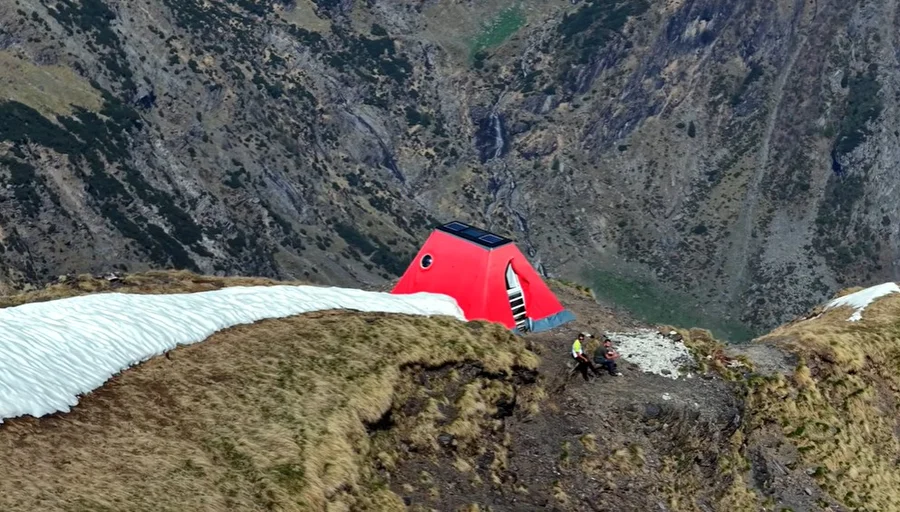
Designed by the architectural studio EX. in collaboration with the Italian Alpine Club (CAI) and gear manufacturer Ferrino, this structure is being praised in design circles as an innovative, lightweight prototype featuring a high-tech “textile skin” over a modular frame.
Yes you are reading correctly, this bivouac is the first permanent emergency textile structure in an alpine environment, with some aluminum-like body underneath.
But if you look past the sleek architectural press releases and look at the actual physics and user experience, you are left asking a simple question: Are we just reinventing the wheel here, or is this design genuinely ridiculous for such a brutal environment?
Before I continue, you might want to know how to find it. So here is its location on our map with all bivouacs in the Italian Alps, it is south of Sondrio:
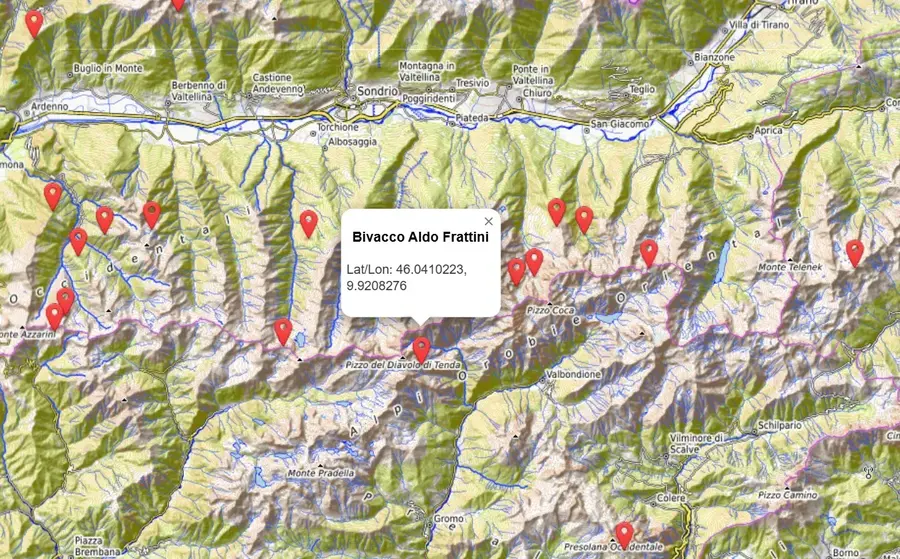
Here is what I find problematic in this new Bivacco Aldo Frattini version. I stress that I have not visited it yet, my thoughts are based on observation from the excellent video which is given in the text below:
1. The geometry flaw: the A-frame “crypt”
Traditional bivouacs utilize vertical walls to maximize interior volume. When you are trapped in a storm with four or more other climbers, you need shoulder room, headspace, and a place to hang wet gear.
The new Bivacco Frattini uses a sharp, angled A-frame profile. While a triangular shape may be great for shedding snow, it is catastrophically inefficient for interior space.
Slanted walls create massive amounts of dead space near the floor and ceiling where you cannot sit up straight. None of the four walls is vertical.
In a recent video by Italian hiker Matteo Peroni, visitors who stayed in the new Frattini openly complained about this exact flaw. Instead of feeling like a welcoming shelter, the interior was described as a “sensazione di cripta” (a crypt-like feeling) resembling a cemetery vault.
There isn’t even room for a basic central table, forcing climbers to balance stoves and food on their laps. It trades decades of practical alpine spatial wisdom for a geometric aesthetic.
The new Bivacco Frattini completely fails here by using a sharp, angled A-frame profile. The exterior dimensions are 3.75 x 2.6 x 2.6 m (length x width x height). But this is a sort of a truncated pyramid, see the pictures. So the total volume is probably around 9-11 cubic meters.
But the volume is further reduced by the thick insulation, you will realize this below from the pictures of windows, and by integrated benches on three sides. From the video, you will also hear them talking about 5 beds only.
From the video below it looks to me that the hole in the middle can be closed to create a continuous additional flat surface for sleeping. So more people can fit inside if/when needed. But this is a suffocating space in any case.
A classic metal container bivouac of the same base and height with vertical walls and an oval ceiling, like the one that was there for half a century, would contain around 24 cubic meters of volume, and it would provide space for 9 beds.

2. The textbook UV trap: learning from Decathlon
The most controversial feature of the new Frattini is its outer structural textile skin. The designers boast that this modular fabric layer can be easily swapped out if damaged. But why design a shelter that invites degradation?
Anyone who has walked past a Decathlon or outdoor retail shop with permanent tent displays knows exactly what happens to synthetic fabrics left under the sun for a long time. Within a few seasons, UV radiation breaks down the polymer chains, turning tough canvas into brittle, shredded ribbons.
Now, lift that concept up to 2300 meters. At high altitudes, UV radiation increases exponentially while the thinner atmosphere offers less protection.
Combined with relentless alpine gales that whip the fabric against its internal frame, this textile skin faces a mechanical and solar beatdown. Expecting a fabric cover, no matter how high-tech, to match the zero-maintenance longevity of traditional corrugated aluminum or steel is a massive gamble.
I read that it “aims to minimize environmental impact”. I wonder how in view of the fragile textile shell that will have to be replaced frequently.
3. The solar oven effect
The interior of the Frattini is lined with natural cork for insulation, which is a great material on paper. However, the bivouac also features prominent, round oblò (porthole) windows.
When you combine a tight, fabric-wrapped frame, heavy insulation, and direct high-altitude sunlight beaming through glass portholes, you don’t get a cozy shelter, you get a solar cooker.
Hikers documenting their first reactions upon stepping inside summarized it instantly: “Fa tantissimo caldo… fa straaldo” (It is super hot). A shelter designed for freezing emergency conditions should not turn into a stuffy greenhouse the moment the sun comes out.
4. The alpine pest reality: a five-star hotel for rodents
There is another massive oversight that completely exposes the gap between a city design studio and real-world mountain ecology: rodents.
Anyone who has spent time in the high Alps knows that field mice and snow voles thrive in the rocky scree well above 2500 meters. They are drawn to bivouacs by the scent of hikers’ food crumbs.
Traditional shelters are built as completely sealed metal boxes for a reason, metal is rodent-proof. But the Frattini’s textile skin and natural cork lining will readily absorb food odors.
To a starving alpine mouse in the dead of winter, this fabric isn’t “cutting-edge architecture”; it’s a giant wrapper.
Once a rodent chews a single hole through that fabric to nest or find food, high-altitude gales will catch the tear and shred the rest of the skin to ribbons.
5. The ultimate safety hazard: a high-altitude burning glass?
As if a cramped interior and rodent threats were not enough, two windows themselves present a terrifying hidden danger: they are convex glass domes that bulge outward.
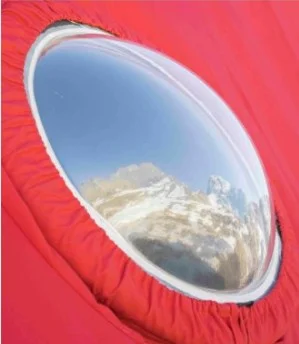
Anyone who has ever used a magnifying glass to start a campfire understands basic optics: a convex lens bends parallel sunlight into a single, intensely hot focal point. At 2300 meters, where solar radiation is exceptionally strong, these windows act as giant burning glasses.
Look at the internal layout: the highly flammable synthetic fabric of the red bunk cots sits directly in the path of these windows. When you factor in the down sleeping bags, nylon backpacks, and technical clothing that hikers leave lying on those cots during the day, you have a recipe for disaster.
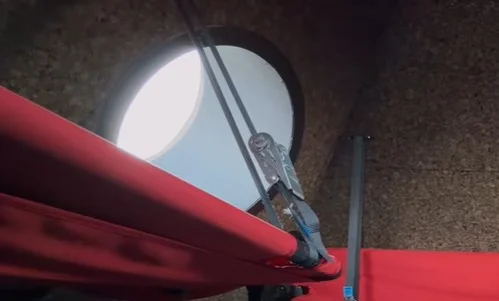
If the sun hits those convex domes at the right angle, it can focus a beam of intense heat directly onto a climber’s gear or the dark cork insulation walls. Turning an emergency high-altitude shelter into a potential fire trap is perhaps the most ridiculous design oversight of all.
In case you did not know, the famous “Walkie Talkie” skyscraper in London notoriously reflected and concentrated sunlight intensely enough to melt parts of parked cars and scorch nearby objects. House fires have also been caused by crystal balls, decorative glass ornaments, and curved mirrors focusing sunlight onto curtains or furniture.
The infamous incident occurred in late August and early September of 2013, while the building (20 Fenchurch Street) was still under construction.
The story peaked globally on August 29, 2013, when a businessman parked his Jaguar XJ on Eastcheap street for a couple of hours. When he returned, the intense, focused reflection from the concave facade had physically warped the car’s plastic panels, melted the wing mirror, and singed the Jaguar emblem.
During that exact same stretch of summer, the localized ground temperatures directly under the reflection reached up to 91°C (196°F) and 117°C (243°F), leading a reporter to famously fry an egg on the pavement.
The building’s developers paid for the car repairs and ultimately installed a permanent system of horizontal aluminum fins (a brise-soleil) across the south facade in 2014 to break up the light and permanently neutralize the glare.
6. The thermal lightning trap: molten plastic
Beyond the electrical hazards in the case of lightning, the choice of a textile outer skin introduces a terrifying material physics problem during a thunderstorm.
While modern high-tech architectural fabrics are treated to be flame-retardant (meaning they will self-extinguish rather than burning down like wood), they are not heatproof. A direct lightning strike generates very high temperatures instantly.
When that extreme thermal energy hits a synthetic polymer or rubberized textile skin, the fabric will instantly liquefy and vaporize at the strike point.
From an electrostatic and high-voltage physics perspective, placing a thin textile skin between the atmosphere and an internal aluminum chassis creates a textbook setup for dielectric breakdown and localized plasma puncture.
During a thunderstorm, a massive potential difference (voltage gradient) develops between the storm clouds and the mountain peak.
A traditional metal bivouac presents a highly conductive, continuous exterior surface. The charge redistributes instantly on the outside to maintain a uniform potential.
The new Frattini bivouac setup is different. Here, you have an atmospheric electric field pushing down onto an insulating textile layer, directly underneath which sits a highly conductive, grounded aluminum internal container/frame.
When lightning strikes or an intense streamer forms, the air and the fabric act as the dielectric material separating the cloud’s charge from the internal aluminum skeleton.
Because the fabric is a dielectric insulator, the massive electrical potential will easily exceed its breakdown voltage. The lightning bolt will instantly punch a high-energy arc straight through the fabric to reach the internal metal container.
The localized energy density at that puncture point is immense. The current doesn’t just pass through gently; it creates a highly localized plasma channel. The intense heat will cleanly burn, vaporize, or disintegrate the synthetic fibers.
Instead of shedding the energy smoothly across a metallic outer surface, the design forces the lightning to physically blow holes through the outer skin to access the internal frame. The winds will do the rest.
This is an extraordinary wrong design choice for an environment known for severe static buildup and direct lightning discharges.
Traditional metal cladding will perhaps dent or scorch under a strike, but it will not melt.
7. Wrong door design
Looking closely at the visitor video reveals yet another glaring design error regarding the entrance. It appears that the outer textile shell unzips via a flexible fabric flap, behaving exactly like the vestibule of a standard camping tent. Behind this lies an inner metal door on the core module.
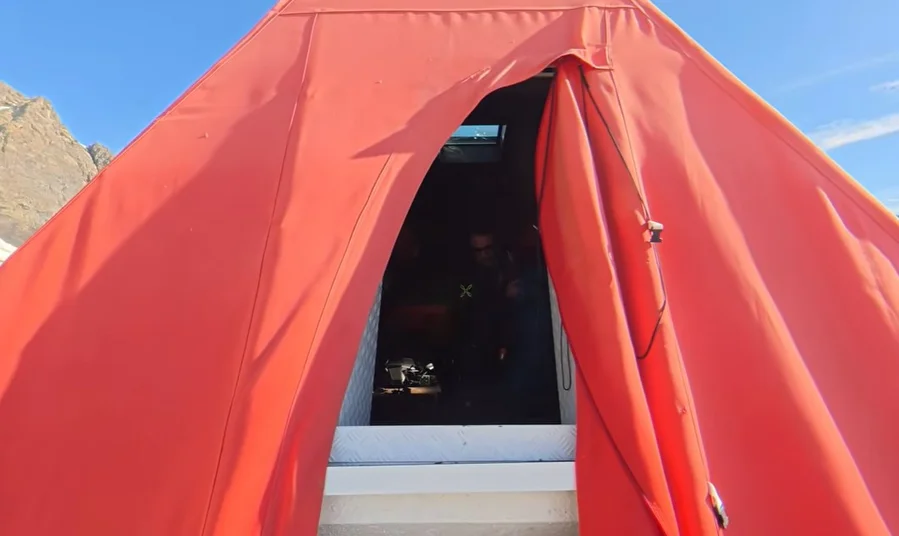
Consider the reality of a winter alpine storm. When high-altitude winds deposit deep drifts around the structure, the problem is compounded by the Frattini’s sloped walls. Snow will slide down the angled faces and accumulate heavily right at the base, burying the entrance.
To gain entry, you must unzip the outer fabric flap. However, a zipper cannot be operated if it is encased in hard, frozen snow and ice; attempting to force it will simply destroy the teeth.
In a life-threatening whiteout, a freezing climber cannot afford to spend an hour carefully clearing ice down to the ground plate. Faced with an emergency, hikers will inevitably take an ice axe or knife and slice the fabric open to survive.
Once cut, the main wind shield of the structure is permanently ruined, and the most vulnerable part of the bivouac, the entrance, is compromised.
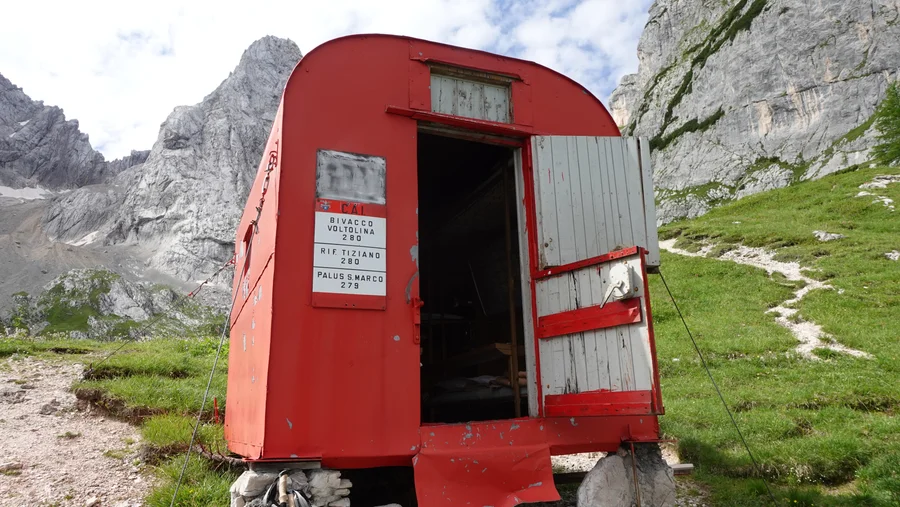
Traditional shelters solved this decades ago. As seen on the classic Bivacco Musatti (pictured below on my tour), standard alpine doors are split into independent upper and lower halves. If snow blocks the bottom, you simply swing open the top half and climb inside.
The irony is that the designers of the Frattini actually included an inner door that corresponds to the upper half door in the classic design. You will see in the video that people climb some ladder to get inside through that small inner door. This proves that they probably recognized the snow hazard.
Yet, they completely overlooked the fact that a vulnerable, easily frozen zipper on the textile full-size vestibule (shell) flap stands between the climber and that inner door. It is an extraordinary oversight in survival architecture.
Oh, I almost forgot: the inner metal door (which is angled) opens to the inside of the bivouac, see the picture. This is opposite to the classic design where the upper and lower halves open to outside.
Now imagine what happens if by any chance this inner door is left open or forced to open by the snow pressure on its angled profile, and/or the shell flap is damaged or unzipped.

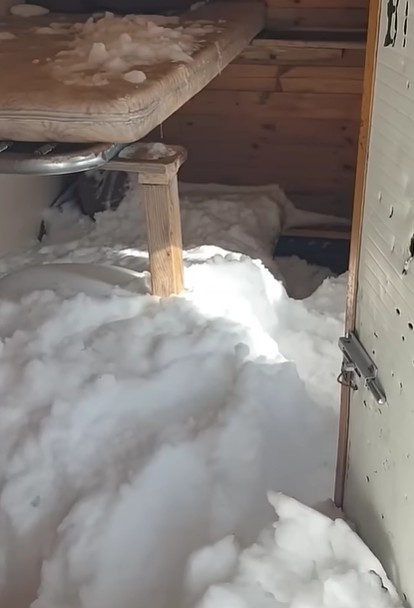
Can this really happen? I do not know, the time will show. Perhaps the guardian of the Marmolada Punta Penia hut may know more, see what he found, and note that the door on this winter room is not even angled inside, it is vertical:
8. No dry entry
This is related to the wrong door design and also to the wrong bivouac design in general. If you are in the bivouac and it is raining heavily outside, as soon as you open the outer flap door to get out, you will have rain inside.
Imagine you spend a night there and there is a snowstorm. In the morning you can have lots of wet snow accumulated on the outer flap. Now, you open the inner door and then have to unzip the flap which will be resting on that inner door because it is pressed by the snow from outside. You can visualize the rest.
This issue is well known in tents industry. I would never consider buying a tent without a dry entry. Who would expect to encounter such a problem in a mountaineering bivouac?
But see more in this video and judge yourself:
Conclusion: form over function
The new Bivacco Aldo Frattini was commissioned as part of an art gallery program (Thinking Like a Mountain), and frankly, it shows. It is a sleek, conceptual prototype that looks stunning in a modern art portfolio, but stumbles on basic mountaineering utility. Alpine shelters are survival infrastructure, not architectural sculptures.
When you arrive at a ridge after a grueling 5-hour ascent in deteriorating weather, you do not care about “dialoguing with the landscape” or experimental architectural layers.
You want vertical walls you can sit against, a space that doesn’t feel like a coffin, and a structure built to outlive the decade without needing a fabric replacement.
In the end, the hikers in the Orobie Alps said it best: “Il design alla fine: bello, bello, ma non comodo.” (Beautiful, beautiful, but not comfortable.)
What do you think? Is this the future of lightweight alpine shelters, or a step backward disguised as progress? Let us know in the comments below.
Leave a Reply