This text is inspired by a pointless discussion on a FB group, so I decided to write it and keep as a reference, it might be useful for other people when they ask the same question.
Here is the actual question:
“I have just one quick question. Wild camping is forbidden, i get it and i am ok with this. Is bivaqueing from 19:00 till 7am allowed? I guess ill add that i respect nature and love mountains so the place will be left like i was never there (no trash, no damages, no open fire etc). Thank you in advance for any reliable info.”
It is as asked, I did not try to edit or improve grammar. This ‘dusk to dawn’ is a frequently discussed topic. If you have spent any time researching wild camping in the Dolomites on Facebook groups, Reddit, or hiking forums, you have undoubtedly run across some version of this advice:
“Wild camping is illegal, but pitching your tent from dusk to dawn (7 PM to 7 AM) is totally fine as long as you pack up and leave no trace.”
It sounds perfect and it may also sound official. People online will even throw around legal-sounding terms like bivacco notturno and tell you that as long as you are outside a Nature Park and/or above the tree line, you are completely within your rights.
But as someone who has spent months mountaineering in the Dolomites, and who has actually reached out to local Italian authorities for clarification, I am here to give you the reality check that forum lawyers will not:
If you pack a tent into your backpack with the premeditated plan to sleep out under the stars to save money or catch a sunrise, you are breaking the law.
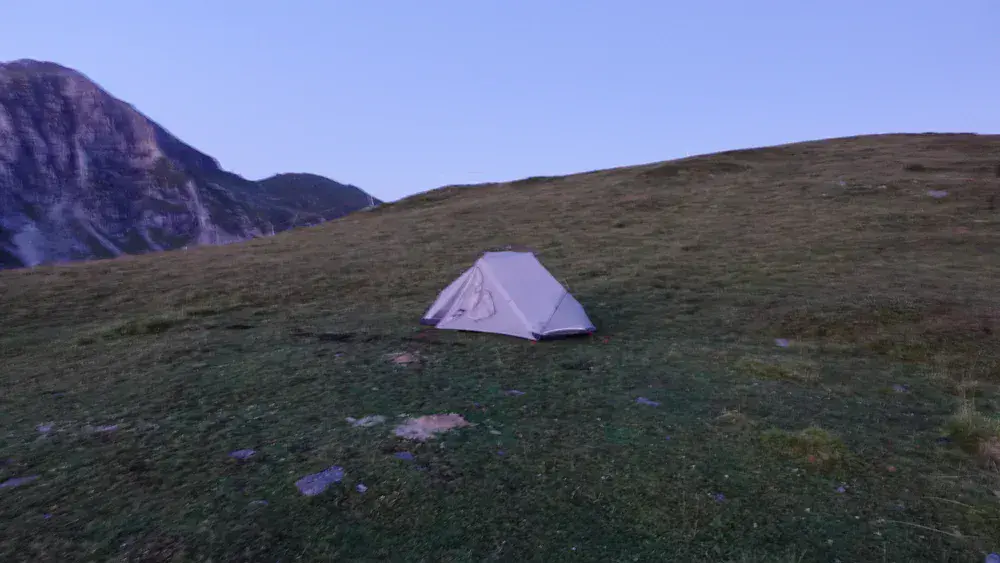
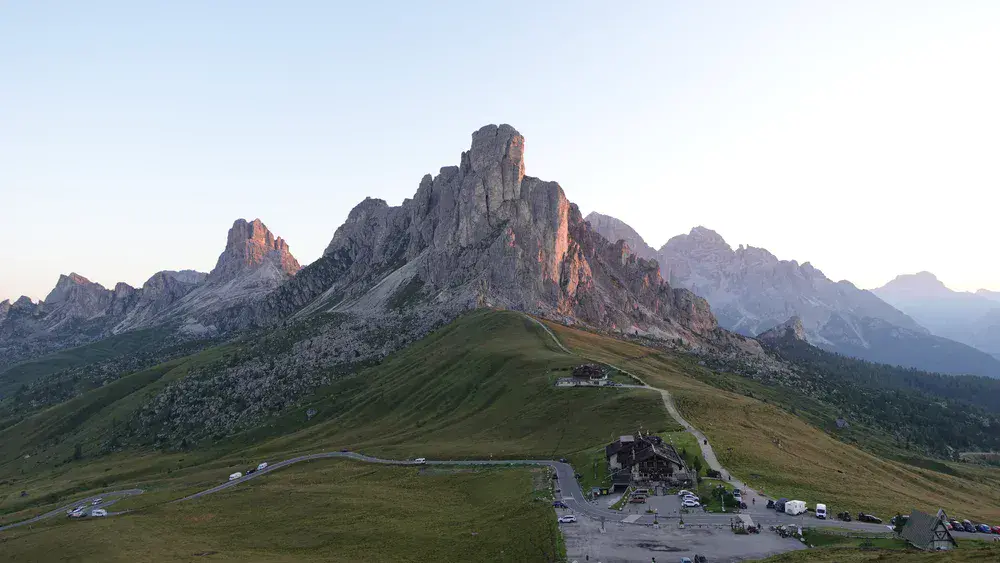
This was the case with the person in the tent shown in the top picture above. I spoke to him but not preaching about this topic, this was a friendly conversation as we were waiting for the sunrise. Below you can see how it looked and can understand why he wanted to be there.
Now, with local authorities heavily increasing the number of active rangers across major sectors recently, relying on bad internet advice could easily land you a 1000 E fine.
Before you pack your tent thinking you have found a legal workaround to bypass the rifugio (mountain hut) system, let us look at the actual laws, the regional traps, and the massive difference between an emergency survival situation and a recreational night out.
The myth vs. the reality
There is a difference between a planned recreational bivouac and an unplanned emergency bivouac (what the law actually protects).
Emergency bivouac (bivacco d’emergenza): You are injured, caught in a violent storm, or trapped on a climbing wall at nightfall. This is legal everywhere in the Alps.
Recreational bivouac (bivacco notturno): You packed a tent with the intention of sleeping out to save money or get a sunrise photo.
If you think you can navigate the legal nuances of three different regions, multiple provinces, and dozens of individual municipalities, think again.
I contacted five different local authorities directly. They either do not answer, or they give a flat, blanket ‘No tent.’
If the official tourism and forestry offices do not recognize a ‘dusk-to-dawn’ (dal tramonto all’alba) exception, do you really want to argue that exception to a ranger at 6:00 AM using a screenshot from a Facebook group?
The park & town overlay
Italian regional laws are just frameworks. The actual power to fine you belongs to the Comuni (municipalities) and Natural Parks.
Even if Veneto’s regional law does not explicitly ban a 12-hour pitch, local towns like Cortina d’Ampezzo or Auronzo have their own local police regulations (regolamenti di polizia urbana) that absolutely forbid it.
The point is, you do not get fined by the Region of Veneto. You get fined by a local ranger enforcing a specific town or park ordinance. Looking at the regional law is like looking at a map of a country to see if you can park on a specific sidewalk.
So even if you see something in regional law that may support your idea of sleeping in the tent, this may be useless because the Dolomites are a jigsaw puzzle of local jurisdictions.
The reason is simple: if you are outside an official boundary of a park, you are usually on municipal land or private pasture.
Think also about recent ranger influx, they are active in several key areas. It is no longer just a sign on a post, there are eyes on the ground.
The problem with above the tree line myth is in the following. For a “dusk to dawn” setup to even look like an emergency, you have to be completely hidden in high alpine terrain. Pitching a tent next to a popular trail or lake (like Lago di Sorapis or Tre Cime) is a guaranteed fine.
The summit sleeping bag: is “no tent” a legal loophole?
If you follow alpine photographer Bruno Pisani, you have seen him sleeping directly on the highest peaks of the Dolomites. Sometimes this is in a lightweight tent anchored with rocks, and sometimes just on a pad under the stars.
Sooner or later, I intend to do the exact same thing. But let us clear up the legal and practical reality of leaving the tent behind.
If you think going tentless makes your overnight stay 100% legal, you are mistaken.
Most local municipal regulations and park laws ban unauthorized pernottamento (overnight staying) regardless of your gear. To the strict letter of the law, a planned night on a sleeping pad is just as illegal as a night in a tent.
On a pure rock summit, the physical impact on the ground is identical anyway. You are not crushing grass, and since you have to anchor a tent with rocks rather than stakes, a tent leaves the exact same footprint as a pad.
So why do rangers seem to target tents so aggressively while minimalist alpine bivouacs sometimes get ignored, or is this really so? It comes down to visual impact and public perception.
A tent, even a small one, creates a distinct silhouette that can be spotted from the valley floor or a nearby rifugio with binoculars. When people see a tent, it acts as an advertisement. It signals to every other tourist that “camping is allowed here,” which triggers a chain reaction of overtourism.
Because tents are highly visible, rangers have to enforce the law to prevent the mountains from turning into crowded campsites.
A person lying flat on a gray rock in a sleeping bag does not create that same public precedent, but make no mistake: if a ranger walks up to you on that summit, there will be a fine to pay.
So leaving the tent behind does not magically rewrite the local laws. It does not make your stay legal, and it does not change the physical impact on a rock summit.
Whether you are in a tent or just a sleeping bag, if you are there for recreation and photography, you are still operating outside the law and taking a calculated risk.
Ranger discretion
This is almost purely my speculation, or wishful thinking, but there is more to it.
Rangers are mountain people. They understand the historic tradition of the alpine bivouac. If they see you on a high summit edge with just a mat, packing up at first light to shoot a photo, they may recognize a fellow old-school alpine mountaineer respecting the peaks.
While technically still against the rules, rangers are probably far more likely to tolerate a low-profile photographer on a barren peak than someone who pitched a bright tent near a popular trail.
Or more likely, the penalty may be lower. As I discussed in my previous text, the fine is in the range from 100 E to 1000 E, and it is not clear to me why such a large span.
I think possible reasons are explained above. The massive scale of the fine depends on the specific area and municipality, and it is almost certainly also designed to give enforcement officers room for context and discretion.
What if a bivouac is full, and other real-life unpredictable situations
• You may plan to go to the mountains and to sleep in a bivouac. But what if you arrive there and it is full? It may be late afternoon, and the weather may not be on your side, so you have to stay.
Sometimes 11 people sleep in a bivouac with 9 beds, you can read about this in my Ombretta Orientale text. But what if there are even more people? Well, I would describe this as emergency, and if you have a tent you will sleep outside.
I have even met some telling me they would then sleep under the stars in their sleeping bags, read more about my tour to Latemar.
This is why I sometimes carry a bivy tent with me even if do not really plan to sleep in it.
• Once I arrived in a bivouac that was heavily infested by mice. Mattresses were damaged by them, and there was a warning on the wall.
Sleeping in such a place brings possible health hazards, I have a text where this was discussed a bit. So if you have a tent you will rather sleep outside.
Now, it is hard to say how rangers would react if they find you in such situations. But they are humans and understand real life. This is where their discretion may play a big role.
Overtourism crisis
The biggest change right now is not the wording of the law, it is the enforcement.
Because of social media and the post-COVID boom, many people started trying the “dusk-to-dawn” trick, pitching tents at famous spots. This has caused severe littering, human waste issues, and wildfire risks.
Authorities have responded by putting active rangers and forestale on the trails. An official rule that used to be ignored because “nobody is out there checking” is now actively enforced because the mountains are overcrowded.
But I saw someone camping on Instagram/Facebook!
Here is a real person’s unedited comment on FB:
I didn’t see a single ranger. I went at 5 am to see tres cimes sun rise at the famous cave spot behind rifugio Locatelli, there was someone camping in there! Near entrance of the cave so no one could get the photo, also there were drones flying, I don’t think anyone cares or enforces rules.
That Facebook comment is the absolute definition of “survivor bias.” Just because one person did not see a cop on a specific morning does not mean the law does not exist.
The scenario described, someone blocking a famous photo spot at Tre Cime with a tent and people flying illegal drones, is exactly why the authorities have started cracking down.
The caves behind Rifugio Locatelli facing the Tre Cime are an Instagram sensation. Because of people camping right in the cave entrances, leaving trash, and blocking the view for early-morning hikers, authorities have been pushed to act.
This is an incredible example of truly ugly obnoxious overtourism.
There is a massive difference between a discrete alpine climber finding a hidden ledge to put a tent at dusk because he runs out of daylight, and an influencer pitching a tent directly in the entrance of the most famous photo-spot at Tre Cime so they can get a sunrise view while flying a drone.
The latter is not respectful alpine custom, it is precisely the behavior that forced parks to increase ranger patrols.
‘I did not see a ranger’ fallacy
Rangers do not stand on every corner of a mountain like city police. They target specific high-impact zones, often during peak season or sudden sweeps.
Relying on the logic of ‘I did not see a ranger, so it is legal’ is like saying ‘I did not see a speed camera, so the speed limit is a myth.’
Just because one lucky camper managed to block a cave entrance at Tre Cime without getting caught does not mean the local Comuni are not handing out hefty fines a mile down the trail.
A confession: I have done it too
Look through this website, and you will find photos of my tent pitched high up under the Dolomite summits. I have slept out in a tent there a few times, and this was always on my summit tours.
So I know the temptation. When I did it, I knew well I was breaking the law and risking a massive fine. When I pitched my tent in the Dolomites, I did it with a clear understanding: I am breaking a rule, I need to be invisible, and if I get caught, I will pay the fine without arguing.
The new wave of online loophole hunters wants it both ways. They want to pitch a tent in highly visible, illegal zones, block the trails, and then use parsed legal language from a Facebook forum to argue with a ranger. It does not work that way on the mountain.
However, what was a calculated risk a few years ago is probably a terrible idea today. The rules have tightened, overtourism has forced the authorities’ hands, and rangers are now actively patrolling areas that used to be completely unmonitored.
I met three of them on my way up to Sasso Vernale, this was on Passo delle Cirele (2683 m) so you realize they go very high in the mountains. There are no easy routes to that particular spot with a Martian-like landscape, and they were there very early.
They were equipped with binoculars, and they were in some uniforms. When I asked what they were doing, they replied watching wildlife. I was not sure about that.
Conclusion
The point of the text is: if you carry a tent intending to use it for recreation, you are breaking the rules. There are fines prescribed by law, and they are in certain range.
So “forum lawyers” should realize that the law is not a simple blanket yes or no game you can win with internet clauses.
Instead, it shows that the system is practical, enforced by real people (rangers), and that your behavior on the ground matters infinitely more than a fictitious loophole you read about on Facebook.
Many online tent itineraries describe what people do, not what regulations allow. What you do with the information presented here is up to you, but stop pretending there is a legal loophole protecting you. There isn’t.
There are ways to sleep on the mountains legally. Dolomites in particular are full of regular huts, but as we all know, many of them are on some of Alta Via routes, and fully booked months in advance.
However, there are more than 140 bivouacs throughout the Dolomites, and I have slept in some of them. They are always open and anybody can use them.
Thank you for reading. Please use the comment box below in the case of questions or comments. Join us at our FB group Dolomites Visitors Hub and stay informed.
Official sources for further reading
• Veneto Regional Law 1984 No. 40: Relevant articles 3, 4, 12.
• Belluno Dolomites National Park Regulations: Article 20, item 4. A newer regulation was approved in 2021 (published in Gazzetta Ufficiale n. 163 on 9 July 2021 and effective from October 2021), but it did not make wild tent camping easier.
• Friulian Dolomites Park Regulations: Article 10.
• Paneveggio Pale di San Martino Park Regulations: Article 14.
Leave a Reply