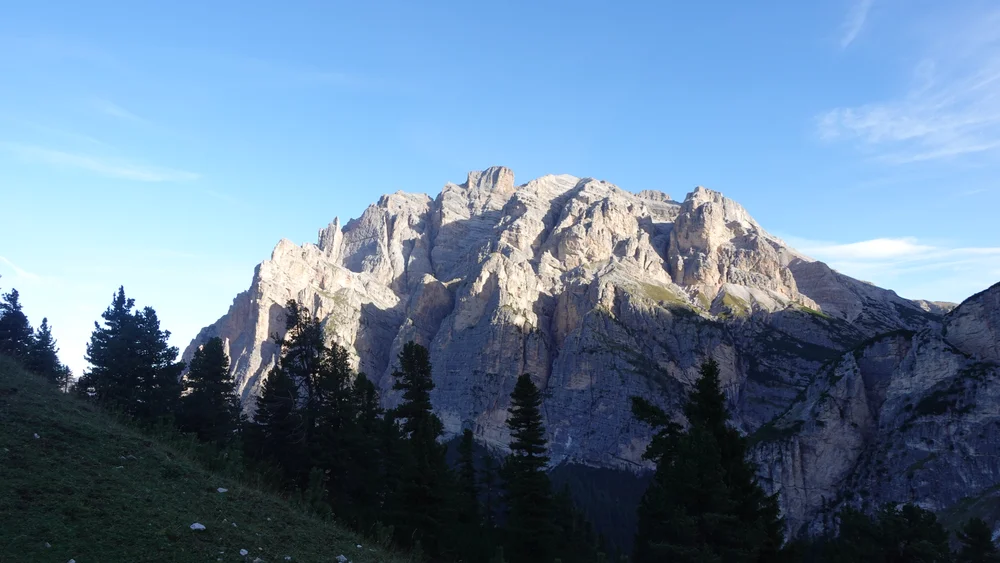
In the summer of 2026, a new cave was found on Conturines mountain in the Dolomites at an elevation of around 2800 meters, containing a large number of fossilized cave bear skeletons. The previously known cave is in the same area and holds fossils that are over 46000 to 50000 years old.
What this is about
From what I know, the first news about the new cave on Conturines was published in this article. It begins with the word “sensational,” which captures the tone of the article itself.
A more detailed article provides some additional information. All in all, the discovery is quite recent, it happened on July 3, 2026, when mountain guide Kurt Walde discovered another cave below the Conturines peak. It contains a very large number of fossil skeletons of the so-called cave bear (Ursus spelaeus or Ursus ladinicus).
Currently secret location
The exact location of the cave is far from clear. The first article says “below the Conturines summit and above the original Conturines Cave.”
In the second article, we read that it is in the Fanes-Sennes-Prags Nature Park, within the municipalities of Enneberg and Abtei. These translate to Marebbe and Badia in Italian. Of course, this is Alta Badia, so that makes sense, though there is no Marebbe municipality right there, or at least I could not locate it.
To make the story even more confusing, the name Col Toronn is mentioned in one of the figure captions in the second article. The name also appears explicitly in the provincial government’s later announcement on October 23, 2026, including the Italian caption:
“La parete rocciosa del Col Toronn con al centro l’ingresso della grotta scoperta.” This means “The Col Toronn rock face with the entrance to the discovered cave in the center.”
However, no map shows such a location on Conturines.
There is a separate mountain peak with that name above Corvara, but from everything we can read, it has nothing to do with the new cave. This is because of the following details:
- The cave entrance lies at an altitude of approximately 2800 meters above sea level, whereas the elevation of the aforementioned Col Toronn is 2655 m.
- In the same article, we read that the new cave is “below the Conturines peak and above the Conturines cave.”
In any case, the cave is situated in exposed terrain and extends for a length of 170 meters. Its height and width are roughly the same as those of the known cave, reaching six to eight meters high and eight to ten meters wide. In short, it is huge.
The old cave story
Clearly, the previously known cave is important context for this new discovery. Here are a few details from the second article mentioned above:
As early as September 23, 1987, Willy Costamoling discovered paleontological remains of cave bears, approximately 50000 years old, in the first Conturines Cave. Since then, the results of the series of excavations carried out from 1988 onwards, led by the Viennese paleontologist Gernot Rabeder in cooperation with the State Office for the Preservation of Monuments, have been extensively researched.
The map below shows the exact location of the old cave (marker 1). If you zoom out, you can easily see where it is located if you are familiar with the area.
The route splits from Grande Piano in Fanes Nature Park (marker 2 on the map). You can also see that this is very close to the Alta Via 1 route, which splits to the right and goes to Forcella di Lago.
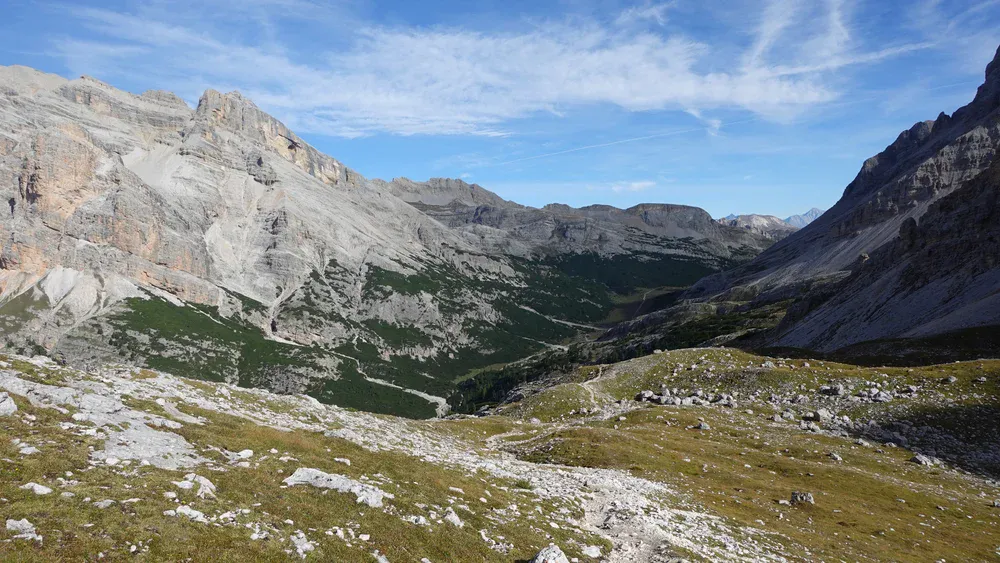
This area is shown in the photo below from my tour to Bivacco Baccon Barborka; Conturines mountain is on the left, and the cave area is also visible.
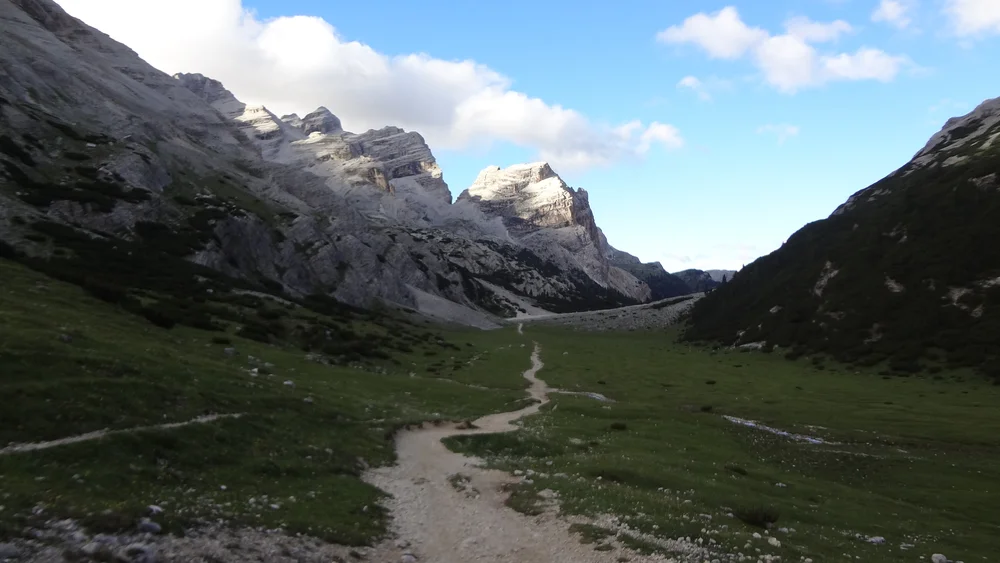
Below is the view looking back from Grande Piano toward the viewpoint of the previous photo, giving you a sense of the beauty of this entire area. The elevation here is 2000 meters.
I found a scientific study that gives plenty of details related to the old cave, and it confirms that this is “by far the highest known cave bear site worldwide.” According to the map above, its elevation is 1730 m.
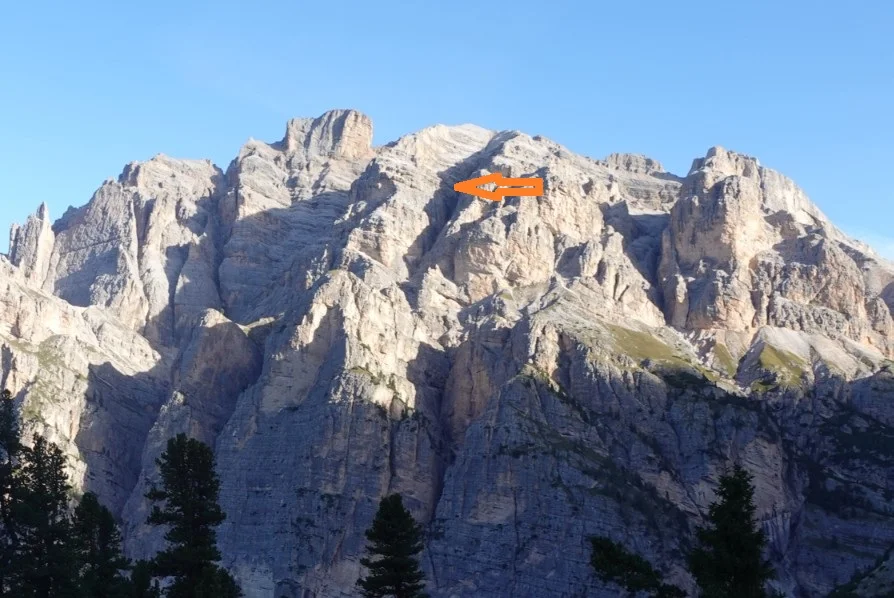
To help you visualize how high it is, I have marked the rough position of the cave in the photo below. The new cave is even higher. In the study, the authors write that the remains “likely date from a warm climate period with a high treeline, possibly the Last Interglacial.” Clearly, no bear would live in such a place if the area looked the way it does now.
In the study, they state that the remains are in excess of 46000 to 50000 years old. Specifically, the text notes:
- Direct dating: The carbon samples yielded consistent ages beyond 46–50 thousand years ago, pushing the limits of standard radiocarbon dating.
- Geological context: This makes them older than Marine Isotope Stage 3, suggesting they date back to an earlier warm climate period, likely the Last Interglacial (roughly 115000 to 130000 years ago).
Back to the new cave: where is it really?
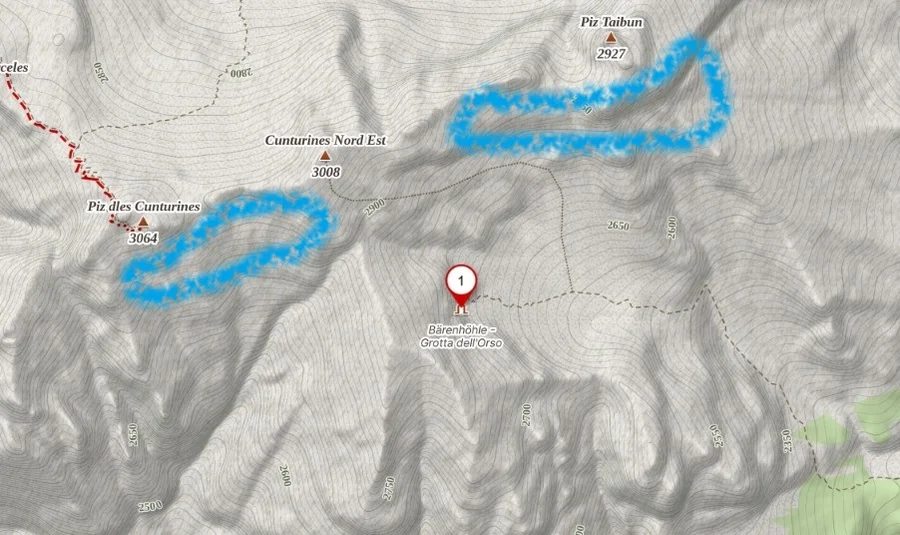
My guess is that the new cave is somewhere inside the blue zones in the picture below. As you can see, there is a path to Conturines Northeast peak, so this area is likely well known to mountaineers, meaning a cave right along it would probably have been found by now.
However, I am just guessing, because as of the time of writing, the exact coordinates are not publicly available. The reason is that authorities are working on permanently sealing the entrance so that the finds and features are not contaminated by unauthorized access, and to ensure the fossils are not stolen.
Thank you for reading. If you know any more details about this story, please share them in the comment box below.
Leave a Reply