When I showed some zoomed photos and videos from Dolomites to my wife, she said “the rock looks alive”. Her reaction was spot on.
There is something almost biological about that transformation of the rock when light changes. It is as if the mountains are “flushing” or breathing.
Enrosadira
Enrosadira is a local Ladin term used in the Dolomites (northern Italy) to describe the striking phenomenon when the mountains glow pink, red, or orange at sunrise and especially sunset. The word literally means “turning pink”.
Why it happens
Enrosadira is caused by alpenglow, a lighting effect produced when the sun is low on the horizon. The Dolomites are particularly famous for it because their rock is light-colored and reflective, the steep vertical faces catch sunlight dramatically, the clean mountain air often enhances the color contrast.
Several factors play a role:
- The mineral composition: The calcium and magnesium carbonate in the dolomite rock contains traces of iron and manganese.
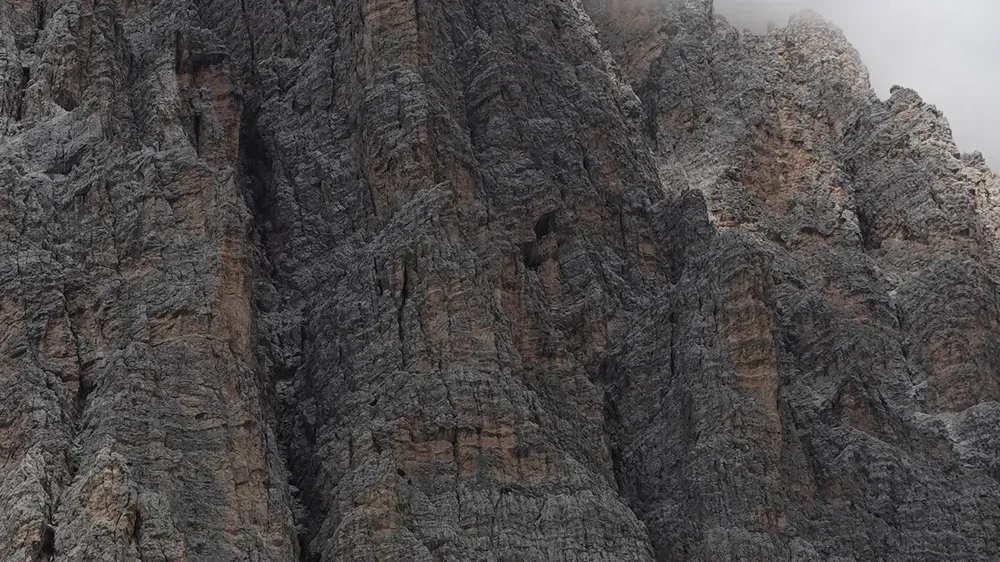
- The albedo effect: During the day, the walls look “pale” or ghostly white because they reflect almost all sunlight. You can see this in the photo above, but there is another orange layer behind that pale face.
- The sunset filter: As the sun dips, the light has to travel through more of the Earth’s atmosphere, which filters out the blue and green wavelengths, leaving only the warm reds and oranges.
- The reveal: Because the rock is so pale and porous, it doesn’t just reflect that light; it seems to absorb and glow with it.
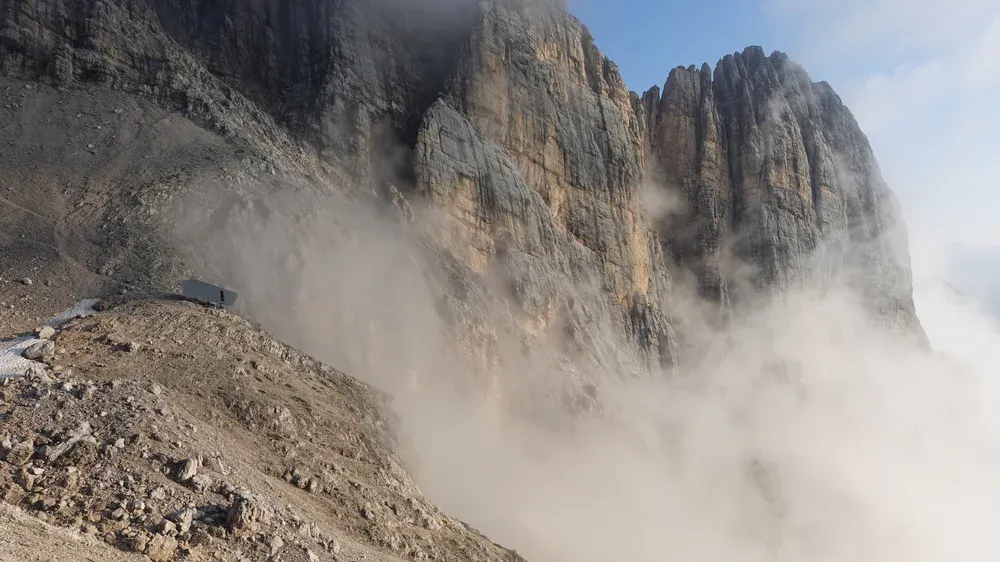
The photo below shows Bivacco Fanton in Marmarole area, one out of 140+ bivouacs in the Dolomites with the pale and yellow wall details behind.
Cultural importance
The word comes from the Ladin language, spoken in parts of the Dolomites (Val Gardena, Alta Badia, Val di Fassa, etc.). It’s not just a scientific description, it’s a deeply emotional and cultural symbol for the region.
There are also Ladin legends tied to it, including stories of the mountains being tinted pink by magical events or enchanted kingdoms.
The Legend of King Laurin (Re Laurino)
Enrosadira is strongly connected to the Ladin legend of King Laurin, one of the best-known Dolomites myths, especially around the Rosengarten (Catinaccio) mountain group.
King Laurin was a dwarf king who ruled a magical underground kingdom in the mountains. He owned a magnificent rose garden, said to be the most beautiful in the world, guarded by spells.
According to the story, a prince (or knight) kidnapped a woman Laurin desired (often named Similde), and Laurin retaliated. Eventually Laurin was defeated and his rose garden destroyed.
In rage and grief, King Laurin cast a curse on the rose garden so that no one would ever see it again by day or by night. But he made a mistake: he forgot twilight, the in-between time at dawn and dusk.
So the garden still appears briefly, glowing red and pink when the sun rises or sets. The mountain range linked to the story is literally called Rosengarten in German (Rose Garden), but Catinaccio in Italian has a different meaning. And it’s one of the most dramatic places in the Dolomites to watch the sunset glow.
So culturally, people don’t just see a lighting effect, they see Laurin’s enchanted roses returning for a few minutes each day.
In short, Enrosadira is the Dolomites’ signature sunset glow, famous both as a natural phenomenon and as a cultural icon of the Ladin Alps.
Leave a Reply