Have you noticed that Deuter Futura Pro backpacks now have something that looks very similar to Osprey’s Stow-on-the-Go attachment for trekking poles introduced many years ago?
I wonder why they have been waiting for so long to add such an excellent feature. One would think this was a patent-protected feature, but perhaps this is not so.
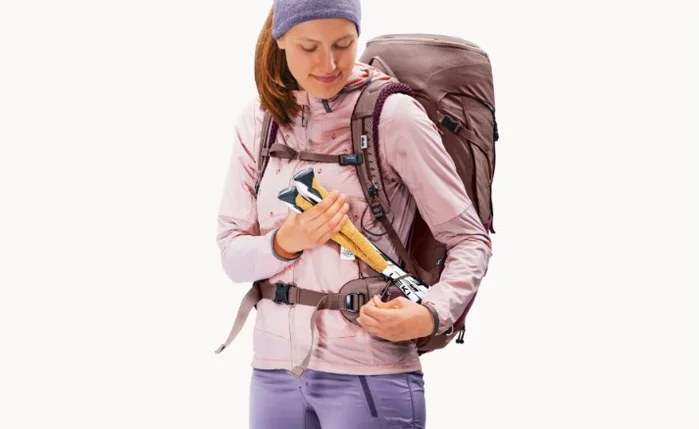
So what this is about
The new 2026 Deuter Futura Pro explicitly advertises a quick-release pole attachment on the shoulder straps. Deuter’s new product catalogue also lists this feature.
You can see it in this video at 1.51, but see the whole video because this is an excellent backpack with incredibly great features.
As you realize, the system has two components. One is the stretchy loop on the shoulder strap, and the other is yet another similar on the side of the hip belt. The former is essentially the same as in Osprey’s packs, but the latter is very different.
The system is only on one (left) side, and this makes it very similar to Osprey. But you realize from the picture below that when poles are attached, it is difficult to use the hip belt pocket:
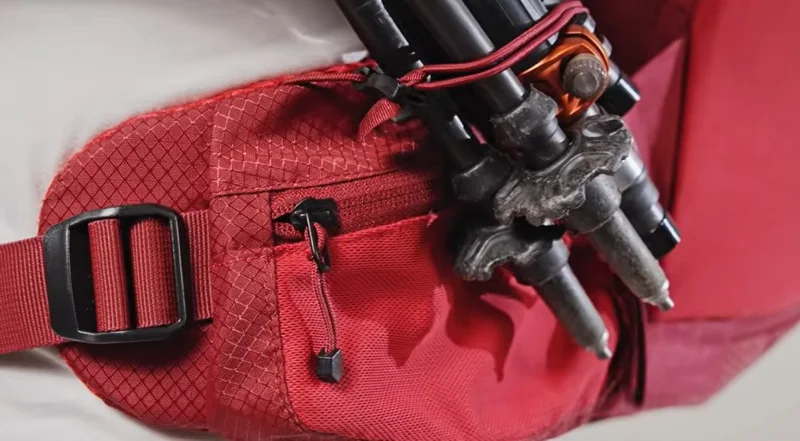
This is different on Osprey packs where there is a stretchy loop in a plastic pipe on the side of the backpack. If you follow the link you will see it in one photo there. But I do not think this is a big problem, such poles attachment is only for temporary situations on the go.
On the other hand, Deuter’s design is better if your poles fold to a very short length. The two attachment points are still close enough.
This is not so with Osprey’s design where telescopic poles fit well, but this may not always be with very short folding type, the attachment points may be separated too much.
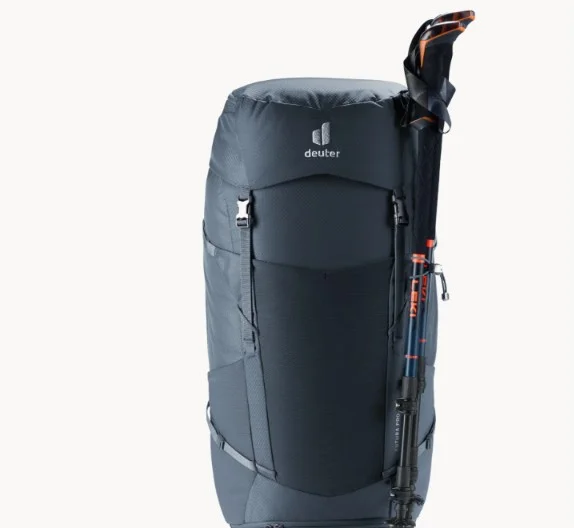
It should be stressed that the usual poles attachment points on the front of the backpack are available as well, see the picture:
Awkward name
They call it quick-release pole attachment on shoulder straps. I think they should come up with something better.
First, to quick-release it, you have to quick-attach it in the first place. So it is more about easy and quick attachment when you need free hands to take a photo, to do some scramble, to drink, etc.
Second, the system includes attachment on two places, on the shoulder strap and on the side of the hip belt, so this is not about shoulder straps only.
But this aside, you have an excellent feature here if you carry trekking poles on your tours. This is is what I have been doing for decades, so I love this detail.
Which Deuter’s backpacks have this quick release system
Currently, this system is on 6 packs from Deuter Futura Pro series, and also in 6 backpacks from Deuter Speed Lite Pro series. The photo below is from the latter.
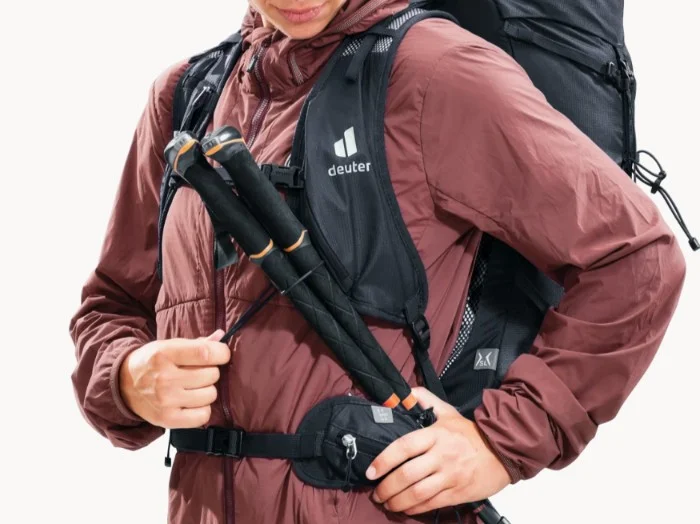
Note that these two series include versions both for men and for women, the latter have SL letters in the name, which means slim line. Regarding the volume, they all belong to the group of day packs.
Here is a video about Speed Lite Pro series. Please follow the link to see more.
Alternative use
For people who do not use trekking poles, this system may not be important, but wait, this is still very useful for the following situations:
- You can attach a tripod here and use when needed.
- If you carry a selfie stick, this is the place where you can attach it. I do this sometimes with my Osprey backpack, I use the DJI Osmo Action 1.5m Extension Rod Kit.
- The same is with a monopod for camera, it can be carried attached here.
- Even a hiking umbrella can be carried here.
Why did Deuter wait so long?
I suspect the answer is a combination of several factors, rather than simply patent restrictions. But let me say a few words about Osprey’s design.
Osprey Stow-on-the-Go
From what I know, Osprey introduced Stow-on-the-Go on its Kestrel series around 2008. Contemporary outdoor press coverage from January 2008 describes the system and its operating principle. Currently, at least 7 distinct series families, encompassing 13 named men’s/women’s or paired product lines come with this feature.
The design is quite clever:
- A lower elastic loop on the side of the backpack holds the basket end of the pole.
- An adjustable elastic cord on the left shoulder strap holds the handle.
- You can insert or remove the poles without taking off the backpack.
Osprey has incorporated this feature across lightweight hiking, traditional trekking, backpacking and premium backpack ranges. It isn’t restricted only to expensive backpacks.
So there is a genuine resemblance, but those systems are not identical.
Was Osprey protecting it with a patent?
This is where things get interesting. There are three different types of intellectual property that could be relevant:
| Protection | What it protects |
|---|---|
| Utility patent | How a mechanism works |
| Design patent / registered design | The ornamental appearance of a product |
| Trademark | The name, such as Stow-on-the-Go™ |
Osprey’s Stow-on-the-Go is a trademarked feature name. That does not, by itself, mean the underlying mechanism is patented.
I found documentation establishing its introduction in 2008, but I haven’t established a corresponding patent that gives Osprey exclusive rights to the particular two-point trekking-pole attachment arrangement.
There is also a practical consideration: a patent doesn’t protect an entire idea in the abstract. It protects the particular technical claims written into the patent.
For example, Osprey couldn’t necessarily prevent another manufacturer from developing a system that:
- Holds a trekking pole on a shoulder strap.
- Uses an elastic loop.
- Allows attachment while wearing the backpack.
The question would be whether the competitor’s actual mechanism falls within the claims of a valid patent.
Now back to Deuter to consider some possible reasons for waiting so long.
1. Deuter has traditionally prioritized a different type of hiking experience
I found an interesting interview with Deuter’s global product manager, published in 2026.
He explains that Deuter designs each backpack around a specific type of hiker and selects three priorities for that product. Features that don’t serve those priorities can be deliberately excluded, even if competitors offer them.
He also discusses how Deuter considered vest-style shoulder straps for the Futura but decided against them because they don’t suit everybody.
This gives us a useful clue: Deuter isn’t necessarily trying to incorporate every clever feature available in the market. Its product philosophy is relatively conservative about adding things.
2. Their traditional pole attachment was sufficient for their target customer
Deuter’s older Futura Pro models already had conventional trekking-pole attachment points, including ice-axe and pole loops. Their 2018-era catalogue, for example, lists these features. That arrangement works perfectly well if you attach poles before starting a hike or leave them attached for extended periods.
But it is inconvenient if you repeatedly take them off and put them back on during a hike. This is precisely the use case Osprey addressed in 2008. The contemporary review even specifically praised the system for hikers alternating between pole use on steep terrain and free hands on easier terrain.
3. Perhaps the feature wasn’t as universally valued as we think
This is an important commercial consideration.
A trekking-pole attachment that can be operated while wearing a backpack is particularly useful to:
- Hikers frequently changing between steep and flat terrain.
- People who use poles for descents but not every section.
- Hikers who stop frequently to take photographs.
- People who don’t want to remove their backpack just to stow their poles.
- But for someone who walks with poles continuously, or only uses them occasionally, it might not be a major selling point.
A manufacturer has to decide whether adding the feature justifies the extra components, assembly, testing and potential maintenance.
4. The 2026 update suggests Deuter finally recognized the value
The new Deuter Futura Pro now explicitly lists quick-release pole attachments on the shoulder straps as a feature.
I find this significant because Deuter has been making Futura backpacks for many years, yet this convenience feature wasn’t part of their traditional design.
My interpretation is that this is more likely a product-development decision than the expiration of an Osprey patent.
I haven’t found evidence that Osprey held an exclusive patent preventing Deuter from making a similar attachment. And Deuter’s different lower anchoring mechanism makes it quite possible to develop its own implementation.
Conclusion
Regarding Stow-on-the-Go, Osprey clearly established an early, commercially recognizable implementation in 2008. However, I haven’t verified that it held an enforceable patent covering the underlying mechanism.
Deuter’s new attachment may be an independent implementation, a variation on an unprotected mechanism, or potentially something covered by different intellectual property rights. We cannot determine which without examining the actual patent claims and construction.
I wouldn’t rule out patents as part of the explanation. But I would not claim that Osprey’s patent prevented other brands from using it without finding the actual patent and its claims. The absence of competing products doesn’t prove patent protection. It could also reflect a deliberate decision not to copy a feature that Osprey had made commercially distinctive.
In any case, Deuter’s new backpacks with this system are available on Amazon, and also at Deuter.
Thank you for reading. Please use the comment box below if you have questions or comments.
Leave a Reply