John Ball’s 1857 ascent of Monte Pelmo is usually presented as a clean historical milestone: the first successful climb of the mountain, achieved by a determined Victorian alpinist and recorded in his classic writings.
But after reading Ball’s own account closely, and comparing it with what the route looks like today, it becomes difficult to accept the story in its simple form.
The more one examines the details, the more the “first ascent” begins to look less like a clear-cut discovery and more like the moment when local knowledge was finally written down and claimed in print.
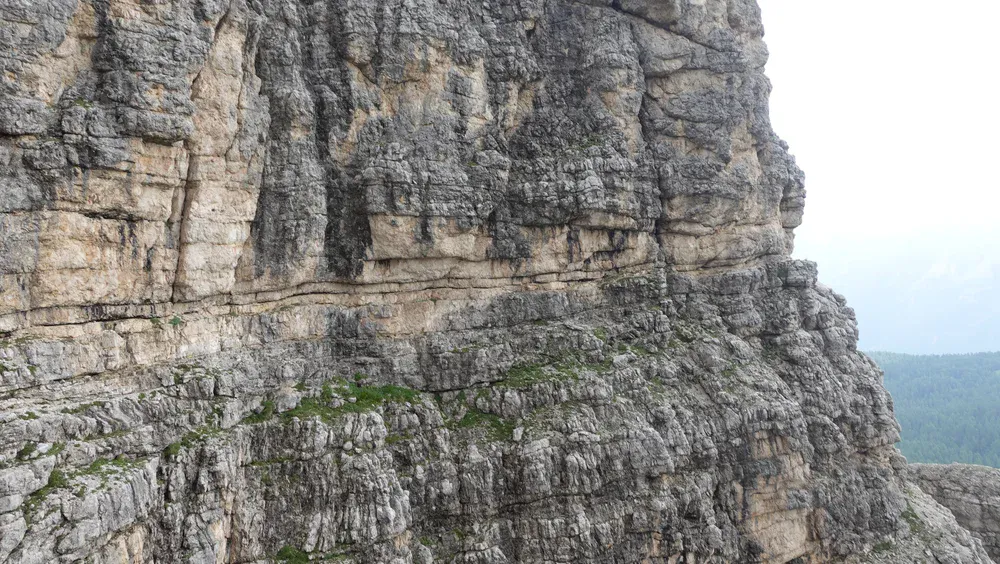
When John Ball and his guide made the first ascent of Monte Pelmo, the route involved following a natural ledge (now called Cengia di Ball) along the face of the mountain. It is important for this text, so here it is in my photo taken from my own tour 167 years later by walking the same Ball’s route:
Sections from Ball’s book
Here is what Ball writes on page 525 in his book from 1868 (note he calls himself “the writer”):
The writer ascended from Borca by the E. face of the mountain, with a chamois-hunter who professed to have discovered the course which they followed. At a comparatively low level, (less than 7,000 ft. ?) a ledge was gained which had to be followed horizontally along the face of the precipices that show so boldly on the side facing the Ampezzo road.
Three deep recesses were rounded in succession. In two places the ledge had been broken away, but it was found possible to clear the gap thus created. The most eccentric obstacle was encountered at a place where the overhanging rock came down so low as to leave a space of only about 18 inches; far too little to make it possible to creep on hands and knees.
The guide, who had hitherto gone first, declared that the breaking away of a projection of rock that overhung the precipice on the 1. hand, had made the passage impossible.
Unwilling to be baulked, the writer contrived to crawl along the narrow ledge in reptile fashion, and was followed by his guide. Soon after a place was reached from which the ascent to the topmost plateau is merely a long and steep, but not difficult, scramble.
In addition to the characteristic spe cies of the Dolomite Alps, Valeriana repens, Campanula Morettiana, and Androsace Hausmanniana were gathered on this side of the mountain.
Whatever course the traveller may take, he finds with surprise a not inconsiderable glacier lying on the broken plateau which is surrounded by the topmost ridges of the mountain.
On a small rock-terrace above the upper end of the glacier, the writer was told that they had reached the top, and on his pointing to the shattered ridge above, was assured by the guide that this being all ‘ croda morta ‘ disaggregated rock loosened by weathering, the further ascent was entirely impracticable.
It required some time and some caution to loosen with the Alpenstock considerable masses of rock, still hanging together, but detached by a slight effort, before the real topmost ridge was reached by the writer, without his guide. No token of a stoneman was seen, and it is not unlikely that the barometer observation recorded by Fuchs was made some way below the true summit.
The height must be about the same as that of the Civetta, and can scarcely be 200 ft. below that of the Antelao. Melchior and Luigi Zugliani of Selva, near Caprile, are recommended as guides for the Pelmo; but there must be several competent men in Val di Zoldo.
The mystery of the unnamed guide
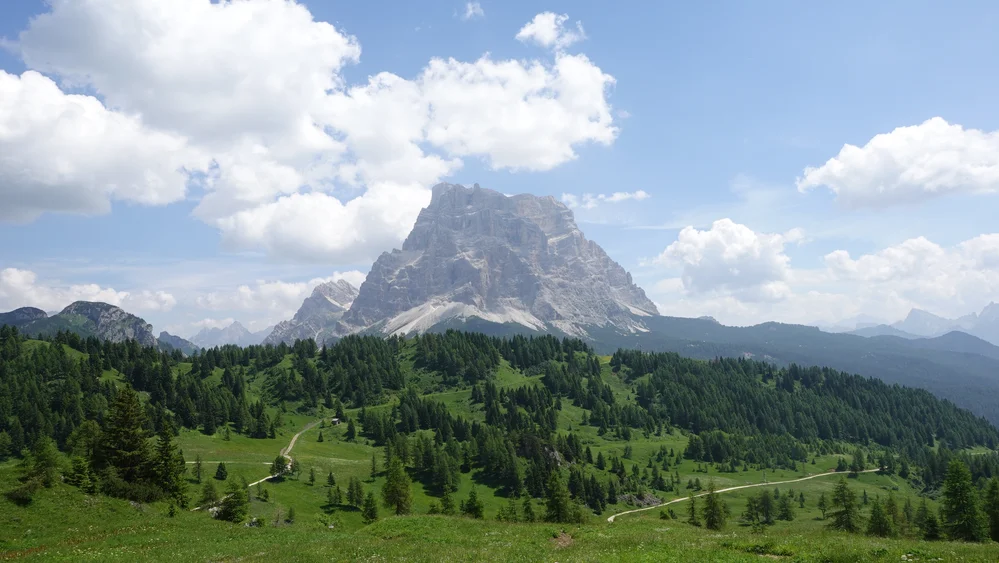
As you realize, Ball writes about a chamois-hunter, without mentioning his name.
To omit the name of the man who literally led him across deadly terrain is not just a Victorian habit, it is an act of arrogance that erases the real expertise behind the climb.
The reality is that he would need many days to discover the ledge which now carries his name, Cengia di Ball. The ledge was previously known to his unnamed guide of course.
However, historical records and Alpine research have identified him. The man who accompanied Ball on that historic first ascent on September 19, 1857, was Giovan Battista Giacin. He was a local chamois hunter from Borca di Cadore.
Why Ball was dismissive?
If you re-read the text from the book, you can see a bit of summit fever tension between the two. Ball notes that the guide declared that the breaking away of a projection of rock… had made the passage impossible.
Later, the guide tells him the summit is all ‘croda morta’—the further ascent was entirely impracticable.
Ball eventually pushed on to the summit alone, leaving Giacin behind on a lower terrace.
Because Giacin did not believe the final summit was possible and did not join him for the final few meters, Ball likely felt less inclined to give him coauthor status for the discovery. In Ball’s mind, he was the visionary leader and the guide was simply the person who knew the first half of the path.
Today, the mountain community has much more respect for these local pioneers. While the ledge is named after Ball, the people of Borca di Cadore still remember Giacin as the man who actually knew where that 18-inch gap was hidden in the first place.
18 Inches gap
Ball described a very narrow section, with only about 18 inches (45 cm) of clearance, which he had to crawl through. That was probably a natural gap in the rock caused by erosion and rock fracturing.
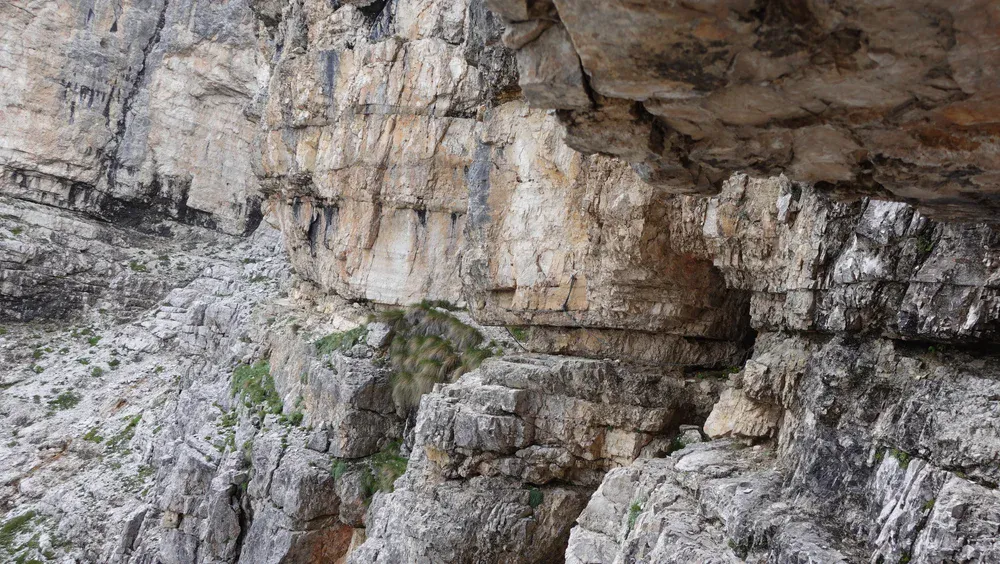
When I climbed Pelmo 167 years later, I could not see anything similar to Ball’s description. Of course, the ledge is still there, breathtaking as always. There is also what is known Passo del Gatto, the photo below, but no low gap.
I searched online to see if this was blasted or carved out in later years, but could not find any information. So what happened with the gap?
Most likely this is about rockfall and erosion. Natural processes like freeze-thaw weathering, rockfall, and slumping slowly change the shape of ledges over time, often making them less precarious compared to their state in the mid-19th century.
When I was there on the ledge, there was a fresh rockfall some 30 meters from the famous Passo del Gatto. On my way back, the person from Rifugio Venezia wanted to know the situation regarding that particular point.
So I believe that one should not doubt Ball’s lines, the gap was likely there, but something happened later on the route and the described low passage is not there any longer.
What was Fuchs doing there?
From Ball’s lines we learn that the person with that name was there before Ball and did elevation measurements. He gives the number 3163 m (10377 ft) in the book, but with a question mark. He also assumes the following:
- That Fuchs’ result was was wrong (because he wanted to believe that Fuchs was not on the summit).
- That Pelmo elevation is “about the same as that of the Civetta”, i.e., 3182 m (10440 ft), the number that he gives on the page 526.
By the way, Civetta is 3220 m (10564 ft), and Pelmo is 3168 m (10393 ft), so Ball was wrong for 52 meters. Fuchs’ measured elevation was 10 times closer to the actual Pelmo elevation than Ball’s assumption of its elevation.
Here is what I found in a source, this is translation from German:
“…there are the descriptions of Wilhelm Fuchs, a Hungarian mining official active in the Agordo area. In 1844, in a geological work he published entitled “The Venetian Alps, a Contribution to the Knowledge of High Mountains,” Fuchs not only precisely measured the height of Monte Pelmo at 3,162.8 meters, but also mapped the geological strata up to the summit region, noting that the uppermost layer consisted of shell deposits.
But his passion for flowers also led him to note elsewhere that some saxifrage species grow up to 9,000 feet (2,923 m). “I found no flowering plants higher.” Where in the Dolomites could he have reached that altitude?
Mining Councilor Fuchs was not destined for a long life. Years later, he participated in an uprising against the oppression of minorities in the Habsburg Empire, fled to Serbia, where he died under mysterious circumstances in 1849.
But that wasn’t all. A daring hunter, Belli Battista Vecchio, claimed before 1856 to have already stood on the summit of Pelmo and to have found the remains of a stovepipe and a human skeleton on his way.”
How to understand this?
There is no way to know what exactly the highest point was that Fuchs reached. The elevation of Pelmo is 3168 m, so his measurement shows only 5 meters difference.
However, this cannot be taken as the proof that he was really on that elevation. One can argue with good reasons that measurement was not accurate because barometers measure air pressure, which changes with the weather, so he could had been anywhere below. “Some way below the summit” as Ball wants to believe because Ball wanted the summit for himself.
But Fuchs was respected for his accuracy and precise measurements. And this was not a remote sensing; he had to be physically on the spot on which he measured the elevation.
He was not a mountaineer but a person doing his job there. He did not go to put a stoneman on the summit. So Ball’s statement about “some way below the summit” is completely arbitrary.
While Fuchs clearly reached high altitudes and conducted direct observation of Monte Pelmo by 1844, the historical record does not preserve the name of a guide or companion for his ascent. So we do not know who, if anyone guided him on the mountain.
If this was Giacin, there are no reliable sources which would confirm this. According to Ball, Giacin hesitated at the 18 inches gap. Perhaps this gap was not there if/when he led Fuchs over the same ledge 13 years earlier. This is possible, I have seen a rockfall myself.
Here is something I found from AI (Gemini) as an indirect geological evidence about Fuchs:
Fuchs noted that the uppermost layer consisted of shell deposits. In the stratigraphic column of Monte Pelmo, these are the Megalodon fossils (large heart-shaped bivalves).
These fossils are found in the Dolomia Principale layers. While they appear in the upper “Vant” (the internal basin), the highest concentrations—and the specific “uppermost” layers Fuchs describes—are located on the summit ridge and the final crest leading to the peak.
I am not a geologist, and did not read original Fuchs report. When I climbed the mountain, the top was under snow, so cannot say more about that topic.
What about Belli Battista Vecchio?
This story is a well-known piece of local Cadore/Pelmo lore, though it is based on oral tradition rather than contemporary written records from the 1820s. Here are the key details drawn from historical accounts:
Belli Battista Vecchio, a chamois hunter from Serdes (a hamlet of San Vito di Cadore, right at the foot of Pelmo), is said to have reached the summit area of Pelmo around 1824. He lived from 1792 to 1880 and was a legendary local figure known for bold hunts (including wolves and bears).
Tradition credits him with knowing the routes to the summit long before John Ball’s 1857 ascent (he was already in his mid-60s by then and probably did not guide Ball).
During his climb (or while hunting chamois along the ledges), he reportedly found, in a cave or under a rock shelter (“sotto un antro della Vallona”, in the upper cirque/Vallona area), the remains of a human skeleton and a corroded metal object described as a caldaia (cauldron or kettle). Some later retellings refer to this as a stovepipe or similar metal remnant.
The interpretation in local tradition: someone else had climbed the mountain even earlier, perhaps got into trouble, and perished there. The presence of the metal object suggested it was not a natural death but someone who had been equipped for a longer stay or different purpose.
The story was recorded in the late 19th century by local historian Antonio Ronzon (in Indicatore Cadorino, 1896) based on information from Bartolomeo De Sandre, then secretary of San Vito di Cadore.
A 1894 letter from De Sandre to Ronzon explicitly mentions Belli Battista Vecchio’s discovery around 1824.
Monte Pelmo glacier
You have seen him mentioning it, and the same is in Paul Grohmann’s book Wanderungen in den Dolomiten (1877). I discussed this topic in my other text here in the site. The top cirque was filled with glacier which is not there any longer
Ball’s description suggests that glacier must had been very thick. The reason for this is that the remaining part above it was described in such a way that it looked short and full of unstable rock. Nothing of that is there now.
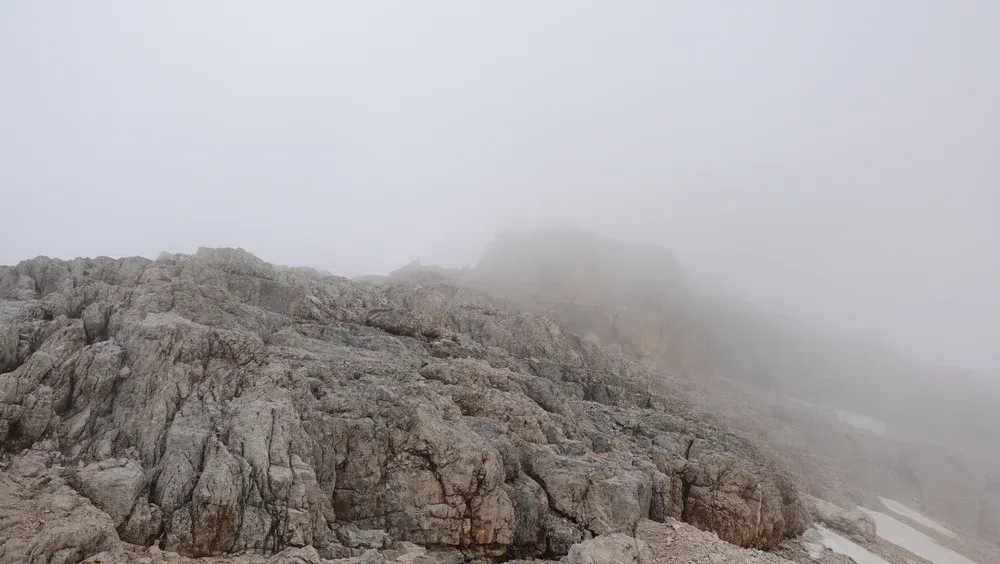
From my own climb I know that the upper cirque is a large bowl, and there are quite a number of ledges above it to climb before getting to the summit. I was in clouds so cannot provide clear views of what I have seen, the photo below shows one part only:
Conclusion: who was the first?
John Ball may have been the first person to publish a detailed narrative of an ascent of Monte Pelmo, but that is not the same as proving he was the first human being to stand on its summit.
His own text quietly admits that his unnamed guide already knew the crucial ledge system, meaning the key to the route existed locally before Ball ever arrived.
The later identification of that guide as Giovan Battista Giacin only strengthens the idea that Ball was following knowledge already developed by hunters who moved through these mountains long before tourists and alpine clubs appeared.
Even more troubling for Ball’s “first ascent” claim is the presence of Wilhelm Fuchs in the historical record. Fuchs measured Pelmo’s elevation with a value remarkably close to the modern figure and described geological layers that strongly suggest he reached very high ground, possibly even the summit ridge itself.
Ball’s insistence that Fuchs must have stopped “some way below the true summit” feels less like certainty and more like an attempt to protect his own achievement.
Finally, the oral tradition surrounding Belli Battista Vecchio, while impossible to prove, fits the broader pattern seen across the Dolomites: local hunters often reached extreme places decades before outsiders began documenting them.
If Vecchio truly found human remains and metal equipment high on Pelmo, then the mountain may have witnessed attempts long before 1857, even if those climbers left no written trace.
In the end, the most honest conclusion is that John Ball was likely the first to popularize Monte Pelmo’s ascent and to record it in a form that entered Alpine history. But the evidence strongly suggests he was not necessarily the first to discover the route, and quite possibly not the first to reach the highest point.
Pelmo’s “first ascent” story is therefore less about a single heroic moment and more about how history is shaped: not by who was there first, but by who had the power and the platform to write it down.
Thank you for reading. Let me know if you have some useful information to add here, there is a comment section below. You might want to read also how Ball missed to climb Marmolada highest peak.
Leave a Reply