I was reading this on a FB group “Standing on the edge of the world. Seceda, you are unreal.” There are plenty of posts of that type around, so let us see what this is about.
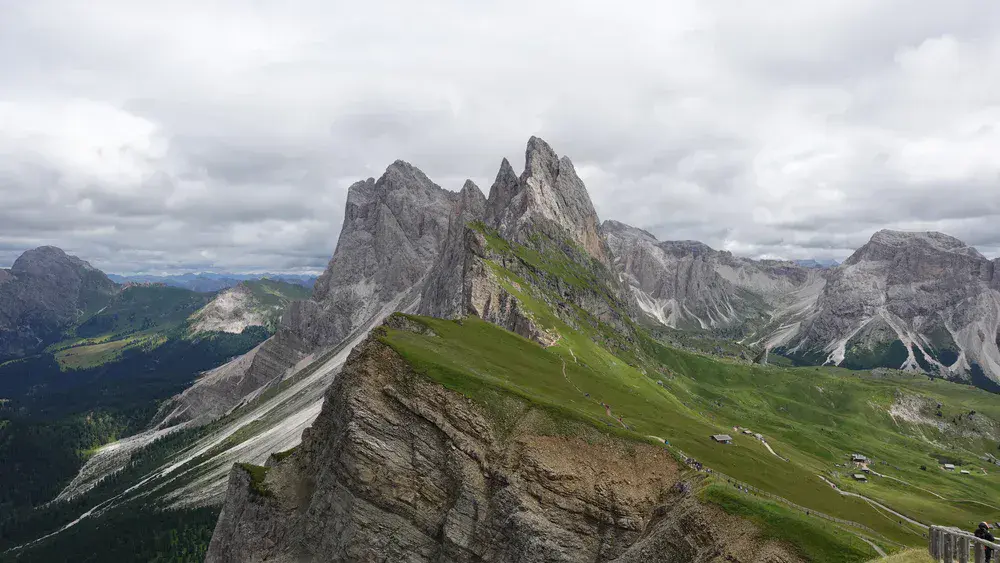
Visually striking and accessible, and that is why it is famous
The view is indeed unique, but the same is with every place in the Dolomites. Seceda has become a victim of its own accessibility.
But I would point out the reality behind the camera frame. For every dramatic photo of someone “alone with nature,” there are probably 50 people standing just out of frame waiting for their turn to take the exact same picture.
It is an engineered experience and a very strong case of social-media-driven perception mismatch. Seceda get famous for a very specific visual reason: that razor-thin ridge dropping into sheer grass-and-rock walls. From the right angle, especially with a wide-angle lens or drone, it looks almost unreal, like a computer-generated backdrop.
That “edge of the world” caption basically writes itself once you have seen that one iconic viewpoint.
Why Seceda gets overhyped online
Here are a few reasons:
First, photography compression. Most viral images are taken with long lenses or carefully chosen angles that exaggerate the drop. When you stand there in person, your eyes see depth differently and the slope feels less impossible. See the top photo above, this is my own, and this is how it really looks.
Seceda is almost a textbook case of vertical-phone mountain design: the composition naturally collapses into a dramatic strip when you shoot it upright. You get a tall, narrow slice of ridge, sky, and drop-off, and the brain fills in “infinite exposure” because there is no lateral context.
In landscape orientation (the photo above), the illusion weakens fast, you suddenly see the fence lines, the plateau, the footpaths, and the scale stops feeling cinematic.
Second, selective framing. People do not post the crowds, the fences, or the queue for the same spot where everyone takes the “edge” photo. They post the 5 seconds when the frame is clean.
There is also something subtler going on with how people stand there. Most visitors position themselves at the famous edge, turn their body slightly toward the drop, and shoot straight ahead. That posture biases the image toward “void in front of me” rather than “mountain system around me.” It is almost a stage direction more than a viewpoint.
And once a location gets locked into that one reproducible framing, it becomes self-reinforcing: everyone goes to the exact same 2–3 meters of terrain, recreates the same vertical shot, and the place slowly flattens into a single visual cliché.
Third, accessibility bias. Because almost anyone can reach it (compared to many Dolomite summits), it ends up with a huge volume of visitors. More visitors means more posts, more algorithmic reinforcement, hence its must see status.
It is not that the place is fake or bad, it is that its online identity is stronger than its in-person intensity. It is a visual icon more than an experiential one.
Seceda is not fake spectacular, it is selectively spectacular. It gives a very specific kind of beauty extremely efficiently, but not necessarily the most memorable mountain experience compared to other parts of the Dolomites.
Fourth, photoshopped images
It is annoying that some even photoshop their photos, so all becomes greener than it is, including Sas Rigais in the background where there is nothing but pure rock.
In my view, the place is beautiful enough as it is, no need to add anything to its photos.
But most of those greener than reality shots are not necessarily deliberate deception in the old sense of Photoshop fakery. They are partly due to the following:
- Phone auto-enhancement (HDR + saturation curves pushed by default).
- Instagram-style presets that lift greens and blues aggressively.
- Drone footage with cinematic color profiles.
- And simple selective editing where grass gets boosted because it “reads better” on a feed.
The result is that landscapes like the Dolomites get visually re-rendered into a kind of idealized alpine template, lush green foreground, dramatic blue sky, and then rock faces that look cleaner and more uniform than they are in reality.
The irony is that the real landscape around places like Sass Rigais is often more interesting precisely because it breaks that template. The raw limestone, scree, and color transitions do not conform to the “emerald meadow + perfect sky” aesthetic. But algorithms and editing styles strongly reward that simplified palette.
So what I am reacting to is not just editing, it is a convergence of incentives:
- platforms reward images that pop instantly in thumbnails
- audiences interpret “more vivid” as “more beautiful”
- creators unconsciously drift toward what performs
- and eventually the edited version becomes the mental baseline.
At that point, reality feels slightly “washed out,” even when it is objectively richer in texture.
There is also a psychological twist: pure rock environments like the high Dolomite limestone are hard to sell visually in isolation. They need scale, weather, or human presence to communicate drama. Otherwise they risk reading as grey on a small screen, even if in person they feel immense.
So people compensate by boosting greens in the valleys, which ironically pulls attention away from the very geological character that makes the place special.
The modern alpine aesthetic has drifted toward a single dominant color story, green meadows and blue skies, which flattens the geological reality of places like the Dolomites.
Once you have spent enough time in that terrain, the over-green version starts to feel less like enhancement and more like a different place entirely.
The gift of accessibility (and a dose of humility)
Before I sound too much like a mountain purist, let us ground this in reality.
Accessibility is a beautiful thing. Cable cars like the one to Seceda allow a grandfather to share a panoramic Alpine sunset with his toddler granddaughter.
They allow people with physical limitations, injuries, or health conditions to experience the sublime beauty of the Dolomites, a beauty that would otherwise be locked behind grueling trails they could never hope to conquer.
As a 67-year-old climber, I am acutely aware of the passage of time. I know that the day will come when my knees will protest the scree fields of the nearby Sas Rigais and other peaks, and carrying a stove up a vertical rock face will be a memory rather than a weekend plan.
When that day comes, I will be profoundly grateful for the lifts that take me to the ridges. So, the issue is not the cable car itself. The issue is the mindset of those who use it.
Seceda becomes a victim of “mass hysteria” when able-bodied visitors treat it merely as a backdrop for social media clout, entirely blind to the vast, wild world surrounding it.
The psychology of the earned view
There is a fundamental difference between consuming a landscape and connecting with it.
When you ride the Seceda cable car, you are buying a commodity. Within minutes, you are transported from the valley floor to a manicured ridge. You step out, walk a few hundred meters on a wide path, and look at the dramatic drop-off.
It is beautiful, yes, but it is passive. Your heart rate has not changed, your boots are not dusty, and your mind is still carrying the buzz of the town below. You are looking at a postcard that someone else framed for you.
Now, contrast that with the summit of the nearby Sas Rigais which is always in the background when people make their famous photos.
To stand there, you have to commit. You shoulder a pack, navigate the scree, clip into the steel cables of the via ferrata, and earn every single vertical meter with your lungs and your legs.
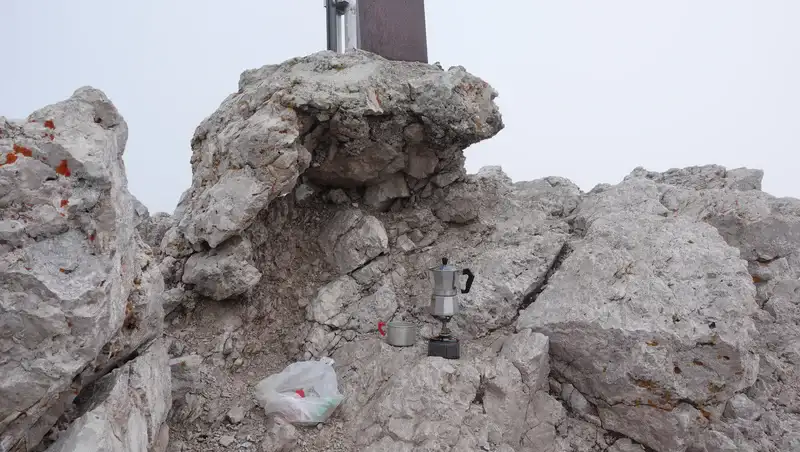
When I reached the top, I did not just take a quick photo and check my phone. I pulled out my stove, boiled water, and enjoyed a hot cup of coffee in the clouds, the photo below.
That coffee did not just taste good because of the altitude; it tasted good because of the effort.
The rule of the mountain
The beauty of a summit view is directly proportional to the sweat required to get there.
When you struggle, sweat, and focus through a tough climb, a psychological shift happens. The fatigue acts as a sensory filter, stripping away the trivial noise of daily life. When you finally top out, the sudden stillness and the massive expanse before you create a profound sense of awe that a cable car platform can simply never replicate.
An unearned view is a backdrop for a selfie. An earned view is a trophy, a memory of resilience, and a moment of genuine peace.
Final thoughts
If you actually spend time in the Dolomites, especially doing long days, summits, ridge traverses, the iconic postcard viewpoints often feel less intense than transitional moments. Cloud layers breaking, wind on exposed ridges, or those in-between sections where the terrain is doing something interesting but no one is photographing it.
Seceda ends up being a perfect image generator more than a high-signal alpine experience. And once you have seen enough of the region, you can feel that gap immediately.
It is less about the mountain being overrated in absolute terms, and more about a mismatch between what cameras compress into a symbol, and what long exposure in the terrain actually feels like. That mismatch is getting sharper everywhere with Instagram/TikTok, but Seceda is one of the cleanest examples in Europe.
The Dolomites contain far more emotionally and physically varied terrain than the iconic shots suggest. You are only seeing one export format of a very complex and beautiful landscape.
Thank you for reading. Let me know in the comment section below what you think. For more texts about the area check under Dolomites here on the site.
Leave a Reply