It is becoming a frequent practice that some mountaineers sleep directly on summits. I have met some of them in the past, and I also watch videos of such adventures. This text is motivated by somebody’s night on the summit of Antelao in the Dolomites.
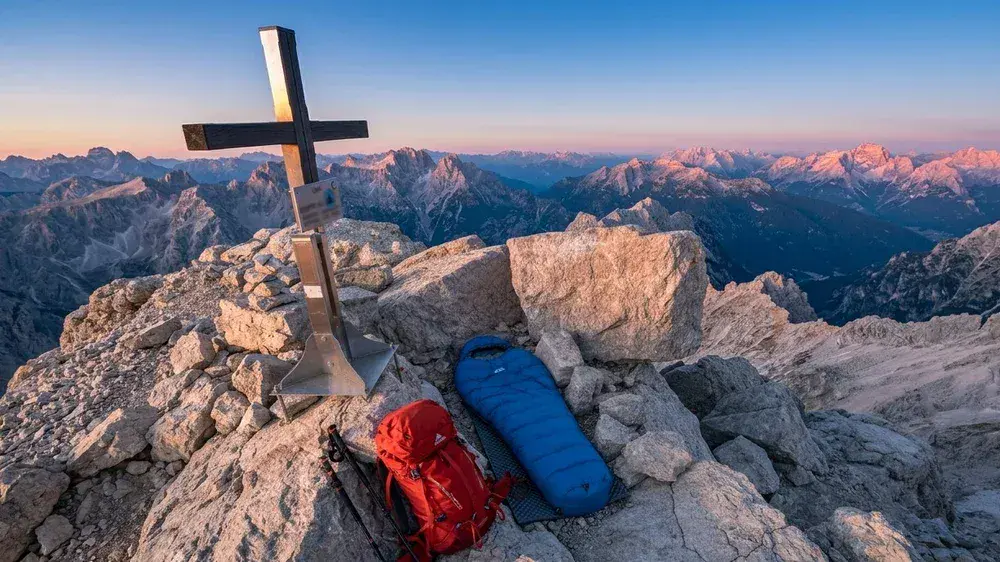
Sleeping right next to a giant metal summit cross or register box on a high peak like Antelao (3264 m) is incredibly dangerous.
Even if the forecast is excellent, weather in the Alps can deteriorate far faster than many people expect. But this is also becoming a part of what is known as paralpinism.
In particular Antelao has no easy descent, route-finding is already difficult in daylight, and descending its upper section in darkness, rain, hail, or fresh snow can quickly become extremely dangerous. I climbed Antelao and I know that from my own first-hand experience.
Spending the night on the summit means committing yourself to remaining on one of the highest and most exposed points if conditions change unexpectedly.
Here is the breakdown of why sleeping at such places is a massive gamble, and what actually happens with lightning in the mountains.
Lightning without a storm (bolt from the blue)
The climber posted his photos on a FB group with his sleeping bag and pad next to the summit cross. He said he was careful in choosing perfect weather conditions. But there was a comment (later deleted by somebody) saying that lightning can strike even without a storm.
This is a bit exaggerated, but there is something in it. While lightning cannot physically generate out of thin, perfectly clear blue air without a cloud anywhere in sight, it absolutely can strike areas where the sky overhead is completely clear.
This phenomenon is known as a “bolt from the blue.” Here is how it happens.
A severe thunderstorm kilometers away can generate a lightning strike that travels horizontally through clear air, away from the parent cloud, before dropping to the ground.
In high mountains, a storm system could be building or active one or two valleys over, completely hidden from your view by massive ridges.
To a person standing on the summit, the sky directly above looks perfectly blue and safe, until a strike travels horizontally over the ridge and hits the peak.
Heat lightning and high-altitude charges
Another reason mountain climbers talk about lightning without a visible storm is because high-altitude terrain can rapidly charge up.
St. Elmo’s fire: On high peaks, the electrostatic charge in the air can build up so intensely that metal objects (like that summit structure) will start buzzing, humming, or even glowing with a blue light.
This occurs when the electric field from a nearby thunderstorm becomes extremely strong, even before the storm is directly overhead.
If the electric field becomes intense enough for a lightning strike, anyone beside the summit cross is in an extremely hazardous position.
What happens if lightning hits the cross?
If lightning struck the summit cross while someone was sleeping immediately beside it, there would be a very high risk of fatal or life-changing injuries. You do not even need to be touched by the bolt itself to die.
When lightning strikes that summit marker, the current expands outward through the ground in all directions. Because the hiker is sleeping directly on the rock right next to it, this happens:
- The electricity flows through the ground and up into the body.
- A side flash (or side splash) can jump from the struck metal object to a nearby person because the lightning seeks multiple conductive paths to ground.
- The voltage difference across the ground where the sleeping pad sits would be massive, sending a lethal current right through their vital organs.
Summary
In the mountains, lightning does not just materialize out of a perfectly storm-free atmosphere across the whole region. But clear skies directly above you do not guarantee safety from a nearby storm.
So sleeping immediately beside a metal summit cross on an isolated summit like Monte Antelao is an unnecessarily high-risk choice, even when the forecast appears favorable. This is one of the most dangerous places you could possibly choose to sleep. Besides, this is likely also illegal in areas like the Dolomites.
Thank you for reading. Please share your thoughts in the comments section below. Check also my text about thunderstorm forecast in the mountains and about situations when you faint on a mountain climb.
Leave a Reply