This Osprey Kestrel 58 is built extremely durable with strong fabrics that can withstand rough trails and bad weather conditions. This is a versatile pack suitable for heavy-loaded day tours or for multi-day backpacking trips where you need to carry plenty of gear.
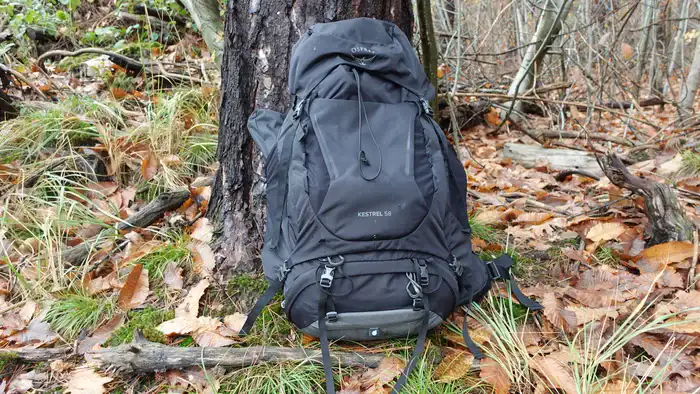
TL;DR – Osprey Kestrel 58 in brief
✔ Very durable 420D/500D recycled nylon
✔ Comfortable with heavy loads up to 45 lb (20 kg)
✔ Three access points including sleeping bag compartment and floating lid
✔ Fully adjustable torso length and hip belt fins
✔ Rain cover included, Stow-on-the-Go for poles, many attachment points
✔ PFAS-free DWR, bluesign approved, 100% recycled fabrics
Bottom line: This is very likely the last 55–60 L pack most users will ever need to buy.
Key features & benefits
- Three access points.
- Hydration compatible.
- Rain cover.
- Adjustable torso length.
- Adjustable hip belt fins.
- Internal frame.
- Stow-on-the-Go poles attachment.
- Bluesign approved.
- 100% Recycled materials.
- PFAS-free.
What is in the name
If you follow Osprey, then you probably know that Kestrel packs have been on the market for years, improved and upgraded a few times. From what I remember they have been around for at least 12-13 years already.
This is a series for men, but they also have the corresponding Kyte series for women with the same functionality and features plus gender-specific ones.
The current version of the Osprey Kestrel 58 backpack for men is a classic design with a top access with a collar and floating lid (the photo below).
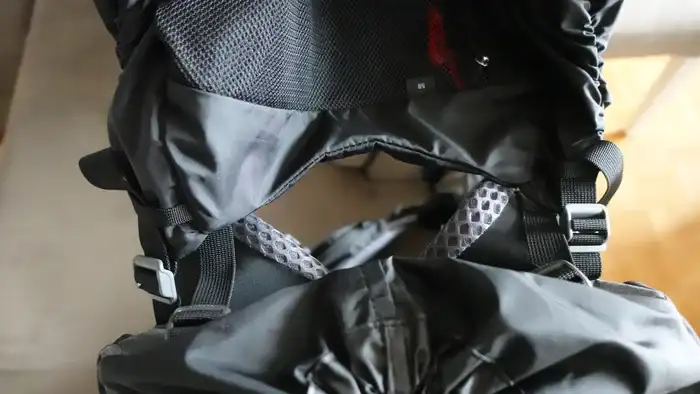
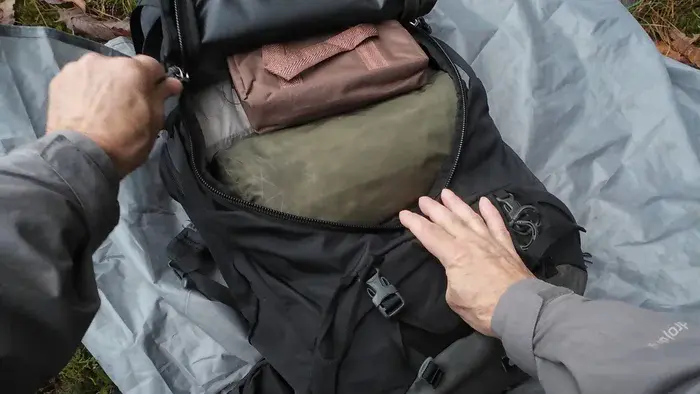
Apart from this top access, it offers also a large U-shaped front zippered access. In addition to this, you also have a bottom zippered compartment, both of these features are shown below.

The divider between the main compartment and the bottom compartment is a drop-down shelf equipped with two buckles, so you can use both compartments as one if needed.
The pack is hydration compatible so you have an inner hydration sleeve in the main compartment with what they call the Hydraclip for easier reservoir hanging. The hose port is also visible in the photo.
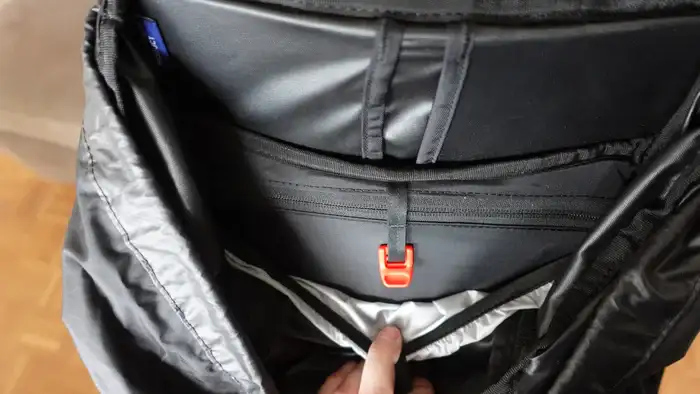
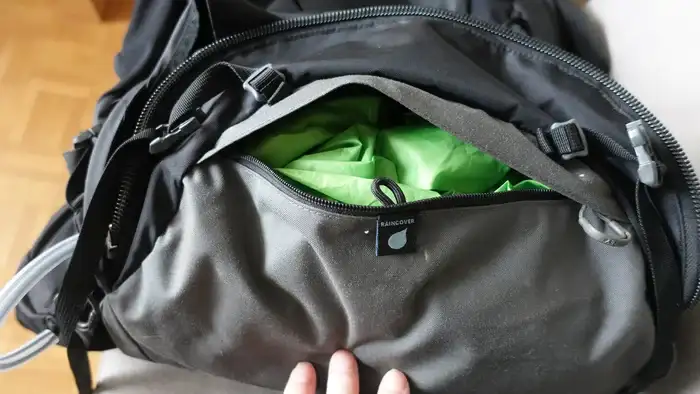
The pack comes with a rain cover included, and it is stored in a dedicated zippered pocket below the bottom compartment, see the photo below.
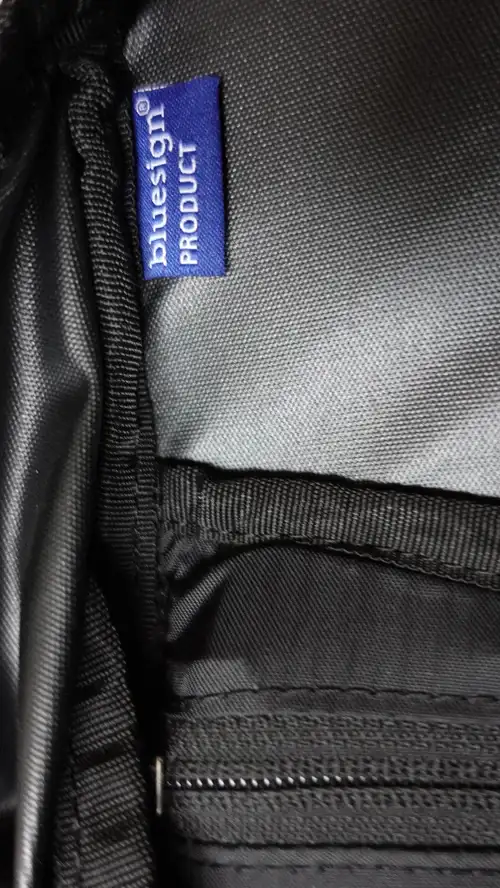
This pack comes with a bluesign approval, see the photo below; more about the materials you have farther in the text.
Harness and frame
The pack has a peripheral 3.5 mm LightWire frame. You can see one part of it in the photo below. It gives the pack its shape and it also effectively transfers the load from harness to hipbelt. I confirm here that the structure is flexible and it does not work against your body movement.

What you do not see is an Atilon framesheet which is behind the panel padding. Its function is important as it spreads load across the entire back panel to the peripheral frame. From what I know, Atilon is Osprey’s proprietary molded polymer composite.
This backpack is designed to stay close to the body, and it is optimized for heavy load of up to 45 lb (20 kg). I have not carried such a weight so far, but if any backpack can stand something like that, it would be this Kestrel 58 pack.
The overall suspension you can see in the photo below. It includes generous padding on the shoulder harness, with soft, edgeless mesh it offers a soft breathable contact surface and large load support.
This is what they call Spacermesh, the term Osprey uses for the lightweight, padded, and highly breathable fabric used on the contact surfaces of many of their backpacks, specifically the harness (shoulder straps) and hipbelt.
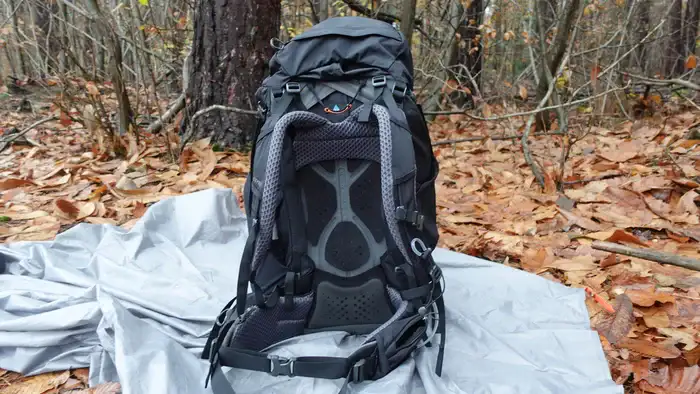
The back panel is with ventilating channels covered with a mesh. This design they call the AirScape backpanel.
The hip belt padding is simply optimal and with the same materials as described above, and you can see how it looks in the photo below. Note also that the lumbar padding is very nicely designed.
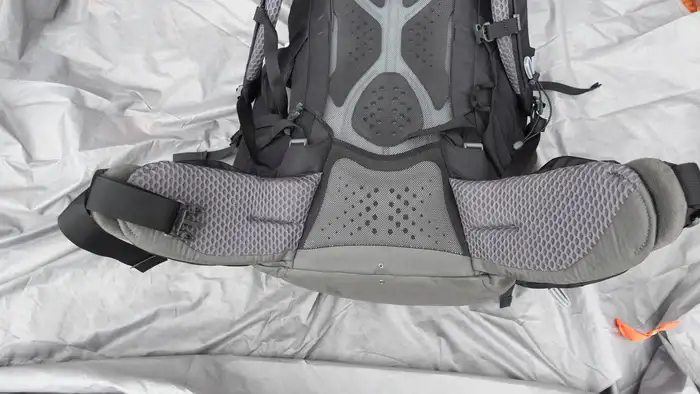
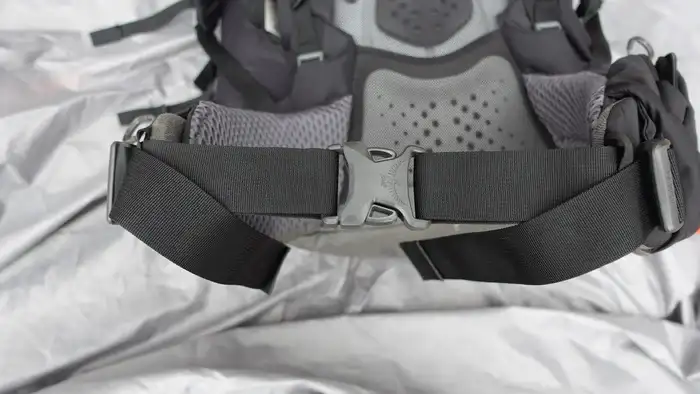
The hip belt straps are pull-forward type and this is the best design you can have, see how they look:
The sternum strap is adjustable and sliding type so you can position it wherever it suits you. It is equipped with an emergency whistle, the photo below.

Adjustable harness
Here you have full adjustability, and this includes:
- adjustable torso length, and
- adjustable hip belt padding.
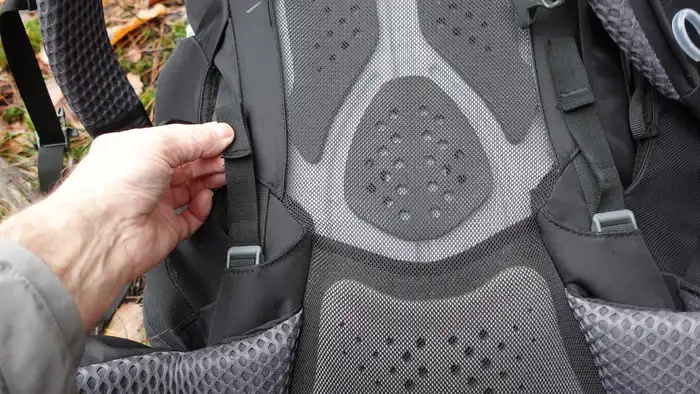
For the torso length you have two straps and buckles shown in the photo below. So it is easy to reposition the harness in any length within the given range.
This is useful for several family members that can use the same backpack and still have a perfect match for the torso length.
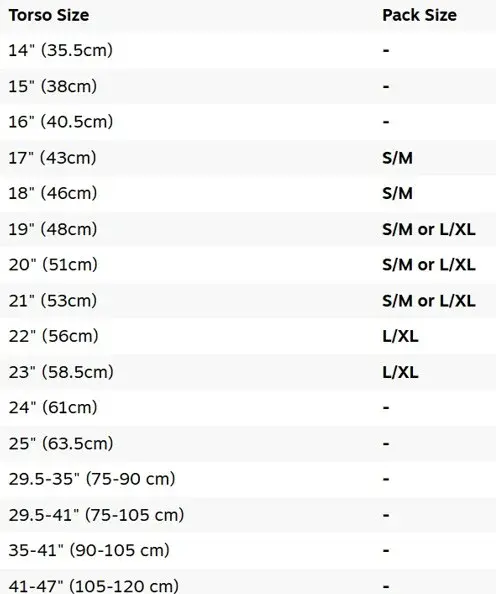
Note that they have two sub-sizes for each nominal size (38, 48, 58, and 68 L), and this applies to the volume and to the harness size. The numbers are given below. So my backpack is S/M, and its volume is 56 liters, but the M/L version is 58 liters volume.
Below you can see the torso length range for each of the sub-sizes, so make sure you choose what suits you best:
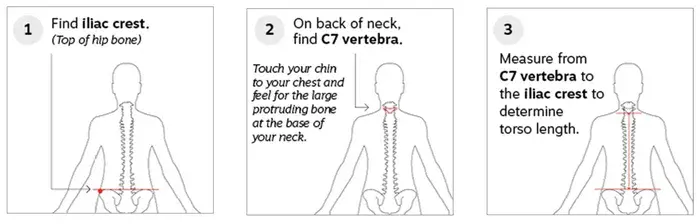
If you are not sure about your torso length, the picture below will guide you how to measure it yourself.
Apart from torso adjustability, you also have adjustability of the hip belt padding. This means that the fins on the sides of the belt can be moved forward and backward, you simply break Velcro connection and do this on the fly.
This is good to have if you use the pack in different seasons, with less or more clothing, or when different people use the same pack.

Pockets
There are 7 + 1 pockets here. This +1 is the rain cover pocket shown previously. But starting from the top, you have a top lid pocket and yet another on the underside:


The pack also includes dual side stretch mesh pockets that are enormous as you can see from the picture below, this is a 1.5 liters bottle inside.

These two pockets are with dual top and side access, both are shown shown below:

One huge front pocket is with strong double-layer fabric on the front and stretch mesh panels on the sides. There is also a drainage hole on its bottom. Upper side compression straps connect to this pocket.
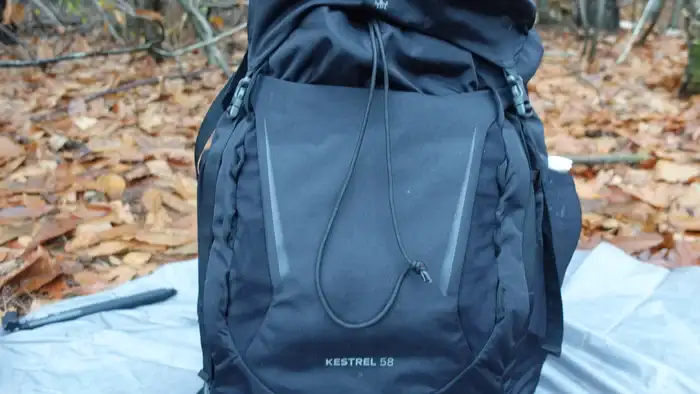
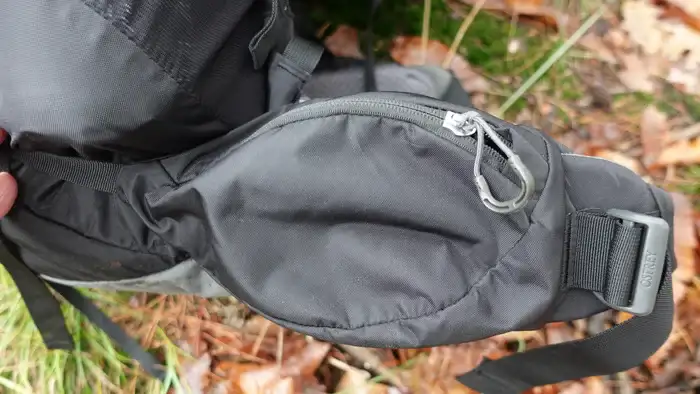
On the hip belt you have two good-sized pockets, one shown below. Note that all zipper pulls are nicely designed with large loops to use with gloves, but this holds for all packs from Osprey brand.
Attachment elements and straps
If you love to attach things to the pack, this is an excellent choice, you have far more options here than in many other backpacks on the market.
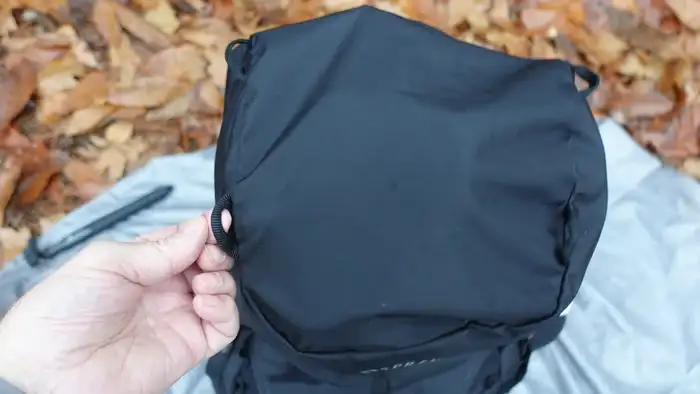
To start from the top where you have four loops added on the lid, so with a peace of cord you can attach some stuff here.
On the front, you have dual daisy chains, each with several loops, see one below. So here again, with a piece of cord you can attach much larger and long items.

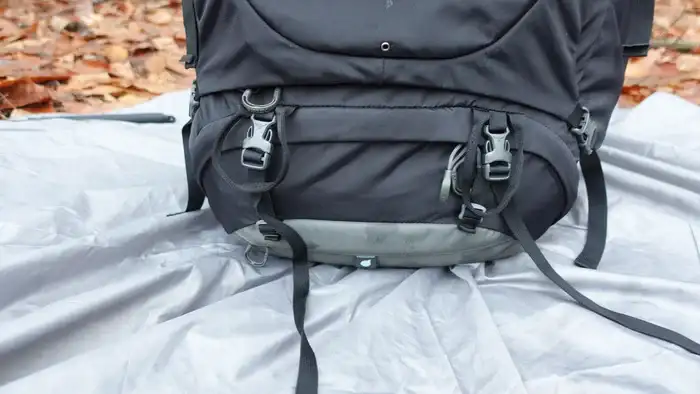
On the bottom, the pack comes with dual straps, so here you can attach a tripod, a pad, or anything similar. Here, you also have dual loops for ice axe and trekking poles, visible in the photo below.
This is not all, you also have Osprey’s Stow-on-the-Go trekking pole attachment that includes a bungee on the left shoulder strap paired with a loop o the side of the pack, see the photo.
This is something I always use whenever need free hands to take photos or to drink or eat something while on the go. I have the same feature on my another pack from this brand, the Osprey Stratos.

On boths sides of the backpack you have dual, lower and upper compression straps. Both of them have dual function. So the lower are directly connected to the hip belt pockets, see the photo.
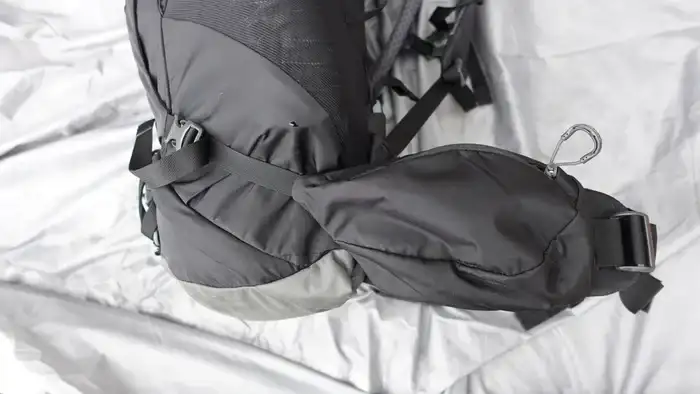
Objection to this design: This is something I do not like here. The reason is interference with stabilizer function, you can’t compress fully without pulling the pack into your back (and vice versa).
When you pull, this flattens the rear of the hip belt and pulls the pack’s bottom corners inward. The side compression doesn’t really work because it is not true compression; it is a lumbar pull system wearing a compression hat.
On the other hand, I do not see the point of attaching side compression straps to the hip belt pockets and pulling them back.
Note also that this lower side strap is connected to the front panel, and you have to undo it if you want to open the front zipper.
The upper side compression straps are a bit too high, and they are also attached to the front pocket. You can see all this here:

In addition to all this, you have the usual load lifters straps that bring the upper part of backpack closer to the body when needed. This is a feature that I use frequently and regulate the position of the pack.
Materials
You have already seen some details regarding padding and frame. Here to add that fabric of this Osprey Kestrel 58 pack is exceptionally strong and durable, and you can feel it under your fingers.
So this is 100% recycled 420D nylon, with DWR treatments made without PFAS. On the bottom you have even stronger bluesign approved 100% recycled 500D high-tenacity nylon.
To better understand this D (denier) value, you can compare it with the excellent Deuter Futura Air Trek which I have, where it is 210D. Also, in my Mammut Lithium pack it is a combination of 100D and 210 D.
So you can be sure that it will last long and withstand every outdoor environment.
The previously mentioned rain cover is also with bluesign approval and DWR treatments made without PFAS. The frame is a sort of alloy but I could not find info what it really is.
The framesheet is a molded polymer composite, a semi-rigid core that distributes load evenly across the back panel, maintains shape, and resists bulging from internal gear.
Please see more in this video:
Who is the Osprey Kestrel 58 pack for
Regarding the size and features, this is a pack for multi day tours or for any tours where you carry lot of equipment, for example for sleeping outdoors. What cannot fit inside, you can easily attach from outside. It has plenty of very useful features for this purpose.
Regarding the weight, the volume to weight ratio is 26 liters/kg, and this makes it moderately heavy. But this is a strongly built and reliable pack for heavy load and I do not mind its weight at all.
Note that some of its adjustability features add a bit of weight but they make the pack versatile and suitable for various users from the same family.
Regarding the load weight capacity, there is no doubt it can accommodate 45 lb (20 kg) as they claim.
Specifications
- Volume S/M: 3417 in³ (56 L).
- Weight S/M: 4.7 lb (2.13 kg).
- Volume L/XL: 3539 in³ (58 L).
- Weight L/XL: 4.882 lb (2.21 kg).
- Dimensions S/M: 30.31 x 14.6 x 12.2 in (77 x 37 x 31 cm).
- Dimensions L/XL: 32.28 x 14.6 x 12.2 in (82 x 37 x 31 cm).
- Load capacity: up to 45 lb (20 kg).*
- Fabric: 420D & 500D.
- Warranty: Osprey All Mighty guarantee. This is their statement: “Osprey will repair any damage or defect for any reason free of charge – whether it was purchased in 1974 or yesterday. If we are unable to perform a functional repair on your pack, we will happily replace it. We proudly stand behind this guarantee, so much so that it bears the signature of company founder and head designer, Mike Pfotenhauer.”
*In their manual they give a range, 30-45 lb (14-20 kg) with a lower limit which I find strange. I use it typically with 12 kg of load. Note also that 20 kg is not 45 lb but 44 lb.
Final thoughts & rating
In summary, this Osprey Kestrel 58 is an excellent choice if you need a reliable backpack for multi-day tours with plenty of gear or even for longer adventures.
After examining all its elements in detail, I can say it is strongly built with durable materials. It offers great comfort even with heavy loads, full adjustability for different users, and many practical features like multiple access points, useful pockets, and attachment options.
It has some minor issues like the design of the lower side compression straps, but overall the pros far outweigh the cons. With the included rain cover, eco-friendly materials, and Osprey’s All Mighty Guarantee that covers repairs or replacement for life, this pack is built to last for many years in various outdoor conditions.
Bottom line: I believe the Kestrel 58 is the last 55–60 L pack most people will ever need. Note that they have the corresponding gender-specific pack for women with the same features under the name Osprey Kyte 58 backpack.
Below you can see how I rate it against my usual rating criteria so that you can easily compare it with other items of this type:
Osprey Kestrel 58 Backpack
Pros
- Very durable.
- Great comfort.
- Rain cover.
- Full adjustability.
- Recycled materials.
Cons
- Not best side straps design.
BEST PLACEs TO BUY
For more options, please check under the category Large Packs. In particular, check how this pack compares with Deuter Aircontact Core.
Let me know if you have questions or comments, there is a comment box below. Have a nice day.
FAQ – Osprey Kestrel 58: Most Asked Questions
Is the Osprey Kestrel 58 good for tall or very broad-shouldered people?
Yes. The L/XL size offers a torso range up to 24 in (61 cm) and the hip-belt adjusts out to roughly 52–55 in (132–140 cm) once the fins are slid to the maximum position.
Many 6′4″–6′6″ (193–198 cm) hikers with wide shoulders report an excellent fit, especially because the LightWire frame keeps the load close without the shoulder straps cutting in. If you’re over 6′5″, the Kestrel 68 is worth a quick look, but most tall users stay perfectly happy with the 58 L/XL.
Can the Kestrel 58 be taken as carry-on on flights?
Occasionally, but it’s risky. The official dimensions of the L/XL version (82 × 37 × 31 cm) exceed most airline carry-on limits (typically 55–56 × 36 × 23 cm including handles and wheels).
However, because the pack is very compressible and has a soft structure, many people get away with it on budget airlines and U.S. domestic flights when it’s only half-full and the lid is cinched down hard. For frequent flyers I still recommend a dedicated 40–45 L travel pack if carry-on is non-negotiable.
How does the ventilation compare to the Osprey Atmos/Aether AG series?
The Kestrel’s AirScape mesh backpanel is very good for a close-fitting load-hauling pack, but it cannot match the suspended-mesh “trampoline” system of the Atmos/Aether AG line. In hot, humid conditions (think Southeast Asia or summer in the Alps) you’ll you’ll sweat noticeably more on the Kestrel.
The trade-off is superior load transfer and stability above 35–40 lb. If your trips are mostly cool-weather or high-altitude, the Kestrel wins; if you hike in 30 °C+ jungle heat, the Atmos 65 AG will keep your back drier.
Is it worth choosing the Kestrel 58 over newer ultralight competitors (HMG, Zpacks, Hyperlite) if I sometimes carry heavy loads?
For anyone who ever exceeds 13–15 kg (camera gear, group cooksets, winter sleeping bags, bear can, etc.) the Kestrel 58 is still one of the smartest choices in 2025. The newer UL packs save 1–1.5 kg in base weight but quickly become uncomfortable and floppy above 15–17 kg, whereas the Kestrel stays comfortable up to its rated 20 kg and is practically indestructible.
Most experienced hikers who have tried both end up keeping an UL pack for summer fast-packing and the Kestrel (or similar framed pack) for everything else.
Leave a Reply