Having used both the Deuter Aircontact Core 50+10 and the Osprey Kestrel 58 extensively, this comparison is based on my own first-hand experience.
TL;DR
These packs are extremely close overall.
Osprey Kestrel 58 wins on: more pockets, adjustable hip-belt padding, Stow-on-the-Go trekking pole system, bottom straps, and tougher fabric.
Deuter Aircontact Core 50+10 leads on: better volume-to-weight efficiency, pivoting harness, zippered glasses loop, a true zip divider, better side straps, and likely a stiffer frame for ~20 kg loads.
Shared strengths: comfortable carry up to 15 kg, durable bluesign fabrics, included rain covers, and similar price.
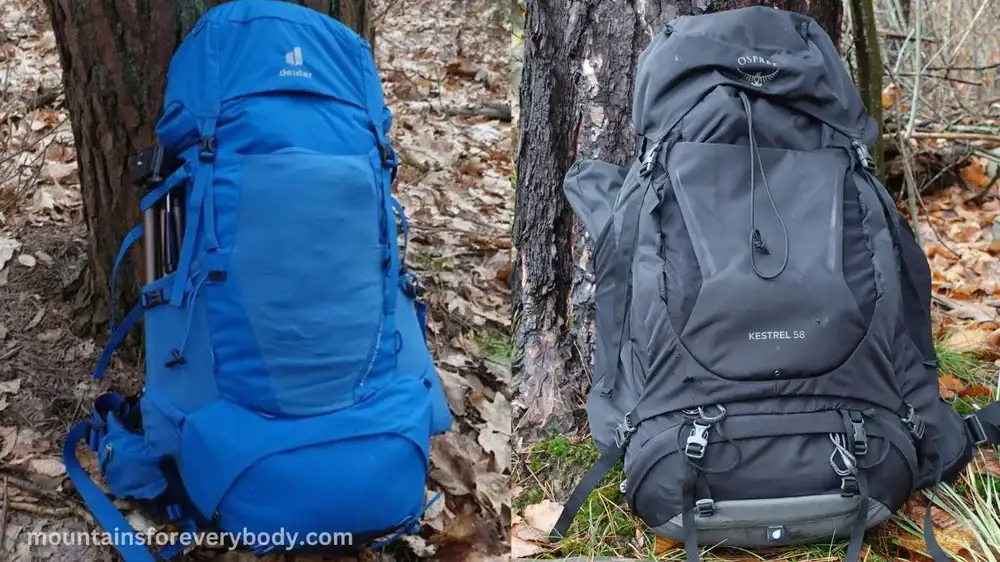
Why this Deuter Aircontact Core 50+10 versus Osprey Kestrel 58 Pack comparison
Here you have two top brands in the backpacks industry, and these two particular packs are in the same volume and weight group.
Both backpacks follow the same general design, and this includes an internal frame, they stay closer to the body, and they are suitable for heavy loads.
These are excellent backpacks and in the same price group. From the text below, you will realize that the comparison presented here makes sense.
Deuter Aircontact Core 50+10 and Osprey Kestrel 58 similarities
I would point out the following similarities, but the list is not definite and there are more:
- These are moderately heavy backpacks, numbers below.
- The materials in both are bluesign approved. No PFAS materials are used.
- They are top loading type with a classic floating lid.
- Both packs come with a rain cover included.
- Similar torso length adjustability system. This means it is continuous type so you can adjust the length to any value within the given range.
- Both have two compartments, the upper main compartment and the bottom sleeping bag compartment.
- Excellent hip belt and lumbar padding is in both backpacks.
- Backpacks are hydration compatible.
- They are with internal frame, but those are quite different. It is a peripheral wire in the Kestrel pack, and dual stays in the Deuter Core pack. The carry load capacity is the same 20 kg (44 lb).*
- They have dual side straps, dual bottom loops for poles and ice axes, and four attachment loops on the lid.
- Hip belt pockets, side pockets, and front pocket are similar.
- Both brands offer the corresponding versions for women. In the case of Osprey this is Kyte series, Deuter packs have letters SL (meaning ‘slim line’) in the packs for women,
*In the Osprey Kestrel manual they give a range, 30-45 lb (14-20 kg). Clearly 20 kg is not 45 lb but 44 lb. Not a big deal but I wanted to mention their official numbers.
Similar access points
I wanted to mention this separately because of the reasons mentioned below. Both packs have three access points. These include a top access through a collar under the lid, and bottom access point.
In addition, the Osprey Kestrel pack has a U-shaped front zipper. I personally rarely use this in my packs, have it also in my other Deuter pack.
Note that this zipper is massive, and it has a flap that covers it, so this all adds weight but it also adds functionality if you need it.

A similar feature is also in the Deuter Aircontact 50+10 pack, but my own pack is without it. Namely, when they launched this new series, the pack was without it, but soon after that a modified version appeared on the market with a J-shaped front zipper shown in the photo.

So the front access is a bit larger in the Kestrel pack, but in my view this is completely negligible.
Differences and my rating
I have summarized the most important differences in the table below. In the first column you have listed some features where these packs differ a lot. In the remaining columns you can see where I give advantage (plus):
Pockets
Hip belt adjustment
Fabric
Bottom straps
Stow on the Go
Volume to weight ratio
Pivoting harness
Attachment for glasses
Inner divider
Side straps
Deuter Aircontact
Core 50+10
Osprey
Kestrel 58
According to this rating, none of them has an advantage. Here is what is behind those pluses and minuses, so you can decide if this is important to you or not:
Pockets
These backpacks have a standard set of pockets that include:
- Dual hip belt pockets.
- Dual side stretch mesh pockets.
- One large front pocket is on both packs.
But:
- Osprey’s pack has two lid pockets compared to only one in the Deuter pack.
- Osprey Kestrel 58 also has a bottom pocket for rain cover, so 7+1 in total, compared to 6 in Deuter’s pack.
Note also that side pockets in the Kestrel pack are gigantic. So I give advantage here to Kestrel with good reasons.
Hip belt padding adjustment
Here I give advantage to the Osprey Kestrel 58 because of the following.
It has hip belt fins that are attached with Velcro. So you have adjustability of the hip belt padding. This is good to have if you use the pack in different seasons, with less or more clothing, or when different people use the same pack.

Fabric
Here you have very durable fabric used in both backpacks. In Deuter’s pack this is a combination of a 500D nylon on the bottom and 235D in the rest.
But it is even better in the Kestrel pack with a 420D nylon and 500D high-tenacity nylon combination. You can feel it is strong when you have the pack in hands.
Bottom straps
In the Deuter Core pack there are no bottom straps, but the side straps are removable and you can use them on the bottom when/if you want to carry something attached to the bottom.
But Kestrel pack is with removable dual bottom straps, and this is what I find better.
Stow-on-the-Go and attachment features
Both packs have plenty of attachment features, so follow the links here in the text to read full reviews. I wish to point out a few differences.
The Osprey Kestrel 58 pack comes with Stow-on-the-Go system for attachment of trekking poles on the move. This is a feature that you have only on Osprey’s packs.
I use poles, and this feature is very important to me when I need free hands for scramble, to take a photo, etc. If this is not so with you, simply ignore this detail.

Both packs have the usual attachment loops for poles and ice axes on the bottom.
The Kestrel pack also has dual daisy chains on the front where you can attach some stuff with a piece of cord, see the picture below.

But Deuter Aircontact Core pack also has four loops on the front that serve the same purpose, see the picture below. Though this may be a bit less functional than the feature on the Kestrel pack.
But observe that Deuter’s pack has extra bungee loops on the front that pair the loops for poles on the bottom.
This is absent in the Osprey Kestrel 58 pack where you use upper side straps to fix poles when they are attached on the bottom loops.
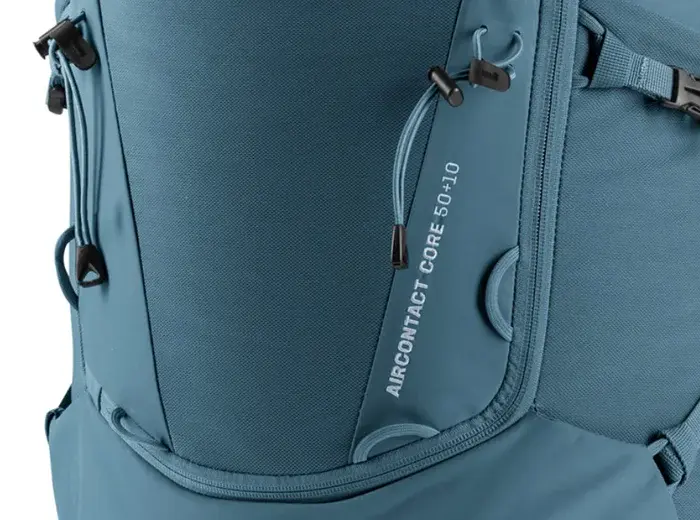
My + here goes to Osprey only because of the mentioned Stow-on-the-Go system, but this may not be equally important for everybody.
Volume to weight ratio
Here are the numbers. The weight of my Kestrel pack, which is actually 56 liters, is 4.7 lb (2.13 kg). So the volume/weight ratio is 26.3 liters/kg, and this makes it moderately heavy.
The Deuter pack weighs 4.76 lb (2.16 kg) and its volume is 50+10 liters with its expandable collar. So the volume/weight ratio is slightly better, 27.8 liters/kg.
I would say that this difference is insignificant and you can ignore the advantage of the Deuter’s pack.
Pivoting harness connections
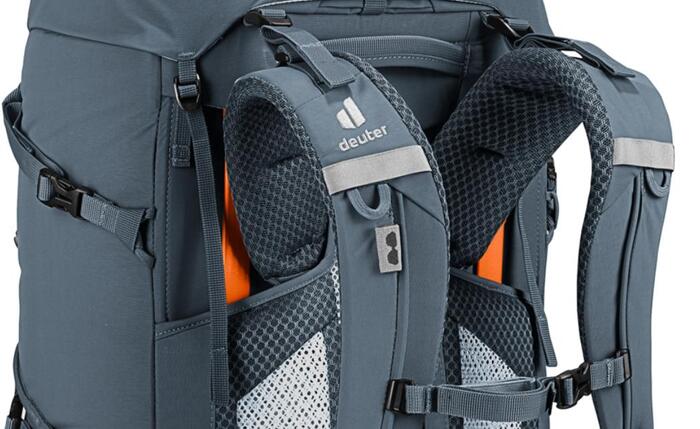
The Deuter Aircontact Core pack has shoulder straps attached to the pack in such a way that they pivot, so they better adjust to the body.
In the hip belt design they apply what they call VariFlex hip fins, which means that those can also pivot to some extent.
Attachment for glasses
This is a tiny detail, but I use glasses on the trail and it is very important to me. So + to Deuter is fully justified, there is no such a detail on the Osprey’s pack.
Inner divider
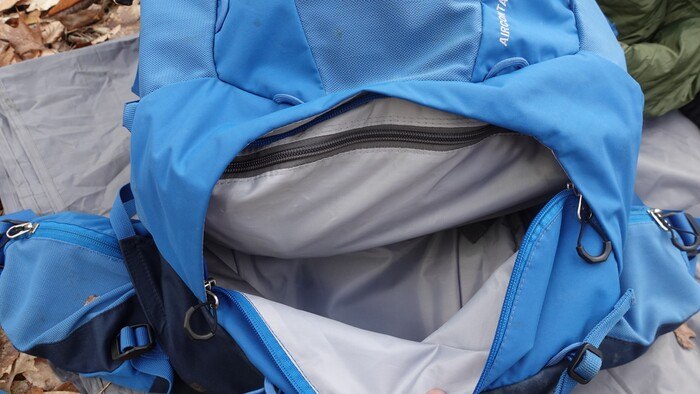
The Deuter Aircontact Core 50 + 10 pack has a true divider with a circular zipper, see the picture below. So you have two completely separated inner compartments. It can be open when needed.
In the Osprey Kestrel 58 pack, this is just a simple shelf with two buckles. Small items from the upper compartment can slide down into the bottom compartment. So + to Deuter is justified.
Side straps
In my review of Osprey Kestrel 58, I have pointed out why I dislike the lower side straps on the pack. It is best that you have a look there.
If you check the side straps on the Deuter Aircontact 50+10, you will realize that those lower straps are optimal, see the picture below, and also removable. So my + goes to Deuter here.
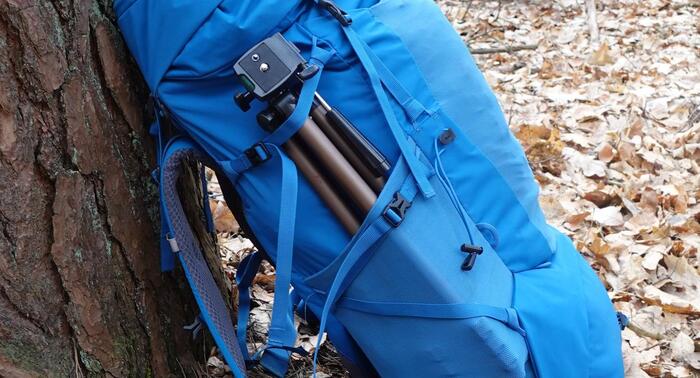
This concludes the list of items given in the comparison table above. It is 5 vs 5, but some of pluses given to one or other pack may be unimportant, like the volume/weight ratio, with the overall score shifting a bit more to Kestrel’s side.
But let’s see a bit more about some other details, this may help more if you are still undecided about these packs.
How about prices?
These packs are in the same group regarding their prices. You might want to follow links below to find the best deal because from what I see online, there may be differences from one seller to another.
Weight carry comfort: is it really the same?
I typically carry the same weight when I go on overnight tours, and this is in the range 12-15 kg. So,
- I know how they compare for such weights: no difference for me.
- But I cannot really say how these packs would perform if you go to the limits which is around 20 kg.
What I do know is that until recently, Deuter would not even mention the carry load capacity. Several years ago I actually ask them about that. I have been using their packs for 23 years already, and I can say they are almost indestructible.
But as I see now they mention the carry load.
In my view, you cannot know which pack works better for you until you try it with full load. This is because we are all differently built. So before buying online, try to find them in local stores and put on your back to get some feeling.
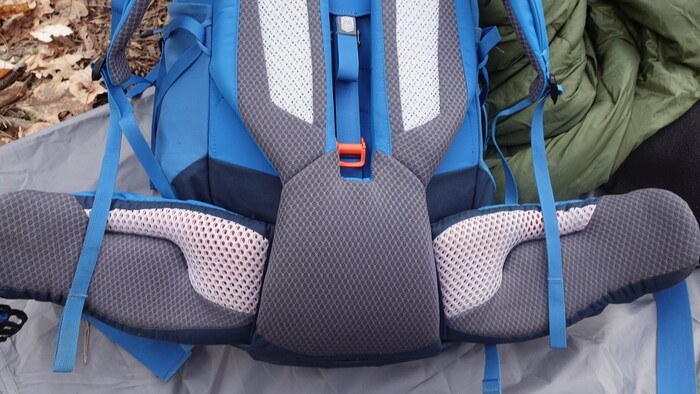
They both work excellent for me, this is what I definitely know. Below you can see hip belt padding and lumbar area in the Deuter Aircontact Core pack:
Now have a look at the same part in the Osprey Kestrel 58 pack, the design is different but equally good:
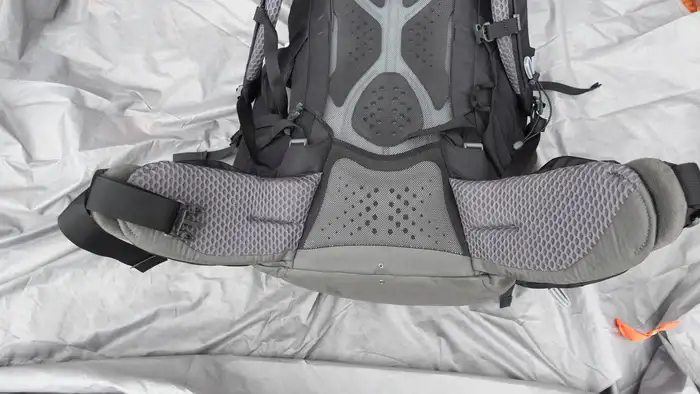
Bear in mind that the hip belt fins of the Osprey Kestrel 58 pack are adjustable, if you have a big hips circumference this might be important to you.
Now, about the maximum load. The picture below shows one segment of the Kestrel’s 3.5 mm peripheral wire frame.

Compare this with two massive stays (orange pieces in the picture below) of the Deuter’s pack, I doubt that you can have anything stronger in a backpack.
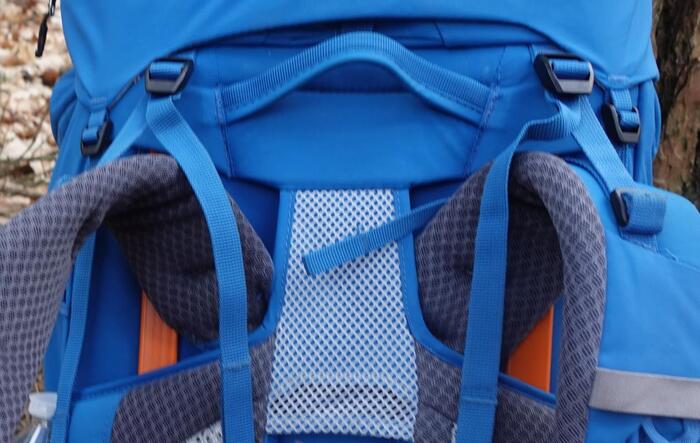
Now you have things to think about if you really plan to carry maximum load. In this case, perhaps Deuter should be your choice.
Sleek and slim design in Deuter’s pack
This is one detail that I do not rate, but it may be important mentioning. The Deuter Aircontact Core 50+10 offers 60 liters of volume only when its collar is expanded. The lid adjusts easily to this, so this is the true volume.
But the Deuter’s pack looks physically slimmer and sleeker than the Osprey Kestrel 58 pack, just to know. You can realize this also from the official dimensions of the two packs that are as follows (L x W x D):
- Deuter Aircontact Core 50+10: 78 x 31 x 26 cm.
- Osprey Kestrel S/M (56 liters): 77 x 37 x 31 cm.
Places to buy
Deuter Aircontact Core 50 + 10 pack is available at:
Osprey Kestrel 58 pack you can find here:
Final thoughts
In conclusion, both the Deuter Aircontact Core 50+10 and Osprey Kestrel 58 are solid packs from top brands. They are with similar weight, materials, load capacity, and carry comfort in the 12-15 kg range I use.
The Kestrel 58 wins clearly on features: more pockets, adjustable hip belt padding, Stow-on-the-Go, bottom straps, and stronger fabric. These add up to a 5-5 score.
Deuter fights back with a volume/weight ratio, pivoting harness, has a glasses loop, true zippered divider, better side straps, and what looks like a stronger dual-stay frame for max loads near 20 kg.
If you value more pockets, and trekking pole attachment, go with the Kestrel 58. If you prioritize a bombproof frame for heavy carries or the small details like glasses loop and full divider, the Deuter Core is the better pick.
Both are excellent; the differences decide it. Try them loaded in a store if possible, then buy where the price is best.
Thank you for reading. Please use the comment box below in the case of comments and questions.
Bookmark this site and come again, this will keep you informed because I add texts here regularly. Have a nice day.
FAQs
What warranties do Deuter and Osprey offer for their backpacks?
Deuter provides a lifetime repair promise, covering free fixes for any damage or defects regardless of the pack’s age or cause, extending beyond the standard two-year legal warranty for manufacturing issues. This includes repairs for wear from extensive use, with options to replace if unrepairable, emphasizing durability for long-term adventurers.
Osprey’s All Mighty Guarantee similarly offers free repairs or replacements for any damage or defect at any time, applicable to packs from any era, though it focuses on functional issues during the product’s reasonable lifetime.
Both brands prioritize sustainability by repairing rather than discarding, reducing environmental impact.
How do I properly fit a hiking backpack?
Start by measuring your torso length from the C7 vertebra at the base of your neck to the iliac crest on your hips, using a flexible tape with help from someone, to select the right pack size.
Once chosen, loosen all straps, load the pack with weight simulating your gear, then buckle the hip belt snugly above your hips to transfer about 80% of the load there.
Tighten shoulder straps to keep the pack close without gaps, adjust sternum strap across your chest for stability, and fine-tune load lifters to angle them at 45 degrees. Walk around to test for comfort, ensuring no pressure points, as proper fit prevents fatigue on multi-day hikes.
Are these backpacks suitable as carry-on for air travel?
While both packs have volumes around 50-60 liters. Their dimensions, typically 25-29 inches in height for models like these, often exceed strict airline carry-on limits of 22 x 14 x 9 inches set by carriers like American or Delta.
However, they can work if not fully expanded and compressible, fitting under seats or in overhead bins on less rigid flights, especially international ones with metric allowances up to 56 x 36 x 23 cm.
Always check specific airline policies, as enforcement varies, and consider using them for checked luggage on longer trips to avoid gate-check fees.
What does bluesign approved mean for these backpacks?
Bluesign approval certifies that the fabrics and components, like the nylon in these packs, meet rigorous standards for environmental protection, worker safety, and resource efficiency during manufacturing.
It ensures minimal use of harmful chemicals, reduced water and air pollution, and traceable supply chains, with products requiring at least 90% approved textiles.
This goes beyond basic eco-claims by auditing mills and suppliers, helping hikers choose gear that aligns with sustainable outdoor ethics and lowers the industry’s ecological footprint.
Leave a Reply