The Bivacco Baccon-Barborka is a tiny, always-open shelter with 4 bunks (no mattresses), located at an altitude of 2620 meters on the Furcia Rossa ridge in the Fanes group.
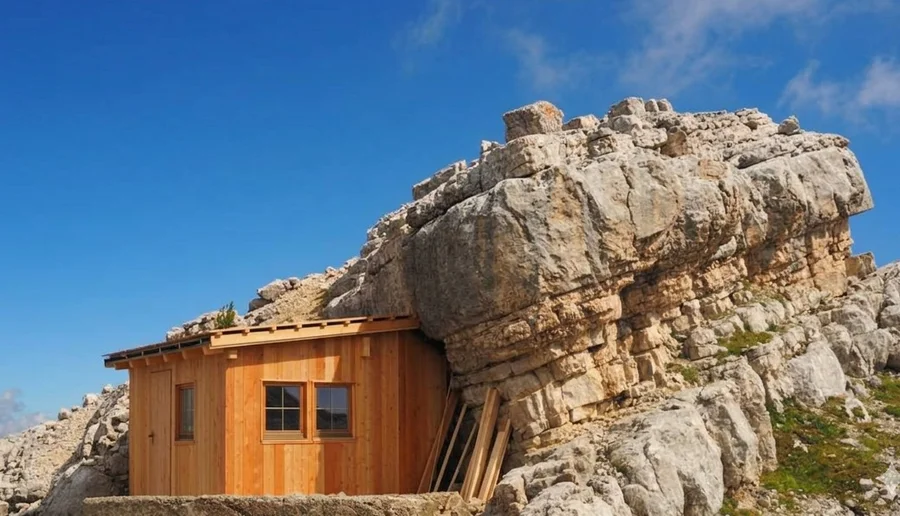
Originally constructed as a military shelter, the bivouac is a significant historical site that reflects the mountain warfare that took place in the Dolomites.
It was rebuilt recently directly on the historic site of a World War I military position that existed from 1915 onward. Large WWI ruins are still visible right beside it.
- Elevation: 2620 m (8596 ft).
- Location: Furcia Rossa, Fanes Group.
- Coordinates: 46.58185, 12.0443.
- Access from Rifugio Fanes: approx. 3 hours via the Via Ferrata.
- Access from Capanna Alpina: approx. 3 hours 50 min.
The interactive and zoomable map below shows the location of the bivouac (marker 1), and also the location of the nearby Bivacco della Pace (marker 2). Please zoom in and out to see all the details. There are several possible starting points to get there, and you can also walk to the bivouac directly from Cortina d’Ampezzo.
A bivouac from an era when even enemies honoured each other
The Bivacco Baccon-Barborka is named after Cap. Augusto Baccon and Hptm. Emanuel Barborka. The name honours two enemy captains who commanded opposing forces in the exact same sector during the brutal 1915–1916 fighting on the Italian-Austrian front in the Dolomites.
Italian Captain (later Lt. Col.) Augusto (Carlo) Baccon (1884–1961) was an Alpini officer (initially 3rd and 7th Regiments, Battaglione Fenestrelle/Belluno).
In the first days of July 1915, he led a daring surprise attack: his companies descended from the Tofana di Dentro, Col Fiorenza area, outflanked the Austrians along rocky ledges, and captured key positions, including Furcia Rossa itself and the Croda del Vallon Bianco, which had been behind the Austrian lines.
He took prisoners and was decorated with the Bronze and Silver Medals for valour. He continued operating in the Val Travenanzes and Tofane area through 1916 (including a famous mine explosion attack at the Castelletto on 30 July 1916, where he was wounded and captured).
After the war, he wrote memoirs about his time “guerreggiando sulle Tofane” and lived until 1961.
Austrian Hauptmann Emanuel Barborka (1884–1916, born in Pilsen, Bohemia) was a Kaiserjäger officer who became the most prominent Austrian figure on the Tofane front.
From late autumn 1915, he commanded the sector in Val Travenanzes (Streifkommandos and a Kaiserjäger company) under extreme winter conditions, avalanches (“white death”), and severe supply shortages.
In May 1916, he personally led a patrol that briefly occupied the peak he renamed “Nemesis” (2758 m on Tofana Terza), in an attempt to retake Italian-held summits.
He was known for his human qualities and was respected even by his enemies. He was killed in action on the Masaré di Tofana on 9 July 1916, right in the middle of the same contested zone.
The two men were direct adversaries in the fight for control of Furcia Rossa, Croda del Vallon Bianco, and Val Travenanzes, but there is no record of them ever meeting face-to-face.
The battles were ferocious, and the positions frequently changed hands or were bitterly contested. Italian forces (including Baccon’s Alpini) gained the upper hand in several actions in 1915 and again around July 1916.
After the war, the Italians chose to name the bivouac after both captains as a gesture of respect for the courage shown by the “valorous enemy” (Barborka), and for their own commander who had first seized the position (Baccon).
This is why the full name pairs them, and why the nearby equipped path is called Ferrata della Pace (“Peace Via Ferrata”). It deliberately symbolises reconciliation between former enemies on the very ground where they fought.
One contemporary account notes that after the July 1916 clashes, Italian troops paid homage to the fallen Barborka, even searching for his remains.
This joint naming is a classic example of post-WWI Dolomite memorials that honour bravery on both sides rather than glorifying only one nation. It turns the bivouac into a quiet symbol of peace on a battlefield that once saw terrible fighting and deadly avalanches.
Current status
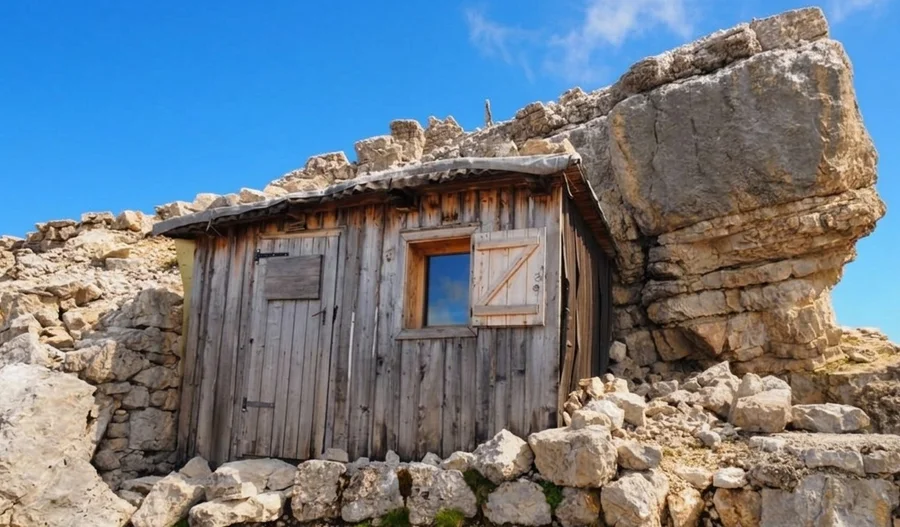
The bivouac has been there for more than a century, allowing mountaineers to sleep among the same WWI ruins and views that the two captains once fought over.
The bivouac is managed by the ANA (Associazione Nazionale Alpini) of Bolzano and the AVS (Alpenverein Südtirol) of Bressanone.
It has always been a small, unheated wooden structure that provides basic shelter with 4 bunks (planking places) for mountaineers tackling the Via Ferrata della Pace.
But the Bivacco Baccon-Barborka was recently rebuilt, marking a significant update for mountaineers visiting the Fanes-Sennes-Prags Nature Park.
The replacement of the original century-old wooden shack was a necessary project due to the extreme degradation caused by over 100 years of alpine weather. The new bivouac is a modern shelter designed for durability and thermal efficiency.
Capacity and amenities
It remains a minimalist, emergency-style shelter with 4 bunks (planking places), no mattresses. Unlike the original, the new build is better sealed against the elements, providing a much safer refuge for those caught in bad weather.
The project was a collaboration between the ANA (Associazione Nazionale Alpini) of Bolzano and the AVS (Alpenverein Südtirol) of Bressanone. This partnership reflects the bivouac’s long-standing role as a symbol of cross-border mountain heritage.
The new shelter ensures that this historic site remains a viable “Plan B” for those traversing the long ridge, especially since the Bivacco della Pace can often be crowded or fully occupied.
Please see more in this video:
Final thoughts
Today, the Bivacco Baccon-Barborka is more than a simple emergency shelter: it is a rare place where history is still visible in stone, trenches, and broken walls just a few steps away.
Spending a night here means sleeping on a former battlefield, surrounded by the same ridges and gullies that once decided life and death for soldiers on both sides.
Rebuilt for modern mountaineers but still stark and minimalist, it remains a powerful reminder that the Dolomites are not only beautiful mountains, but also a landscape marked by sacrifice and, in this case, by a remarkable gesture of respect that outlived the war.
The Bivacco Baccon Barborka is included in my interactive and zoomable map here on the site with all known mountaineering bivouacs in the Dolomites.
Thank you for reading. Please share your thoughts in the comment section below.
Leave a Reply