When I climbed Marmolada in 2010, I noticed a cave high above the glacier and became convinced it was a military outpost from WW1. I was completely wrong.
The oldest man-made mountaineering bivouac in the Dolomites is a cave bivouac on the cliffs below Punta Penia on Marmolada. It was carved out in 1875 at an elevation of around 3100 meters.
What this is about
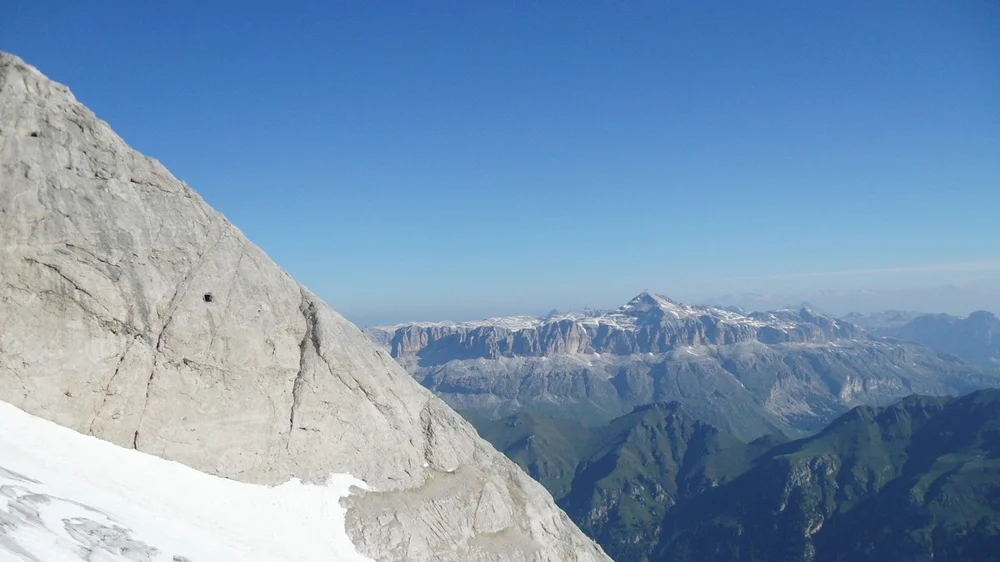
The first refuge in the Dolomites, shown in the photo above, is located on the east face of Punta Penia. Its approximate coordinates are:
- Latitude: 46.4380394.
- Longitude: 11.8525447.
The interactive and zoomable map below shows its approximate location (marker 2). The other markers indicate the parking area (marker 1), the summit (marker 3), and the Punta Penia hut near the summit (marker 4).
The top photo above is from my tour in 2010. As you can see, it is impossible to miss the cave from the glacier route; it overlooks the glacier and appears on the cliffs to your right.
My initial thought was that it was a WW1 tunnel, since Marmolada was a major WW1 battlefield (1915–1918). This is because the Austro-Hungarian and Italian armies dug extensive tunnels and “Ice City” galleries inside the glacier itself, along with many rock caves and trenches elsewhere on the mountain.
However, this cave was built 40 years earlier as a civilian climbing refuge, not a military post. Many modern climbers still mistake the dark opening for a wartime bunker when they see it from the glacier below.
The cave was built in 1875 (some sources note that work began in 1874) by the Agordo section of the Italian Alpine Club (CAI), in cooperation with Trentino mountaineers.
They had to carve it. In 1875, that meant men swinging hammers at 3000 meters, drilling by hand, and using black powder ‘mines’ to blast the limestone. Every inch of that shelter was paid for in sweat and gunpowder.
It is roughly 5 m wide and 4 m high, excavated with the help of explosives. It served as a basic shelter and base camp for early alpinists attempting the summit.
Marmolada’s first recorded ascent was in 1864 by Paul Grohmann, so this refuge supported later climbs. Some sources refer to it as Ricovero della Marmolada, and sometimes as the Grotto of the CAI Agordo. I have also read that Grohmann contributed funds from Vienna to help build this specific shelter.
Inside the cave, there is a small visitors’ register where people leave notes. Its dimensions are roughly 5 meters deep and 4 meters wide, large enough to provide real protection for a group of climbers.
The sad reason why the Marmolada Cave Bivouac is not in my interactive map
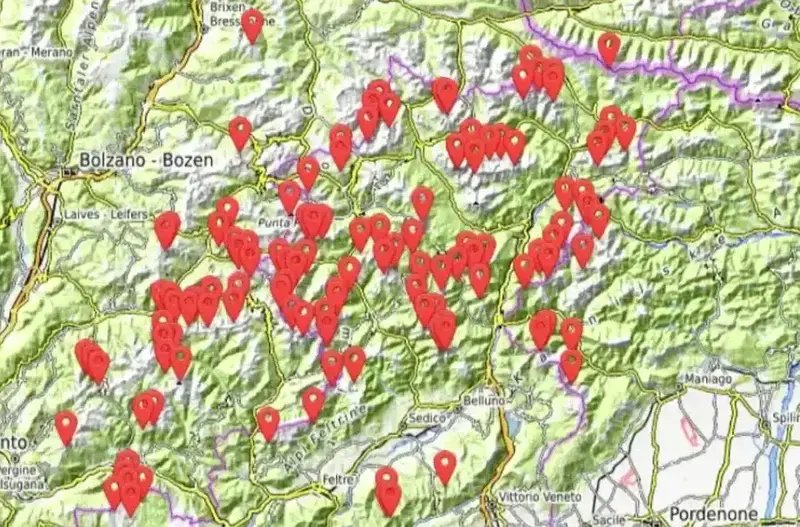
I have an interactive and zoomable map on the site with all known mountaineering bivouacs in the Dolomites. However, this cave bivouac is not included there.
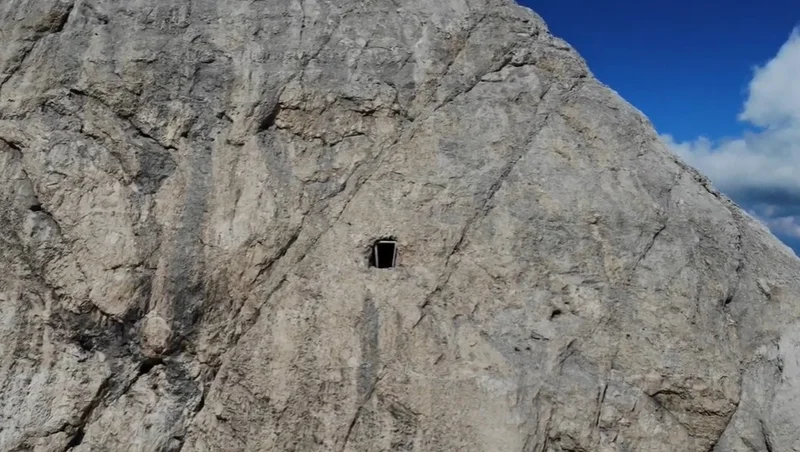
The reason is simple: most people cannot use it. From the video below, you will understand the sad story behind this. There is an 80-meter gap between the cave in the cliffs and the glacier, as shown in the photo above.
To reach it, one option is to climb above it and then descend to the cave using a rope. For ordinary mountaineers and hikers, this is simply not feasible.
As you will see in the video, Bruno Pederiva, despite having climbed Marmolada hundreds of times as a guide, had never visited the shelter before. In other words, it has little to no practical use today.
So imagine: when it was chiseled and carved into the rock next to the glacier in 1875, it was at the same level as the ice. You could simply walk off the glacier and step inside. Bruno Pederiva’s video is a powerful illustration of climate change and glacial retreat.
In the video, Pederiva checks his altimeter and notes that he must climb approximately 80 vertical meters of rock from the current glacier surface just to reach the cave entrance.
Final thoughts
That cave is a permanent, unmoving marker in the rock. The fact that there is now an 80-meter (roughly 260 feet) “cliff” where there used to be solid ice is one of the starkest visual indicators of glacial melting in the world.
It now stands as a “ghost” shelter; visible from the glacier but practically inaccessible to anyone without ropes and technical climbing skills. It is a haunting reminder that the world Grohmann and his contemporaries explored has physically vanished.
As a graduate of the same department where Milankovitch developed his theories on glacial cycles, I find the possible physical evidence on Marmolada particularly striking. It is one thing to study 21000-year orbital oscillations in a textbook; it is quite another to see a century and a half of such change measured against a single stone doorway on Marmolada.
Some will say this is merely the result of human activity. That may be partly true, but the reality is far more complex, and we should not take full “credit” for it.
Thank you for reading. Let me know if you have questions or comments; there is a comment section below.
Note that I also have a book titled Dolomites Solo, so feel free to take a look if you are planning mountaineering tours in the area.
Please join us at our Facebook group Dolomites Visitors Hub.
Leave a Reply