Antelao has a mountaineering story that feels wilder and less polished than many of its Dolomite neighbors, rooted in hunters, solitude, and a touch of mystery.
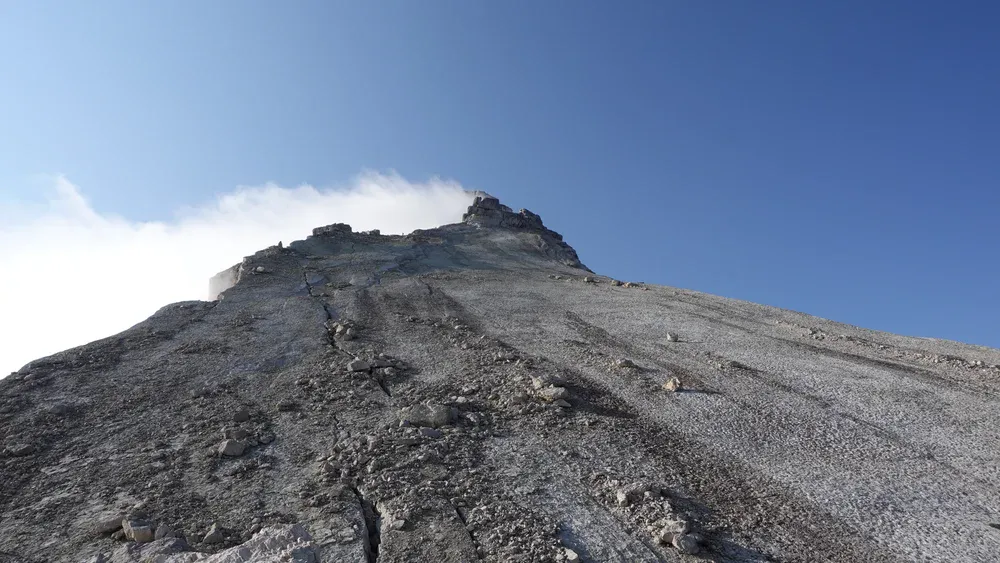
Antelao first climbs
Monte Antelao, often called the “King of the Dolomites” (or “Re del Cadore”), stands at 3264 m (10709 ft), making it the second-highest peak in the Dolomites, surpassed only by Marmolada (the “Queen”).
Unlike Marmolada’s dramatic south face big walls or glacier routes, Antelao’s climbing history emphasizes rugged, exposed scrambling on its classic normal route, with a strong Italian mountaineering tradition. It is with relatively few extreme big-wall lines compared to other Dolomite icons.
From what I can find, the first ascent is credited to Matteo Ossi, a hunter from San Vito di Cadore, who reached the summit in 1850.
He likely climbed alone, navigating what would later become the standard northern route (Laste route), a steep and exposed line of ledges and rock passages.
In 1863, on September 18, Ossi returned, this time guiding Austrian alpinist Paul Grohmann, one of the key figures of early Dolomite exploration, along with local companions F. Lacedelli and A. Dimai.
This ascent, via the same Laste route, helped put Antelao on the map. Grohmann’s writings brought international attention to the peak.
John Ball episode
Interestingly, in some sources I read that English mountaineer John Ball considered climbing Antelao around 1857 but judged it too difficult at the time, choosing Pelmo instead.
That says a lot about how serious and committing Antelao must have seemed in that era.
The statement appears in several Italian tourism and mountaineering websites and local history pages. However, this claim is not directly substantiated in Ball’s own writings or major contemporary mountaineering records.
John Ball’s key works (e.g., Peaks, Passes, and Glaciers series he edited, or his Guide to the Eastern Alps from 1868) focus heavily on his 1857 first ascent of Monte Pelmo (September 19, 1857, via the famous “Ball’s Ledge” with local chamois hunter guide Giovanni Battista Giacin/Vecchio).
No explicit mention appears in searchable excerpts or standard histories of him considering, attempting, or rejecting Antelao specifically due to difficulty.
Ball was in the area around San Vito di Cadore and Boite Valley in 1857 (starting his Pelmo climb from near there), and Antelao looms prominently across the valley. It is plausible he saw it and heard local assessments of its risks; steep ledges, no easy glacier access like Marmolada, loose rock, exposure.
Local hunters and guides often warned outsiders about such peaks, and Antelao’s normal route was already known locally via Matteo Ossi’s 1850 solo hunter ascent but not yet “officially” publicized to foreigners until Grohmann in 1863.
Standard references (Wikipedia, Alpine Journal archives, and Pelmo histories) confirm Ball’s Pelmo ascent but make no mention of Antelao being rejected as too difficult.
The anecdote is a popular local tradition in Cadore and San Vito di Cadore literature. It is used to underscore Antelao’s intimidating reputation at the time (pre-Grohmann era, when it was seen as more committing than Pelmo’s ledge route).
It is probably not “wrong,” but it is anecdotal and perhaps second-hand rather than confirmed in Ball’s writings or primary Alpine Club records.
Many Dolomite peaks have such folklore embellishments, similar to how Pelmo was long called “impossible” until Ball proved otherwise.
My overnight tour to Antelao
Last year I followed Ossi’s original line to the summit, still considered the (only) “normal” route today. A full report is here in the site, and here is my video from the tour:
I put the tent in the evening, the photo below, this was the last grassy area in a cirque surrounded by steep ledges.
After midnight, I could hear some steps nearby, most likely ibex or chamois, and occasionally the distant rumble of rockfall from the crumbling slopes of Croda Marcora.
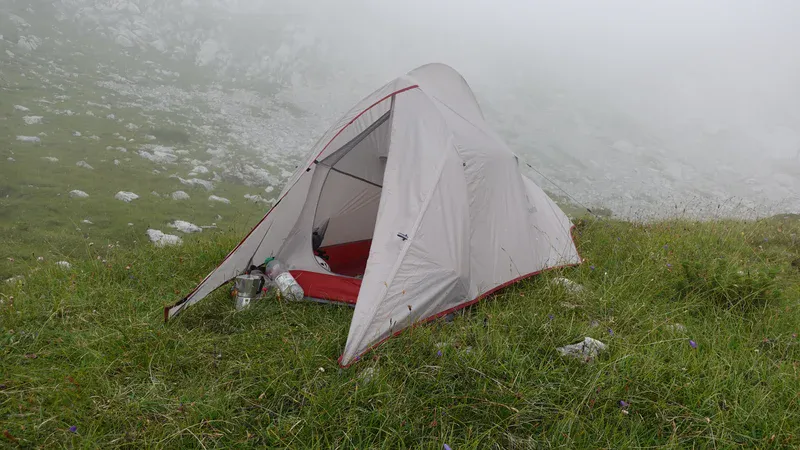
Shot in the dark
But the most unexpected moment came at around 1:30 am, a single gunshot somewhere in the darkness. Probably a poacher. Maybe not unusual here, but the entire mountain was buried in thick cloud.
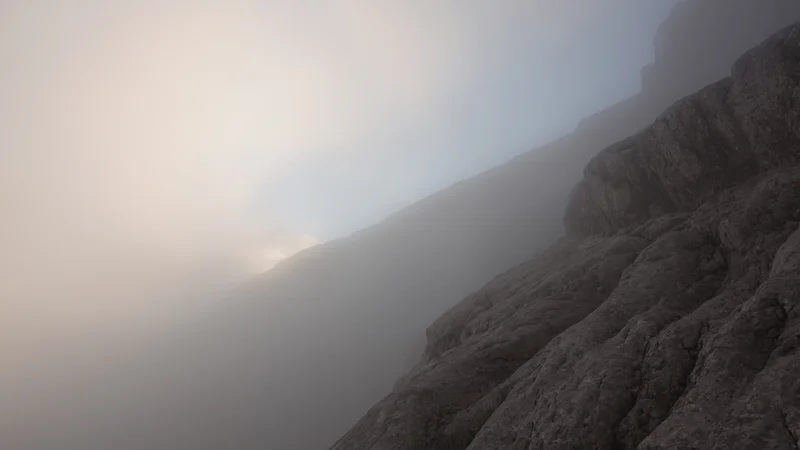
Visibility was basically zero, and it remained that way even in the morning when I started the ascent.
There was no second shot, just the same quiet, heavy clouds pressing down on the mountain.
It felt like I had briefly stepped into the wrong century, and somehow, it made perfect sense. Because Antelao doesn’t really feel like it belongs entirely to ours.
Antelao has a reputation for being solitary. Has anyone else had a strange encounter or a ‘wrong century’ moment while sleeping high in the mountains? Let me know in the comments section below.
From my other tours, I remembered seeing signs in the Lagorai forests below Lago di Lusia Inferiore, official notices asking hikers to report poaching, a phone number was given.
I stayed in my sleeping bag, no lights, total low-profile ‘bivouac’ style. In my mind, I was invisible in the thick cloud and darkness.
It is a strange modern reality: while we hike for the views and the history, others move through these same mountains, perhaps with thermal optics, hunting in ways Matteo Ossi could never have imagined.
The realization hit me as I lay there in the silence following the shot. In these thick clouds, I was blind. But to anyone with thermal optics, my tent was a glowing target against the cold rock.
The mist I thought was my ‘shield’ was no cover at all. It is a strange feeling to be possibly “watched” by technology in a place that feels like it belongs to the 19th century.
That single shot at 1:30 am was a reminder: in the modern Dolomites, the mist is no longer a shield. If that was a poacher with thermal gear, I was a glowing heat signature on a screen.
It is a chilling thought when you are 2200 meters up and alone.
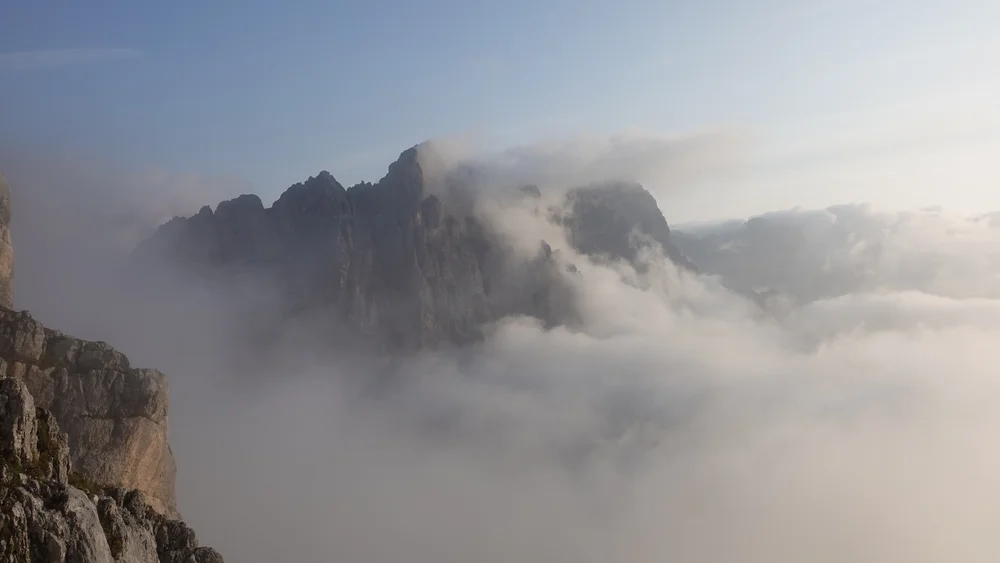
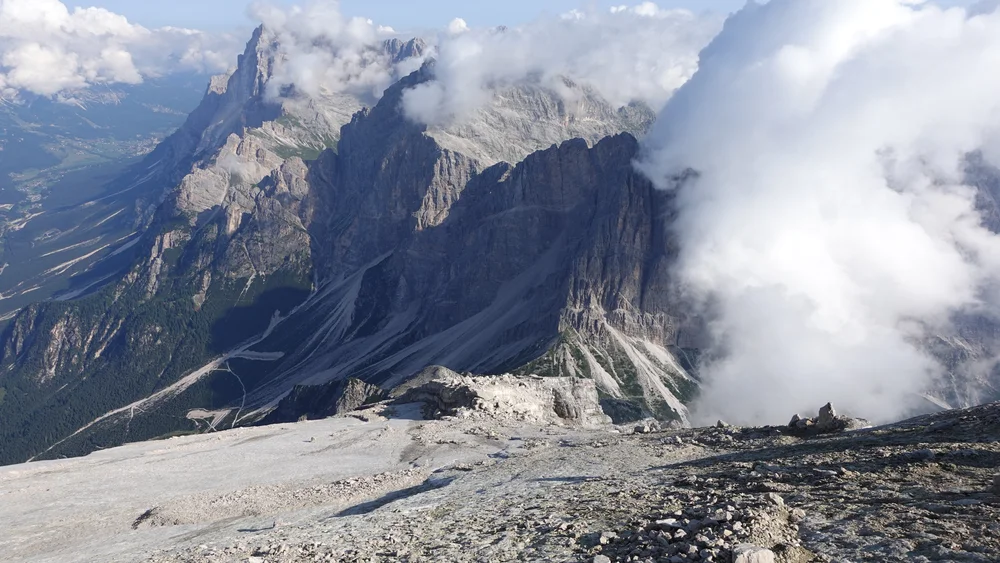
By morning, the spell finally broke. Several hours later the clouds vanished, revealing the massive limestone plates of the Laste in their full, silent glory. It was hard to believe the same mountain had felt so haunted just a few hours earlier.
Thanks for reading, feel free to share your thoughts or similar experiences in the comments below. Below, a few photos from the tour, much more in my full report.
Leave a Reply